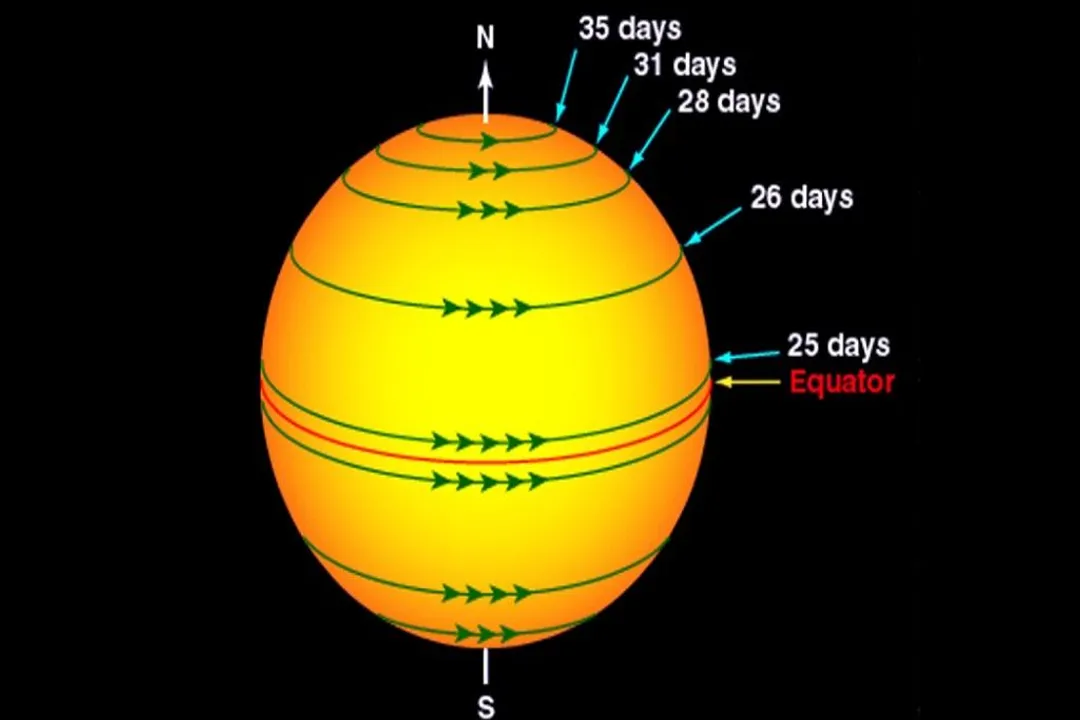
Why was figuring out the Sun's rotation initially a scientific puzzle compared to Earth's rotation?
The Sun does not have fixed landmarks like Earth's solid continents and oceans.
The primary difficulty in measuring the Sun's rotation stems from its nature as a massive ball of plasma, lacking the solid, defined topographical features that make Earth's rotation immediately obvious. On Earth, one can easily observe a landmark like a mountain or coastline moving across a fixed reference point over a 24-hour cycle. The Sun, however, presents a surface constantly in flux without such fixed points. Therefore, astronomers had to depend on tracking transient phenomena, specifically sunspots, to establish a reference path, making the initial confirmation and measurement of rotation a complex observational undertaking requiring patience and careful documentation over multiple days.