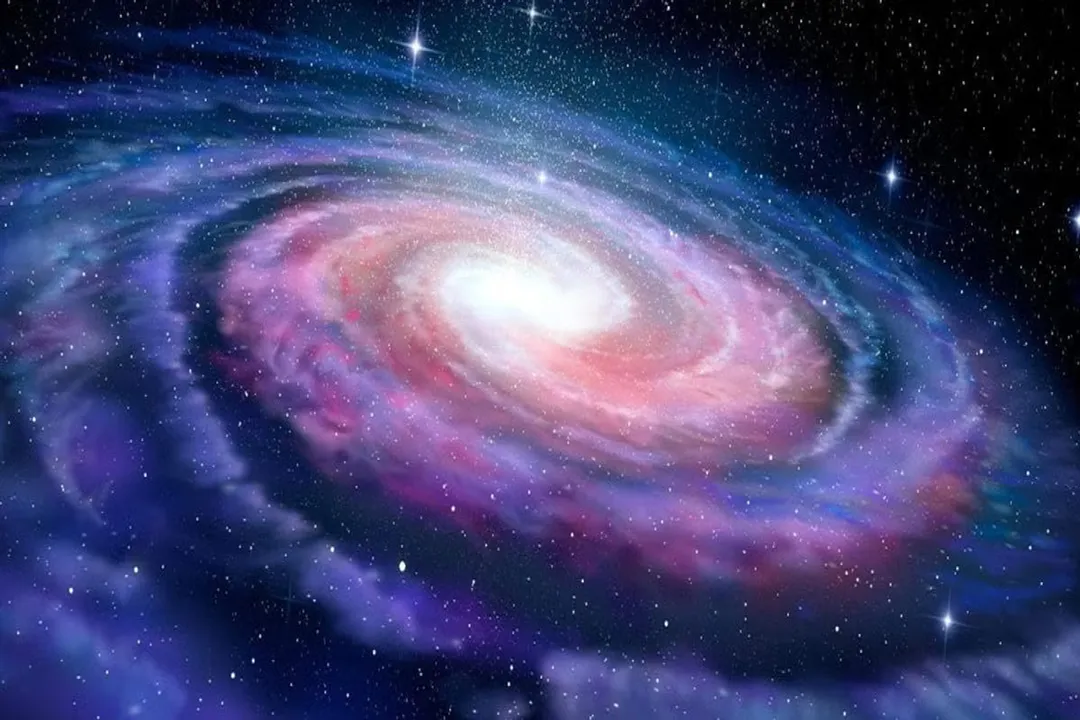
What is the expected relationship for orbital velocity (v) versus radius (r) in a spiral galaxy containing only visible matter?
v falls off inversely proportional to the square root of the radius (v \propto 1/\sqrt{r})
If a galaxy's mass were solely comprised of the visible components like stars, gas, and dust concentrated toward the center, Newtonian gravity, specifically Kepler's third law, dictates how orbital speeds should change with distance. This law predicts that objects further away from the main gravitational source must move slower. Mathematically, this translates to the orbital velocity, v, decreasing proportionally to the inverse square root of the radial distance, r. This decline, symbolized as $v \propto 1/\sqrt{r}$, is characteristic of systems where the enclosed mass is essentially fixed beyond a certain radius, similar to how Neptune orbits the Sun much slower than Mercury because the Sun's mass is overwhelmingly centralized.