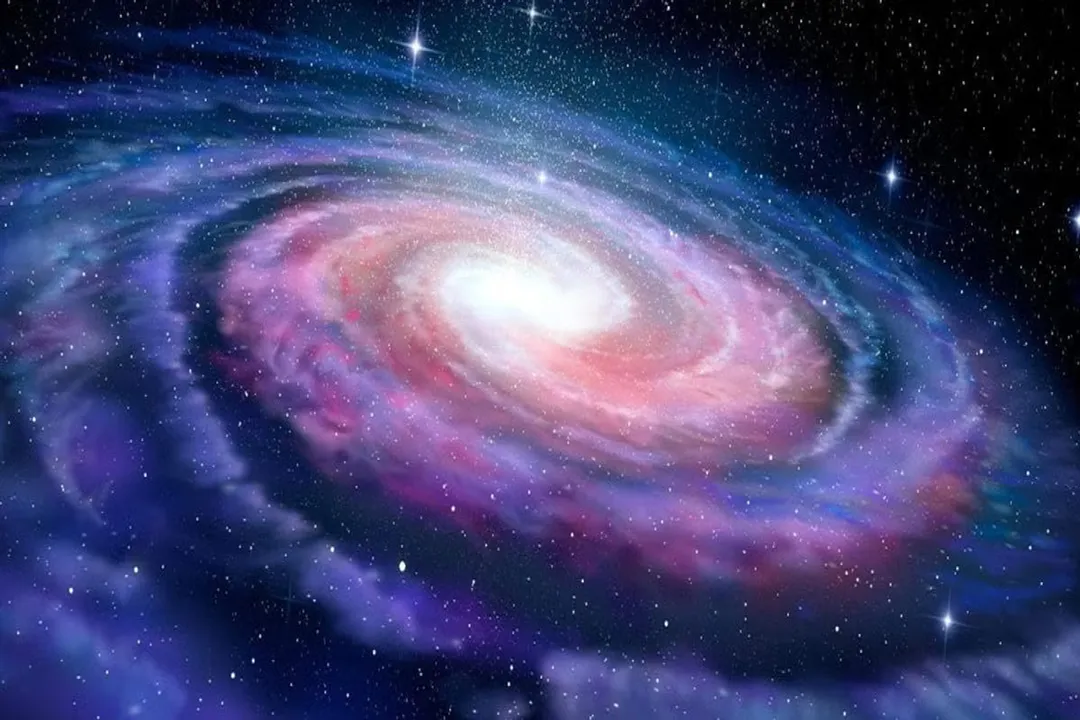
In the Milky Way example, what does the mass discrepancy at 50 kpc imply about the unseen component?
The gravitational influence of the unseen component outweighs visible matter by a factor of five or more in those outer regions.
A calculation based on typical spiral galaxies like the Milky Way reveals a stark contrast between observable mass and required mass to sustain observed speeds. If the visible disk mass within the inner 20 kiloparsecs is around $10^{11}$ solar masses, the calculated total mass needed to keep the rotation curve flat at a radius of 50 kiloparsecs approaches $10^{12}$ solar masses. This vast difference indicates that the unseen gravitational source must supply the majority of the gravity in these distant regions. Specifically, the hidden mass component is inferred to dominate the visible matter by a factor of at least five in these outer domains, positioning the hidden mass as the primary driver of galactic rotation at great distances.