What is the method by which the rate of rotation of a galaxy is calculated?

Calculating the rate at which a galaxy spins is one of the most foundational measurements in astrophysics, providing direct insight into its mass distribution and the nature of the invisible components that dominate its structure. This calculation is not achieved by watching the galaxy turn in real time—these rotations occur over millions or billions of years—but rather by analyzing the light emitted by the stars and gas clouds within it using the Doppler effect.
# Doppler Shift
The primary technique hinges on the principle that light waves shift in frequency depending on the relative motion between the source and the observer. When we observe the light coming from the near side of a spiral galaxy, the gas clouds or stars in that region are moving toward our own vantage point, causing their emitted spectral lines to be blueshifted—shifted toward shorter wavelengths. Conversely, the material on the far side of the galaxy is moving away from us, resulting in a corresponding redshift.
Astronomers measure these shifts by targeting specific spectral lines, most famously the neutral hydrogen (HI) line, which occurs at a wavelength of 21 centimeters in the rest frame. By comparing the observed wavelength of this line from different parts of the galaxy to its known rest wavelength, we can determine the line-of-sight velocity, or radial velocity, for those specific locations.
# Curve Mapping
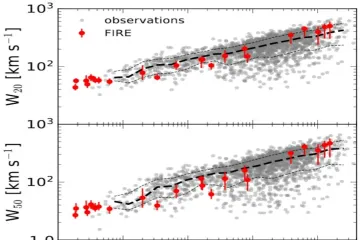
The raw velocity measurements from the Doppler shift alone are insufficient; they must be mapped spatially to create a galaxy rotation curve. This curve is essentially a graph plotting the measured orbital velocity () against the physical distance () of the gas or stars from the galaxy’s center.
To construct this plot for an external galaxy, the observer first needs to estimate the galaxy's inclination—how tilted it appears relative to our line of sight. A galaxy viewed perfectly edge-on yields the maximum possible Doppler shift for a given rotational speed, whereas a face-on galaxy shows minimal shift, complicating the derivation of the true tangential velocity component. Once the inclination () is estimated, the observed radial velocity () is converted into the true circular velocity () using the relationship .
For the Milky Way, the process is more intricate because we are embedded within the disk itself, leading to significant observational challenges due to dust obscuration and the need to accurately map our own position relative to the Galactic Center. In this case, distances to objects are often determined using standard candles or, for the rotation of the immediate solar neighborhood, measurements derived from pulsars or masers serve as critical reference points.
# Orbital Mechanics
Once the rotational velocity at a given radius is established via the rotation curve, the calculation shifts from observation to gravitational physics, typically invoking Newtonian mechanics. The speed at which an object orbits is directly related to the total mass enclosed () within its orbit.
For a simplified, perfectly spherical mass distribution, the calculation directly follows from equating the centripetal force with the gravitational force, leading to the relationship , where is the gravitational constant. This formula is analogous to Kepler’s Third Law when applied to extended systems.
While the idealized Keplerian prediction suggests that the velocity should decrease as the radius increases (like the planets in our Solar System, where the Sun contains almost all the mass), galaxies present a different scenario. We cannot treat the galaxy as a point mass because the visible mass (stars and gas) is distributed throughout a vast disk. This disk structure means that gas clouds far from the center are still being gravitationally influenced by the mass contained in the inner regions plus the mass distributed further out in the disk. This requires applying more complex models, sometimes involving solutions to the Poisson equation for a non-point mass distribution.
# Discrepant Mass
The profound realization in galactic dynamics comes when comparing the mass inferred from the velocity calculation to the mass observed from the light emitted by the galaxy. If we calculate the mass required to maintain the observed velocities using the gravitational equations, we find that this calculated gravitational mass continues to increase or remains stubbornly flat far into the outer regions of spiral galaxies, even where the visible light drops off almost to zero.
This observed flatness of the rotation curve—where does not decrease as increases—is the hallmark measurement demonstrating a mismatch. According to standard Newtonian gravity, if the visible mass distribution ends, the orbital speeds must drop off, following a Keplerian decline. The fact that they do not means there must be a significant amount of unseen, non-luminous mass providing the necessary gravitational pull to keep the outer stars moving so fast. This hypothetical material is what we refer to as dark matter.
# Alternative Measurements
While rotation curves are the definitive tool for mapping spiral galaxies, calculating the total mass within other galaxy types, like elliptical galaxies, relies more heavily on velocity dispersion. Velocity dispersion measures the random motion of stars within the galaxy's volume, rather than their ordered orbital rotation around a central point.
For these systems, particularly in the central bulge region, the total mass is estimated using the Virial Theorem, which relates the kinetic energy of the system (derived from the measured dispersion) to its potential energy (derived from the total mass). While velocity dispersion provides a robust estimate for the total mass contained within the observed stellar population, the rotation curve method remains superior for resolving the mass distribution as a function of radius in disk-dominated systems.
The accuracy of any rotation rate calculation depends heavily on isolating the clean rotational signal from other motions. For instance, a galaxy might exhibit bulk streaming motions due to mergers or tidal interactions, or the individual stars might display significant random velocity components. Distinguishing the smooth, ordered velocity contribution due to steady rotation from these chaotic or systematic non-circular motions requires careful subtraction of the systemic velocity of the galaxy as a whole and advanced modeling techniques.
To illustrate the sheer scale involved, consider a typical mid-sized spiral galaxy. The inner regions might show velocities near , but as you move outward to the edge of the visible disk, the measured rotational speeds often plateau near . This persistent high speed, far exceeding what the visible matter alone can sustain, is the observational foundation for much of modern cosmology concerning the nature of mass in the universe. The method is thus a powerful two-step process: precisely measuring light shifts via the Doppler effect, and then applying orbital mechanics to translate those measured velocities into enclosed mass profiles.
#Videos
Astrophysics: Galaxy Rotation Curves and Dark Matter - YouTube
Related Questions
#Citations
Galaxy rotation curve - Wikipedia
How do I calculate the rotational velocity of a galaxy? : r/astrophysics
How do you measure the rotational speed of a galaxy, taking into ...
[PDF] Chapter 5 Rotation Curves
mass distribution in disk galaxies
Solved What is the method by which the rate of rotation of a - Chegg
[PDF] Rotation Velocity of a Galaxy - Space Math @ NASA
Astrophysics: Galaxy Rotation Curves and Dark Matter - YouTube
Rotation Curves
Measurement of the Milky Way Rotation - PhysicsOpenLab