How to calculate the distance of a galaxy?
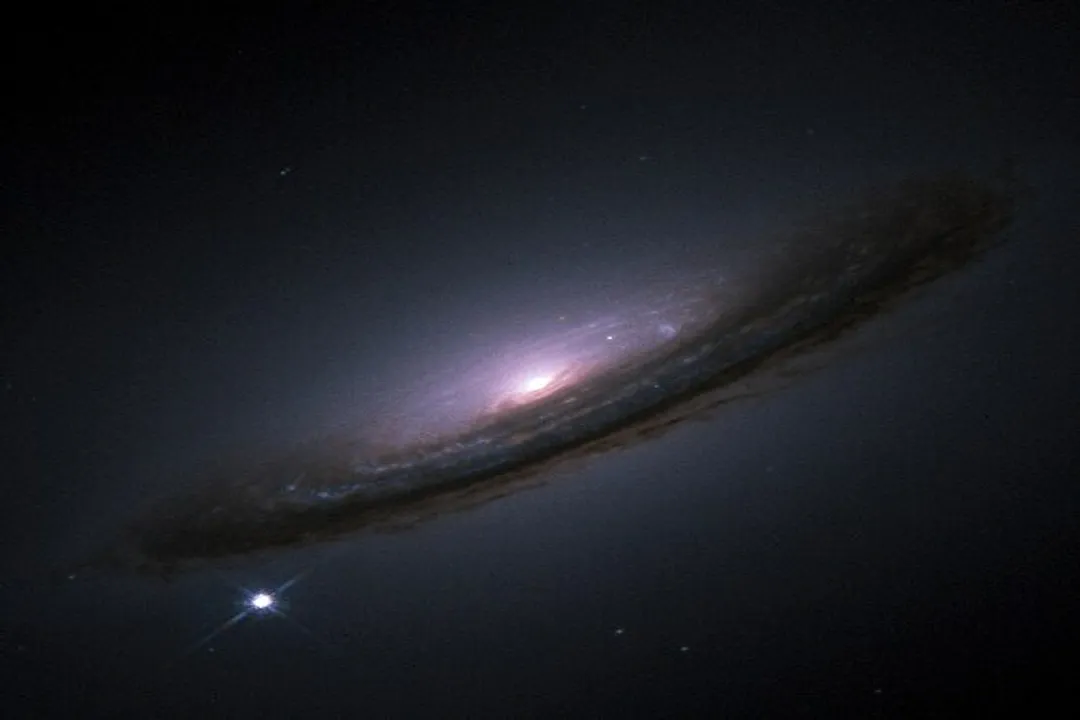
Determining the distance to a galaxy is arguably one of the most fundamental and persistent challenges in astronomy. We perceive everything in the universe as light arriving across vast, empty gulfs of space, and without knowing the distance to these distant star systems, our measurements of their actual size, energy output, and even their place in the history of the cosmos become mere guesses. [2] Because no single instrument or technique can cover the entire range from our own solar system to the edge of the observable universe, astronomers rely on a sequence of interlocking methods, often referred to as the cosmic distance ladder. [1][3] Each step on this ladder is calibrated using the results from the step just below it, extending our reach further into the deep field. [3]
# Base Rung Geometry
The foundation of this entire cosmic scale rests on methods that rely on direct geometry, making no initial assumptions about the physical nature of the object being measured. [3] For objects within our immediate stellar neighborhood, less than about a thousand parsecs away, we can employ parallax. [3] Parallax is the apparent shift in a nearby object’s position against a distant background as the observer changes location. [3] In practice, this means measuring a star’s position now, and then measuring it again six months later when Earth has moved to the opposite side of its orbit around the Sun. [3] The geometry of the resulting triangle—with the Earth’s orbit as one side and the star at the apex—allows for a direct trigonometric calculation of the distance. [3] Space telescopes like Gaia have significantly extended the reach and precision of this foundational method. [3]
The actual scale of this geometric measurement is anchored by the Astronomical Unit (AU), which is the average distance between the Earth and the Sun. [3] The AU is currently known with incredible precision, largely determined today by timing radar signals bounced off nearby planets and spacecraft. [3] Once the AU is known, and the parallax angle of a nearby star is measured, the distance to that star is fixed in a physical unit (parsecs or light-years). [3] This first rung is critical because the accuracy of every subsequent rung on the ladder depends entirely on the precision achieved here. [3]
# Local Galaxy Indicators
Moving beyond the reach of parallax—which becomes too imprecise for objects beyond our immediate galactic vicinity—astronomers step up to the next rung, relying on objects with a known intrinsic brightness, known as standard candles. [3][4] The principle is simple: if you know how bright an object truly is (its absolute magnitude, ) and you measure how dim it appears from Earth (its apparent magnitude, ), you can use the inverse-square law for light to determine the distance (). [3][4] The mathematical relationship derived from this is the distance modulus:
For the nearest galaxies, such as the Andromeda Galaxy (M31), Cepheid variable stars are the key standard candle. [3] These stars undergo periodic pulsations, and Henrietta Swan Leavitt discovered a direct, consistent relationship between the period of this pulsation and the star’s true luminosity. [3][4] By measuring how quickly a Cepheid brightens and dims, we determine its absolute magnitude (), compare it to its observed brightness (), and calculate the distance. [3][4] Historically, Walter Baade’s discovery that there were different types of Cepheids (Population I and Population II) led to a doubling of previous distance estimates to nearby galaxies because the distant ones were intrinsically brighter than first assumed. [3] This highlights a major hurdle: even at this rung, assumptions about the object's physics can create systematic errors that propagate upward. [3]
Other methods apply to galaxies at intermediate distances or specific types of galaxies:
- Eclipsing Binaries: For galaxies within about $3$ megaparsecs (), the fundamental parameters of eclipsing binary star systems can be measured, providing a direct distance estimate accurate to about $5%$. [3]
- Novae: These stellar explosions exhibit a relationship between their maximum brightness and how quickly their light fades, making them useful standard candles out to about . [3]
- Surface Brightness Fluctuations (SBF): This technique shifts focus from individual stars to the galaxy as a whole. [2][3] When a galaxy is close, its structure appears "bumpy" due to the discrete nature of its constituent stars. As the galaxy moves farther away, these stars blend together, making the image appear smoother. [2] By analyzing the statistics of these "bumps"—using a computer to subtract a smoothed model from the image to isolate the fluctuations—and accounting for the galaxy’s color (which relates to its stellar temperature and light output), astronomers can estimate its distance. [2] The galaxy M32, at , looks significantly bumpier than the galaxy NGC $7768$ at in Gemini observatory images, perfectly illustrating this effect. [2]
- Galaxy Relations: Methods like the Tully-Fisher relation (for spiral galaxies) and the Sigma-D relation (for elliptical galaxies) relate a galaxy's overall intrinsic property—like its rotational speed or velocity dispersion ()—to its total luminosity or size (). [3]
# The Farthest Reaches Redshift
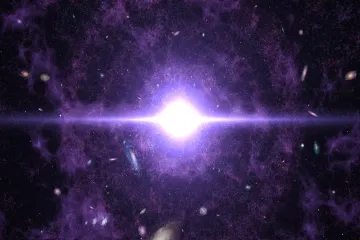
When we look at galaxies so far away that even the brightest individual objects, like Type Ia Supernovae, become too faint or are too rare to be useful as standard candles, we must employ a method based on the expansion of the universe itself. [3][4] This technique relies on Hubble’s Law, which states that a galaxy’s recessional velocity () is directly proportional to its distance () from us, expressed as , where is the Hubble constant. [2]
To find the velocity (), astronomers look at the galaxy’s spectrum, searching for known emission or absorption lines from elements like hydrogen or calcium. [2] If the galaxy is moving away, the entire pattern of these spectral features is shifted toward longer, or "redder," wavelengths—this is redshift (). [2][3] The amount of shift is measured, and since the speed of light () is known, the recessional velocity can be calculated using . [2] For instance, if a hydrogen absorption line normally seen at is observed at , the resulting redshift is , corresponding to a speed of roughly . [2] Once the velocity is known, plugging it into Hubble's Law, , yields the distance in megaparsecs. [2]
The initial work by Edwin Hubble in the 1920s, using the $100$-inch telescope, showed that the fainter and smaller a galaxy appeared, the greater its redshift, leading to the conclusion that the universe is expanding. [2] It is important to note that redshift is caused both by the galaxy's peculiar motion away from us (Doppler effect) and by the expansion of spacetime itself as the light travels across the cosmos. [3] For extremely distant objects, the cosmological expansion component dominates. [3] The precision of distances derived via Hubble's Law is critically dependent on the accurately determined value of the Hubble constant (). [2]
# The Ladder's Higher Steps
Type Ia Supernovae are incredibly bright—sometimes rivaling the light of their entire host galaxy—allowing them to be seen much farther than Cepheids, perhaps out to distances greater than . [3] These explosions occur when a white dwarf star accretes mass from a companion until it hits the Chandrasekhar limit () and undergoes runaway fusion. [3] Because this explosive event happens at a consistent mass, the peak absolute magnitude () is thought to be nearly identical for all Type Ia supernovae, making them the best tools for probing the furthest reaches. [3] Astronomers use methods like the Multicolor Light Curve Shape (MLCS) or the stretch method to standardize the peak brightness even if the event isn't observed at maximum light. [3] While this method carries a current uncertainty near $5%$, it is the only viable option for mapping the geometry of the distant universe. [3]
Furthermore, emerging techniques promise to refine the upper rungs. Standard Sirens, which are the gravitational waves emitted during the merger of compact objects like neutron stars, offer a distance measurement directly from the waveform without relying on electromagnetic calibration (though an electromagnetic counterpart helps measure the redshift). [3] Another approach involves Baryon Acoustic Oscillations (BAO), which use a known physical scale imprinted in the early universe’s matter distribution—an expanding sound wave horizon—as a "standard ruler" visible in galaxy clustering surveys. [3]
This entire structure is a compromise born of necessity. The fact that we cannot calibrate the brightest candles using direct parallax means that errors must creep up the ladder. [3] For instance, the Cepheid calibration for Andromeda, which Hubble calculated in the 1920s, was later revised by a factor of two when the type of Cepheid used for calibration was misidentified. [3] This history underscores a subtle but crucial aspect of cosmic distance measurement: a slight improvement in our understanding of a nearby standard candle, such as thanks to precise parallax data from missions like Gaia, doesn't just improve one rung; it recalibrates the entire scale that follows, potentially shifting the calculated distances for every distant galaxy we have ever cataloged. [3] If the assumption that distant Type Ia supernovae behave identically to nearby ones fails, our cosmological parameters, such as the density of matter in the universe, would be systematically biased. [3] For instance, if those distant explosions are actually slightly fainter than thought, we would systematically underestimate the distance to the far universe. It is a constant battle against systematic error, where the very physics underpinning the standard candles is always under review, making the entire field a dynamic interplay between geometry and astrophysics. [3]
#Videos
How Scientists Measure The Distance To Stars and Galaxies
Related Questions
#Citations
Measuring Distances to Galaxies - Frontiers for Young Minds
How do we calculate distances to other galaxies?
The Hubble Distance - Redshift Relationship
How Scientists Measure The Distance To Stars and Galaxies
Cosmic distance ladder - Wikipedia
How is distance measured to far away stars and galaxies?