How did Hubble calculate the distances to far away galaxies based on?
The monumental task of determining how far away distant galaxies lie was not accomplished with a single telescope reading, but through a remarkable chain of astronomical discoveries built layer by layer. Edwin Hubble, working in the 1920s, wasn't inventing a new way to measure distances in the cosmos from scratch; rather, he was the one who successfully applied and calibrated an existing set of interconnected methods—a cosmic distance ladder—to nebulae that were, until then, a source of great debate regarding their true nature. [5][8] For his work to succeed, two critical components needed accurate measurement: the speed at which these objects were moving away from us, and their actual physical distance.
# Recession Speed
Determining the speed of these remote objects relied almost entirely on the phenomenon of redshift, which is a direct consequence of the Doppler effect as applied to light. [1][4] When a light source moves away from an observer, the wavelengths of the light it emits are stretched out, causing the light spectrum to shift toward the longer, red end of the spectrum. [4] This shifting of spectral lines—the familiar dark lines in a galaxy's spectrum caused by elements absorbing specific wavelengths—provided the key indicator of motion. [6]
It is important to note that while Hubble is famous for plotting these distances, the initial heavy lifting on measuring the recession velocities of spiral nebulae was largely done by astronomer Vesto Slipher decades earlier. [6] Slipher painstakingly measured these redshifts for dozens of these "nebulae," establishing that nearly all of them were moving away from the Earth. [6] Hubble then took this catalog of recessional velocities () and matched them with his independent distance estimates (). [5] The resulting plot revealed a startling pattern: the farther away a galaxy was, the faster it appeared to be receding. [1] This observation led directly to the formulation of what is now known as Hubble's Law, mathematically expressed as , where is the Hubble Constant, representing the rate of the universe's expansion. [1][4]
# Standard Candles
While velocity seemed obtainable via spectroscopy, measuring distance across intergalactic space posed the greatest challenge. To find the distance () to a galaxy, astronomers need to know how bright the object truly is (its absolute magnitude or intrinsic luminosity) and how bright it appears to be from Earth (its apparent brightness). [3][8] The difference between these two values, governed by the inverse-square law of light, yields the distance. [3] Objects of known intrinsic brightness are called standard candles.
Hubble’s breakthrough hinged on finding exceedingly bright standard candles that could be seen across vast cosmic distances. [3][5] His primary tool for this was the Cepheid variable star. [3][8] These are large, luminous stars that physically pulsate, causing their brightness to vary over a predictable period. [3] The critical physical link, discovered by Henrietta Swan Leavitt, is that the longer a Cepheid's pulsation period, the greater its intrinsic luminosity. [3][5]
The process involved several crucial steps:
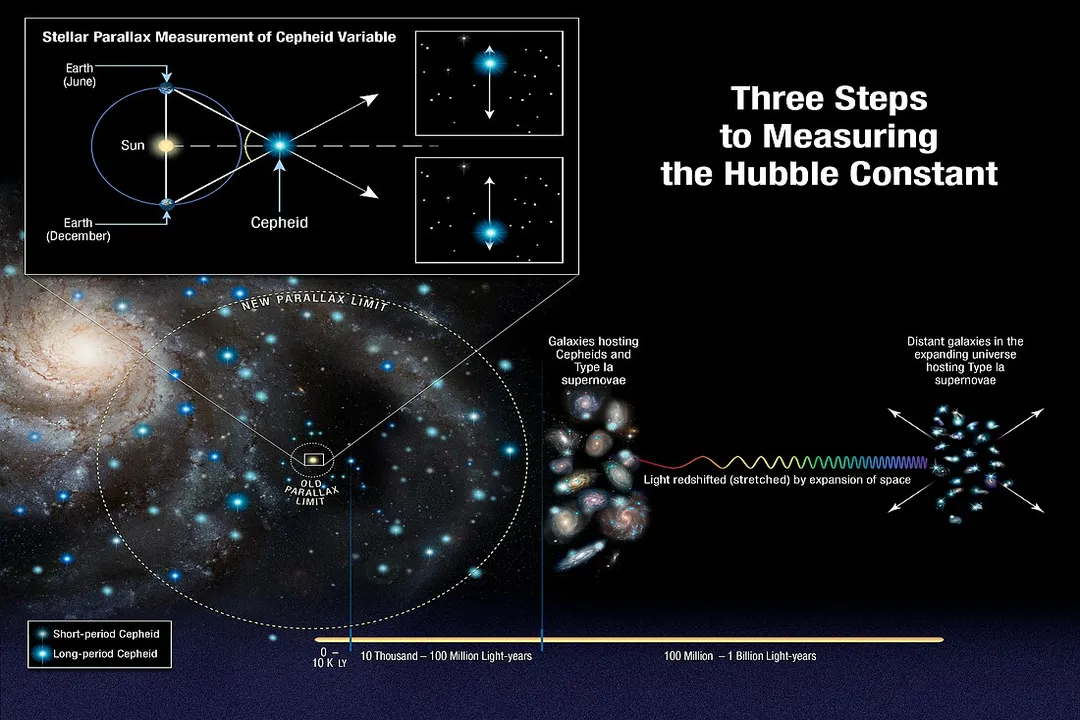
- Calibration: First, astronomers needed to measure the distances to relatively nearby Cepheids using geometric methods, like parallax, to establish their true baseline luminosities. [3][8]
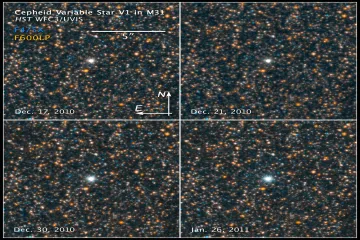
- Period Measurement: Hubble then needed to find Cepheids within the faint, spiral arms of galaxies like Andromeda (M31), meticulously observing them over time to determine their pulsation periods. [5]
- Distance Calculation: Once the period gave the star's known intrinsic brightness, comparing that to how dim it appeared allowed Hubble to calculate the distance to the entire host galaxy. [3]
If we consider the process in terms of difficulty, measuring the spectral shift (velocity) is relatively direct, involving precise optics and spectroscopy on a single light source. In contrast, establishing the distance required a sequence of independent observations—finding the star, measuring its period, linking that period to a known luminosity standard calibrated by an entirely different method (parallax), and then applying the inverse-square law. The accuracy of the final distance estimate is entirely dependent on the accuracy of every single step preceding it in that chain. [8]
# The Relationship Established
With recession velocities from Slipher’s work and distances derived from his calibrated Cepheids, Hubble plotted the data points for numerous nebulae. [5] He found that the resulting distribution of points formed a relatively straight line passing through the origin. [1][4] This simple linear correlation—that velocity is directly proportional to distance—was the smoking gun proving that the universe itself was expanding on a grand scale. [1][4] The slope of that line, the constant of proportionality, became the value of .
Hubble’s initial estimates for varied significantly from what modern cosmology accepts. His early calculations, published around $1929$, suggested a value around (kilometers per second per megaparsec). [4] This high rate implied a very young universe, only about 2 billion years old, which posed a severe contradiction since geological evidence showed the Earth itself was already far older than that. [4] This discrepancy highlights a fundamental truth in observational cosmology: the initial measurements define the structure of the law, but the numerical value requires continuous refinement as distance measurement techniques improve. [4]
# Scale Refinements
The story of Hubble calculating distances doesn't end with his initial findings; it continues through decades of subsequent refinement, driven by better standard candles and improved measurements of nearby stars. [8] Cepheids remain foundational, but to reach the most distant objects, even brighter markers are necessary. For example, Type Ia supernovae—exploding white dwarf stars—now serve as crucial standard candles reaching billions of light-years away. [3] However, these supernovae must be calibrated using the distances established by the previous rung of the ladder, which is anchored by those initial Cepheid measurements. [3][8] If the Cepheid calibration is off by even a small percentage, the resulting distance to the most distant supernova in the universe will be off by a proportionally larger margin.
It's fascinating to consider that the very first step on the ladder—the parallax measurement of nearby stars—is the most difficult to measure with precision from Earth due to atmospheric blurring. While modern space telescopes have greatly reduced this uncertainty, Hubble’s early attempts were pioneering despite significant inherent error margins in his baseline measurements. [8] His lasting contribution wasn't necessarily the final, perfect number for the Hubble Constant, but the irrefutable demonstration that the universe has a scale and a history that could, in principle, be measured by linking spectral physics to variable star photometry. [5]
Related Questions
#Citations
Hubble's law - Wikipedia
The Hubble Distance - Redshift Relationship
Three Steps to Measuring the Hubble Constant - NASA Science
Ep. 279 Hubble Constant - Astronomy Cast
How Hubble Found Distances (Cosmology: Ideas)
How did Edwin Hubble estimate the velocity of distant stars?
The Hubble constant and the most distant galaxies : r/cosmology
The Hubble Law: Measurements of Velocities and Distances
The Hubble constant, explained - UChicago News