Are all galaxies moving away from each other?
The cosmos is an arena of constant motion, and one of the most profound observations in modern astronomy is that the vast majority of galaxies appear to be flying away from us. This observation forms the bedrock of our understanding of an expanding universe, a concept cemented by decades of telescopic evidence. Yet, the simple affirmation that "all galaxies are moving away" doesn't capture the full, nuanced reality of cosmic mechanics. To understand the universe's overall trajectory, we must look closer at the interplay between the stretching of space itself and the persistent tug of local gravity. [4][5]
# Hubble's Finding
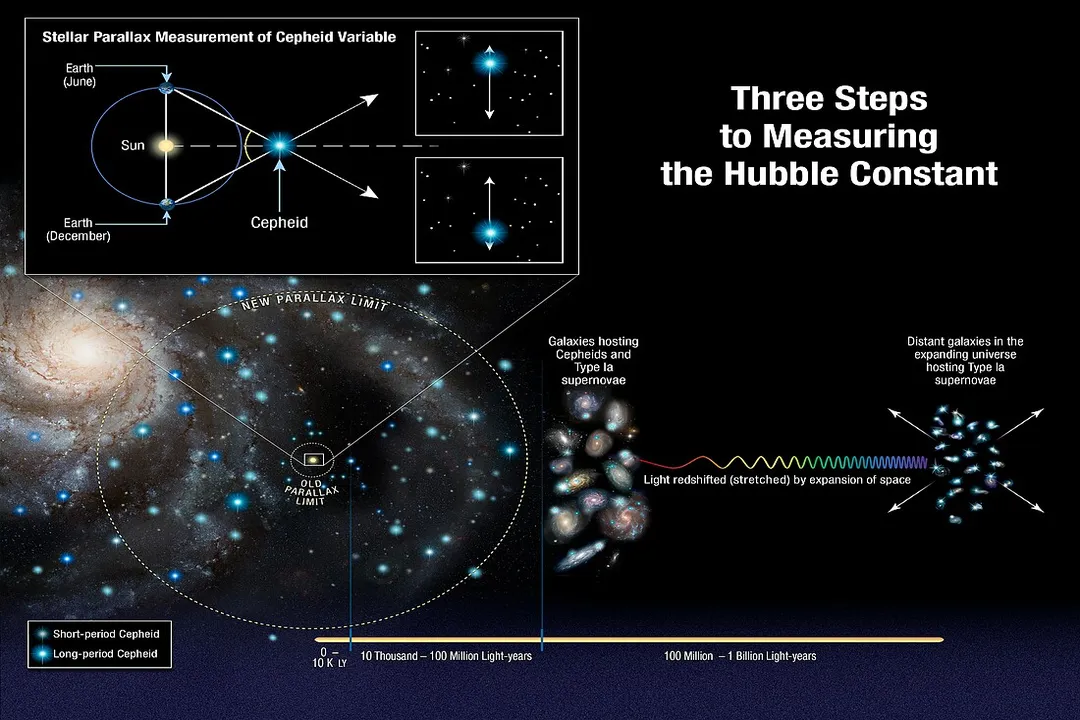
The groundwork for this grand realization was laid by Edwin Hubble in the late 1920s. By observing distant galaxies, Hubble noticed a consistent pattern: the farther away a galaxy was, the faster it seemed to be receding from our own Milky Way. [2][8] This empirical relationship is now formalized as Hubble's Law. [2][8]
This speed is measured through a phenomenon called redshift. As light travels from a galaxy moving away from us, its wavelength is stretched toward the red end of the spectrum. [2][3] The greater the redshift, the faster the object is moving away. [2] This observation led to the inescapable conclusion that the universe is not static; it is actively expanding. [3][7] In fact, virtually every galaxy we look at, aside from our closest neighbors, exhibits this redshift, suggesting an overall outward flow. [1][7]
# Space Stretches
It is critical to grasp what is moving. The common analogy sometimes suggests that galaxies are like shrapnel from a central explosion, flying outward into pre-existing empty space. [6] However, this is a misleading picture. In reality, it is the fabric of spacetime itself that is expanding. [3][6] Galaxies are, for the most part, carried along passively as the space between them grows larger. [3]
Imagine baking a loaf of raisin bread. As the dough rises, the raisins themselves do not move through the dough relative to their immediate neighbors; rather, the dough between every pair of raisins expands, increasing the distance between them. [6] In this analogy, the raisins are the galaxies, and the dough is the universe's spacetime. This explains why Hubble's Law holds true regardless of the observer's location; an observer in any galaxy would see all other galaxies receding from them with a recession speed proportional to distance. [6] The expansion does not originate from a single point in space from which everything is rushing away; rather, it's an expansion everywhere. [6]
# Local Exceptions
While the cosmic background shows a universe getting larger and larger, not every single galaxy in existence is moving away from the Milky Way. The universe is not just governed by the smooth, large-scale expansion driven by dark energy; it is also governed by gravity on smaller, more intimate scales. [4][5]
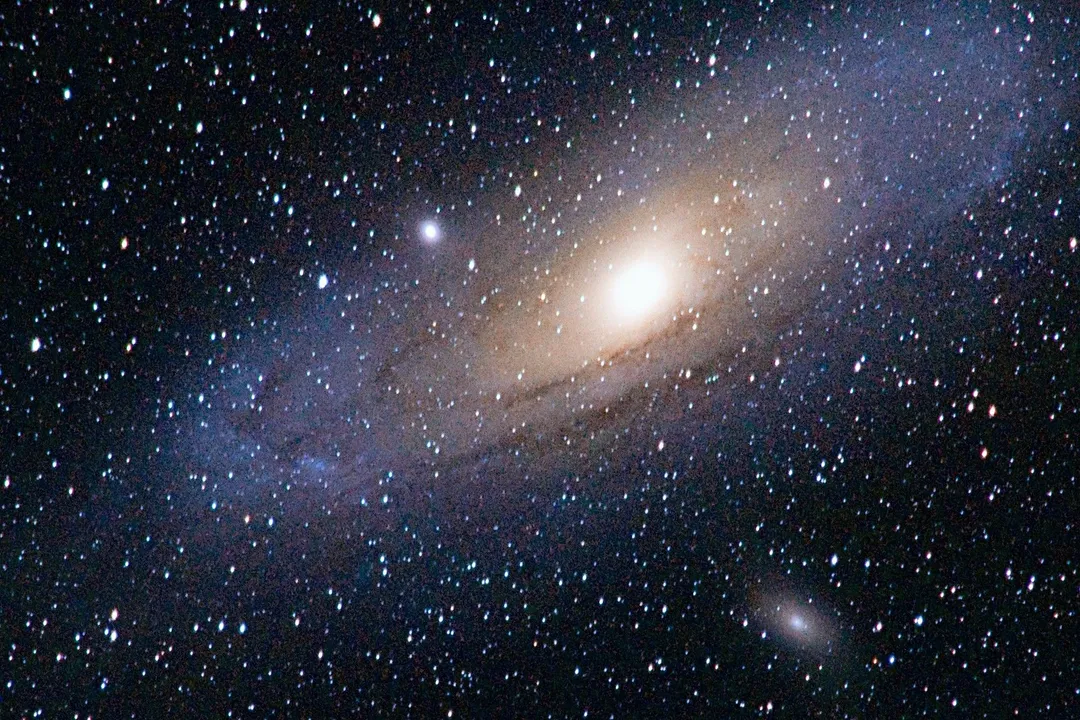
Gravity creates clusters and groups of galaxies that are gravitationally bound. Within these local structures, the mutual attraction between members overrides the general expansion of space. [4][5] The most prominent example is our own Local Group, which contains the Milky Way, the Andromeda Galaxy (M31), and Triangulum (M33), along with several dozen smaller dwarf galaxies. [5]
Andromeda, our largest galactic neighbor, is actually hurtling toward the Milky Way at a speed of about 110 kilometers per second. [5] This local attraction is so powerful that the distance between us and Andromeda is shrinking, causing its light to be blueshifted—shifted toward the blue end of the spectrum—rather than redshifted. [5] In roughly 4.5 billion years, our galaxies are destined to collide and merge. [5]
# Gravitational Dominance
This situation highlights a vital concept in cosmology: scale matters immensely. When we look at galaxies billions of light-years away, the expansion of the space between them dominates, and their recessional velocity is obvious and significant. [1] However, when galaxies are relatively close, perhaps within tens of millions of light-years, the local gravitational pull is the stronger force. [4]
If we were to plot the movement of every galaxy in the sky, we would see an overwhelming trend of redshifts, but scattered amongst them would be a few blueshifts—these are the galaxies that have fallen into our local gravitational sphere of influence. [1][5] The more massive a local structure is, the more it can resist the Hubble flow. [4]
To put this into perspective, consider the difference in speeds. The recessional velocity of a galaxy 100 million light-years away due to expansion is only about 7,000 kilometers per second, based on the current approximate Hubble constant of (kilometers per second per megaparsec). [2][8] Andromeda’s approach speed is a mere 110 . While the Hubble flow is immense across vast cosmological distances, for nearby objects, the local gravitational acceleration, though subtle on a universal scale, is the determining factor in their relative motion. [5]
| Structure Scale | Dominant Force | Typical Motion Relative to Milky Way | Example |
|---|---|---|---|
| Intergalactic (Local Group) | Gravity | Approach (Blueshift) or Slow Recess | Andromeda Galaxy |
| Distant Clusters/Superclusters | Expansion of Space | Recess (Redshift) | Galaxies Mly away |
| Largest Scales | Expansion of Space | Recess (Redshift) | Distant Quasars |
This table summarizes how the relative strength of gravity versus expansion dictates observed galactic velocity across different distances. Notice that the Local Group is not expanding internally; its members are bound together by mutual gravity, whereas the space between groups is stretching. [4]
# The Cosmic Horizon

The concept of "all galaxies" must also be framed by the observable universe. Because the universe has a finite age—approximately $13.8$ billion years—light from objects too far away simply has not had enough time to reach us. [3] This creates a cosmic horizon.
Furthermore, an interesting consequence of expansion is that objects very far away are receding from us at speeds greater than the speed of light, . [3][8] This does not violate Einstein’s theory of relativity, which forbids objects from moving through space faster than light; rather, it is the space between the observer and the distant galaxy that is expanding so rapidly that the apparent recession velocity exceeds . [3] Galaxies receding faster than light are effectively moving out of our causal contact, meaning their light will never reach us, even if they were to stop moving away right now. [3]
An interesting way to frame this is by considering the look-back time. When we observe a galaxy that is currently receding at , we see it as it was billions of years ago when it was closer and receding slower. That galaxy might, in turn, see a distant galaxy receding faster than relative to it. The universe's expansion is universally applied, leading to a complex, yet orderly, kinematic picture where distance dictates the observed speed of separation, modulated by local mass concentrations. [1][7]
# Rethinking the Center
When people hear that everything is moving away, the natural, intuitive—but incorrect—next thought is to locate the center of the explosion from which everything fled. [6] As established with the raisin bread analogy, there is no central point in space that the universe is expanding from. [6] Every location in the universe can legitimately claim to be the "center" because from any vantage point, all other distant points appear to be moving away. [6] The expansion is isotropic (the same in all directions) and homogeneous (the same everywhere) on the largest scales. [8]
This means that the Milky Way is not special in its position, nor is it being left behind. We are simply embedded within a spatial matrix that is increasing in volume over time. [3][7] The Hubble flow describes this metric expansion of space, and its consistent nature across the sky is the strongest evidence we have that the universe is expanding uniformly everywhere, not just in our immediate vicinity. [2][8]
In summary, the statement "all galaxies are moving away" is a powerful simplification that captures the essence of an expanding universe governed by Hubble's Law. [2][7] However, for a complete picture, one must always account for the local dominion of gravity, which keeps our closest galactic companions, like Andromeda, bound to us, ensuring that a handful of galaxies are in fact approaching. [5] The universe expands on the grandest scales, but on the neighborhood scale, gravity still reigns supreme. [4]
#Videos
If the Universe is expanding, then why do galaxies collide? - YouTube
Related Questions
#Citations
Are galaxies moving away from each other, or is space expanding ...
Hubble's law: Why are most galaxies moving away from us? - Space
The Implications of Hubble's Law: An Expanding Universe
Do galaxies move? - BBC Sky at Night Magazine
Are There Galaxies That Are Moving Toward Each Other?
If the Universe is expanding, then why do galaxies collide? - YouTube
Are all galaxies going outwards from a single point or is it spreading ...
Do galaxies move? - Cool Cosmos - Caltech
Hubble's law - Wikipedia
Are there galaxies moving away from each other? faster than the ...