Are all galaxies moving apart?
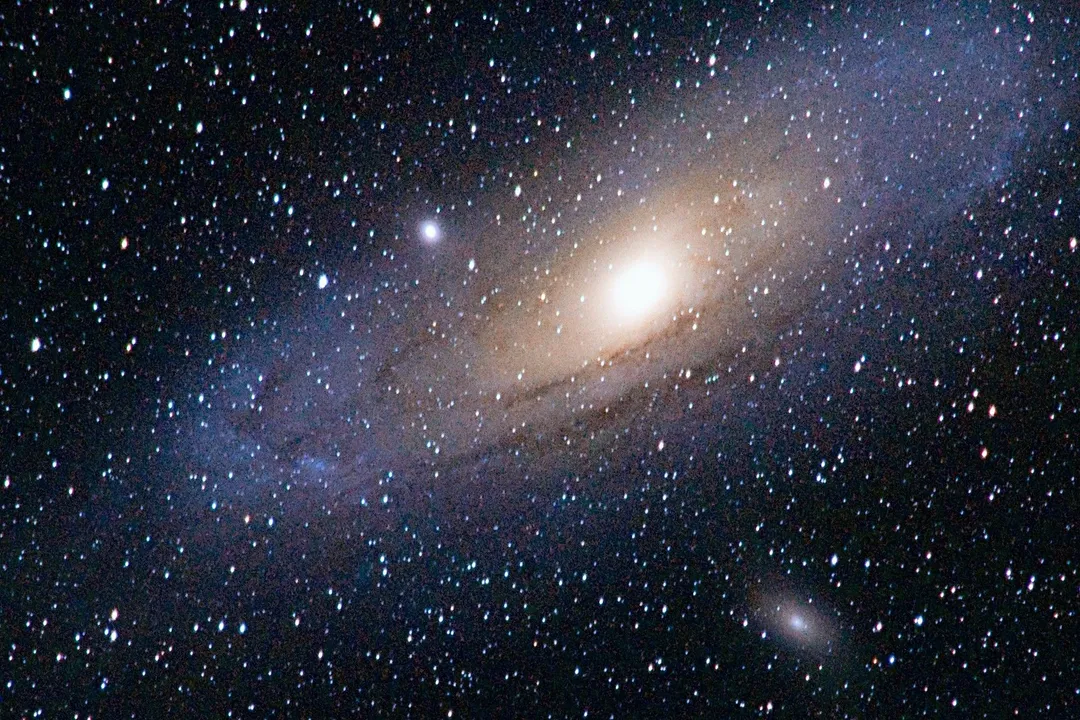
The simple answer to whether all galaxies are moving apart is a definitive no, although the vast majority are receding from us, giving the impression of universal dispersion. This widely accepted view stems from observations showing that the universe is expanding, a discovery rooted in measuring the light from distant galaxies. [1][2] When we look out into the cosmos, we see that the farther away a galaxy is, the faster it appears to be moving away from the Milky Way. [2] This relationship is formalized by Hubble’s Law, which dictates that the recessional velocity of a galaxy is directly proportional to its distance from the observer. [2][7]
However, this recession is not the same as an explosion where galaxies shoot away from a central point through stationary space. Instead, it is the fabric of space-time itself that is stretching, carrying the galaxies along for the ride. [1][7] Imagine peppercorns embedded in a loaf of rising dough; as the dough expands, the distance between any two peppercorns increases, even though the peppercorns themselves aren't actively moving across the dough's surface. [1] This expansion is the primary driver for the separation of most observed galaxies.
# Cosmic Expansion

The key mechanism driving the separation is the large-scale structure of the cosmos. Distances between galaxy clusters are increasing because the vacuum between them is being stretched by cosmic expansion. [1] This phenomenon is measurable through the redshift of light emitted by these distant objects. [2][7] When a light source moves away from an observer, the wavelengths of the light are stretched toward the red end of the spectrum, a clear sign of recession. [2]
Hubble’s initial quantitative work established this connection, showing that the rate of expansion—the Hubble Constant—could be derived from measuring both the distance and the redshift of these galaxies. [7] For objects far enough away, the cumulative effect of this stretching space overwhelms any local gravitational tugs they might experience from nearby neighbors. This distance threshold, generally considered to be beyond the immediate vicinity of galaxy clusters (perhaps exceeding 100 million light-years), is where the expansion signature becomes undeniably dominant. [4]
# Local Gravity
If the universe is uniformly expanding, why do we find exceptions? The answer lies in the fundamental force that governs structure formation: gravity. [4][5] While the expansion of the universe dictates the motion of galaxy clusters on the grandest scales, gravity dictates the motion within those clusters. [4]
Not all galaxies are separating; some are actually heading toward one another, or toward us, because their mutual gravitational attraction is stronger than the influence of the general cosmic expansion over their relatively short intervening distances. [4][5] Our own galaxy, the Milky Way, is part of a small collection of about 50 galaxies known as the Local Group. [4] In this local environment, gravity is the boss.
One of the most famous examples of this local dominance is the Andromeda Galaxy (M31). Despite the universe expanding all around us, Andromeda is not moving away; it is hurtling toward the Milky Way at about 110 kilometers per second. [3][6] This inbound velocity results in a blueshift for Andromeda’s light, the opposite of the expected redshift from universal expansion. [4]
It is helpful to think of the universe as having two competing actions happening simultaneously. On the massive, inter-cluster scales, space is stretching, pushing everything apart. On the small scale of a galaxy cluster, the mass within that cluster creates a gravitational well so deep that it binds the members together, allowing them to orbit each other just as planets orbit a star, ignoring the background expansion. [4][5] The force of local gravity has successfully resisted the subtle outward push from the cosmological constant across these shorter spans.
To put this into perspective, consider the forces at play. If the expansion rate dictates a certain separation velocity, the gravitational binding energy within the Local Group is significantly higher than the kinetic energy imparted by expansion over the few million light-years separating us from Andromeda. This means that any galaxy we see moving toward us is not reversing the cosmic trend, but rather is coasting along its natural orbital path within our gravitationally bound neighborhood. [4]
# Galactic Collisions
The trajectory of Andromeda leads to an unavoidable conclusion: a future merger. In roughly 4.5 billion years, the Milky Way and Andromeda are projected to collide and merge into a single, larger elliptical galaxy, sometimes nicknamed "Milkomeda". [6][8] This event demonstrates the powerful, persistent nature of gravity on scales smaller than the vast voids separating large galaxy superclusters. [6]
The process of galactic collision is not a head-on smash, given the immense distances between individual stars even within colliding galaxies. [6][8] Instead, it is a prolonged, gravitational dance. As the two spirals approach, tidal forces will strip gas and dust from their structures, fueling bursts of new star formation. [6] The initial pass will be followed by several gravitational interactions as they swing past each other, eventually settling into a single, relaxed galaxy. [6][8]
This phenomenon of galaxies merging, sometimes within a cluster, sometimes as large structures drawing in smaller neighbors, serves as a powerful counter-example to the notion that all galaxies are separating. The expansion is a large-scale phenomenon; structure formation and galaxy interactions are local phenomena dictated by mass clustering. [4]
# Measuring Motion
Determining whether a galaxy is approaching or receding, and by how much, relies on analyzing its spectrum of light. [2][7] Astronomers examine specific spectral lines—emissions or absorptions created by elements like hydrogen or calcium—that have known rest wavelengths when observed in a laboratory on Earth. [2]
When observing a distant galaxy, these spectral lines are shifted:
- Redshift: If the lines appear at longer wavelengths than their known rest positions, the galaxy is moving away. [2] The degree of this shift directly relates to the recessional velocity via Hubble’s Law. [7]
- Blueshift: If the lines appear at shorter wavelengths, the galaxy is moving toward the observer. [2] This is the signature we see from Andromeda. [4]
It is important to recognize that the redshift caused by the universal expansion is different from the Doppler shift caused by random local motion through space, although both contribute to the observed shift. [1] For very distant galaxies, the cosmological redshift due to space stretching dominates everything else. For nearby galaxies like Andromeda, the local kinematic motion due to gravity completely overrides the subtle expansion signal. [4] If you could somehow freeze the Local Group while the rest of the universe continued to expand, the galaxies within our group would still orbit each other based purely on their gravitational interactions. [5]
# Cosmic Context
Understanding the answer requires appreciating the difference in scale and the dominant forces acting on those scales. The expansion of the universe is a smooth, general effect that applies everywhere, but its noticeable effect accumulates over immense distances. [1]
Consider this analogy: If you are standing on a very large, slowly moving conveyor belt (representing space), and you walk toward a friend also on the belt (representing gravitational attraction), your relative speed is the sum of your walking speed minus the slow speed of the belt carrying you both away from a starting point. For nearby galaxies, the "walking speed" (gravity) is much faster than the "conveyor belt speed" (expansion). For galaxies separated by hundreds of millions of light-years, the conveyor belt has been moving for billions of years, making the cumulative stretching effect far greater than any minor local gravitational jostle. [4]
Therefore, while the overall narrative of cosmology points toward an ever-expanding cosmos where galaxies are generally moving apart, this is a statistical truth about the universe’s history, not an absolute rule for every single pair of neighbors. The local neighborhood—the galaxy clusters and groups—remains a realm where the ancient, established rules of gravitational attraction dictate who is approaching whom, setting the stage for spectacular future mergers rather than just endless separation. [6]
#Videos
If the Universe is expanding, then why do galaxies collide? - YouTube
Related Questions
#Citations
Are galaxies moving away from each other, or is space expanding ...
Hubble's law: Why are most galaxies moving away from us? - Space
Do galaxies move? - BBC Sky at Night Magazine
Is it true that all galaxies are moving apart? If not, how do we ... - Quora
Are There Galaxies That Are Moving Toward Each Other?
If galaxies are all moving apart, how can they collide?
If the Universe is expanding, then why do galaxies collide? - YouTube
Hubble's law - Wikipedia
If galaxies are moving farther apart, why are there still galactic ...