How do scientists determine the distance to the furthest stars and galaxies?

The challenge of understanding the universe’s true scale begins with a fundamental question: how far away are those twinkling pinpricks of light? Determining the distance to stars, and especially to galaxies billions of light-years away, is not a single measurement but a complex, multi-stage process relying on overlapping techniques that build upon one another, a system astronomers call the cosmic distance ladder. [6] Each rung on this ladder depends on the accuracy of the rung below it. [6]
# Nearby Geometry
For the closest celestial neighbors, scientists can rely on pure geometry, much like measuring the width of a distant canyon using trigonometry. [2] This method is called stellar parallax. [9] As the Earth orbits the Sun, our viewpoint on the star shifts slightly over six months. [1] This apparent shift causes nearby stars to appear to move a minuscule amount relative to the much more distant background stars. [9] The closer the star, the larger this angle of shift, or parallax, appears. [1]
The relationship is straightforward: the distance is inversely proportional to the measured parallax angle. [9] Astronomers use this relationship to define the parsec, a unit of distance equal to about 3.26 light-years, based on an object that exhibits a parallax shift of one arcsecond. [1] Even with this foundation, the angles measured are extraordinarily small. For example, Proxima Centauri, the nearest star to our Sun, has a parallax angle of less than $0.77$ arcseconds. [1] This precision demands incredibly sensitive instruments, often requiring space-based observatories to avoid the blurring effects of Earth’s atmosphere. [9]
One interesting implication of using this method is its inherent limit. While space telescopes like Gaia have dramatically extended our reach, even the best parallax measurements become too small to be reliably distinguished from measurement error for stars beyond a few thousand light-years. [1] This geometric measurement, though precise, only gets us so far before we must switch techniques.
# Standard Markers
Once objects are too far away for measurable parallax shifts, astronomers turn to standard candles. [4] This technique relies on the inverse-square law for light: if you know the true intrinsic brightness—the absolute magnitude—of a light source, you can calculate its distance based on how dim it appears to us on Earth. [4]
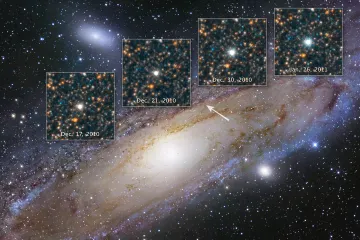
The classic example of a standard candle is the Cepheid variable star. [1] These are specific types of luminous, giant stars that pulsate, getting brighter and dimmer in a regular cycle. [1] Crucially, the period of this pulsation—how long it takes to complete one cycle—is directly linked to the star’s true luminosity. [1] By measuring the star’s pulsation period, astronomers determine its absolute brightness, then compare it to its observed apparent brightness to find the distance. [4] Cepheids are bright enough to be seen in relatively nearby galaxies, allowing astronomers to bridge the gap between local stellar measurements and extragalactic ones. [1]
# Measuring Far Galaxies
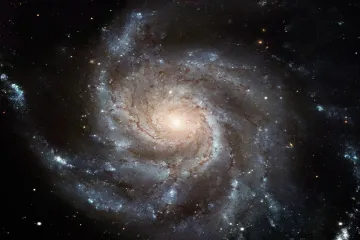
For distances extending across entire galaxies or even across the observable universe, Cepheids become too faint to detect reliably. We need something intrinsically much brighter. This brings us to the realm of massive stellar explosions: Type Ia supernovae. [7]
These events are not random; they happen when a white dwarf star in a binary system siphons material from its companion until it hits a specific critical mass, triggering a runaway thermonuclear explosion. [7] Because this triggering mechanism is highly standardized, the resulting explosions possess a remarkably consistent peak absolute luminosity. [7] If you could witness one of these explosions from a galaxy tens of millions of light-years away, it would briefly outshine the entire host galaxy, making it an excellent beacon for measuring immense distances. [8]
It is fascinating to compare the two main standard candle methods: a Cepheid is a long-lived, repeating beacon that allows for repeated measurements over time, whereas a Type Ia supernova is a one-time, cataclysmic event that provides a single, massive flash of distance information. [1][7] The utility of the Type Ia supernova is that its incredible brightness allows it to calibrate the next, highest rung of the ladder, extending our reach further than the pulsating stars can manage. [8]
If we consider the sheer scale, parallax measures distances in hundreds or thousands of light-years; Cepheids extend this reach to tens of millions of light-years away; and Type Ia supernovae can provide usable measurements for galaxies that are billions of light-years distant. [1][7]
# Cosmic Expansion
For the most distant objects, the light itself tells the story of distance through its stretching—a phenomenon known as cosmological redshift. [5] Edwin Hubble discovered that nearly all galaxies are moving away from us, and the farther away a galaxy is, the faster it recedes. [5] This recession speed is observed as a redshift in the galaxy's light spectrum; the light waves are stretched out as the galaxy moves away, shifting their color toward the red end of the spectrum. [5]
This observation forms Hubble’s Law, which mathematically relates the recession velocity () to the distance () via the Hubble Constant (): . [5][8] If we can accurately measure the redshift (), we can calculate the velocity (), and if we know the current value of the Hubble Constant (), we can determine the distance (). [5] The challenge here shifts from measuring light intensity to measuring spectral line shifts, but more importantly, it requires an accurate value for , which must, in turn, be calibrated using the lower rungs of the distance ladder (like Type Ia supernovae) whose distances were determined independently. [6][8]
# The Ladder's Integrity
The entire structure of cosmic distance measurement hinges on the initial calibration of the lowest rungs. The geometry provided by parallax establishes the true distance scale for nearby stars. [9] These stars are then used to determine the true absolute luminosity of the nearest Cepheids. [1] Those calibrated Cepheids, in turn, are used to measure the distances to galaxies containing Type Ia supernovae, establishing their absolute brightness. [7] Finally, the calibrated supernovae provide the anchors needed to determine the precise value of the Hubble Constant, which then allows us to calculate the distances to the most remote galaxies we can observe. [5][6]
It is this sequential reliance that makes the ladder so powerful, but also so vulnerable. If, for instance, the parallax measurements that set the scale for the very first stars were systematically off by just five percent, that five percent error would propagate and compound up every successive rung. An error of five percent at the bottom could translate into an error of ten or twenty percent for the most distant quasars whose distances are inferred solely via the Hubble constant calibrated by supernovae whose distances were calibrated by Cepheids whose distances were calibrated by parallax. [3] This inherent dependence means that advancing measurement technology at the lowest rung—improving parallax measurements—yields dividends for the maximum observable distance in the entire universe.
#Videos
How Scientists Measure The Distance To Stars and Galaxies
Related Questions
#Citations
How do astronomers measure distances to stars and galaxies?
How are astronomers able to measure how far away a star is?
How Scientists Measure The Distance To Stars and Galaxies
How do scientists measure the distance between stars and galaxies ...
Far, Far Away: Just How Distant Is That Galaxy?
[PDF] Explanation of the cosmic distance ladder
Measuring the Distance to the Far Side of the Galaxy
How do we calculate distances to other galaxies?
Stellar Parallax - Las Cumbres Observatory