What is the dust and gas between stars in a galaxy called?
The space between stars, once thought to be a perfect, silent void, is in reality populated by a diffuse, yet essential, component of any galaxy. This cosmic substance, consisting of both gas and microscopic solid particles, is formally known as the Interstellar Medium (ISM). To an observer on Earth, the galaxy appears overwhelmingly dominated by the brilliant pinpricks of stars, suggesting that the gulfs separating them must be virtually empty. However, the very fact that we can see light traveling vast distances across our galaxy implies that the matter present cannot be too dense, or it would absorb nearly all the starlight before it reached us. This “interstellar matter” fills the space between stars and, at a galaxy’s outer edge, gradually transitions into the even less dense intergalactic medium.
# Composition and Scale
The Interstellar Medium is overwhelmingly gaseous, with solid particles, or dust, making up only a small fraction of the total mass. Roughly 99% of the ISM’s mass is gas, while the remaining 1% is solid dust. This composition is not random; it directly mirrors the overall makeup of the galaxy itself. The gas component is dominated by the two lightest elements created during the Big Bang: hydrogen and helium. Together, these elements account for about 98% of the ISM’s mass. The remaining 2% of the gas consists of heavier elements like carbon and oxygen, which are forged inside stars and later dispersed into space when those stars die.
The dust grains, though minute in mass, are chemically complex. They are generally composed of rock-like silicates or graphite cores, often covered in mantles of various ices, such as water, methane, and ammonia. These particles are incredibly small, typically measuring 500 nanometers or less in diameter. To put their scarcity into perspective: a cubic meter of interstellar space might contain only a few dust motes, a density so low that it is less than the best vacuum achievable in laboratories on Earth. For instance, the air we inhale contains approximately molecules per cubic centimeter, whereas the lowest-density regions of the ISM have only about $0.1$ atoms per cubic centimeter.
Despite this extreme rarefaction, the sheer volume of space within a galaxy like the Milky Way means the total mass of the ISM is substantial. Astronomers estimate that the total mass of gas and dust in our galaxy equals about 10 to 20% of the total mass contained within its stars. For the Milky Way, this translates to a reservoir of raw material equivalent to about 10 billion times the mass of our Sun. This enormous reservoir is constantly cycling, providing the necessary ingredients for future stellar generations.
# ISM Phases
The Interstellar Medium is not uniform; it exists in several distinct physical states, or phases, characterized by dramatic differences in temperature and density. This variation is one of the most fascinating aspects of studying the ISM, as the conditions range from near absolute zero to tens of thousands of degrees. The gas and dust are distributed unevenly, much like water vapor congregating into clouds in Earth’s atmosphere.
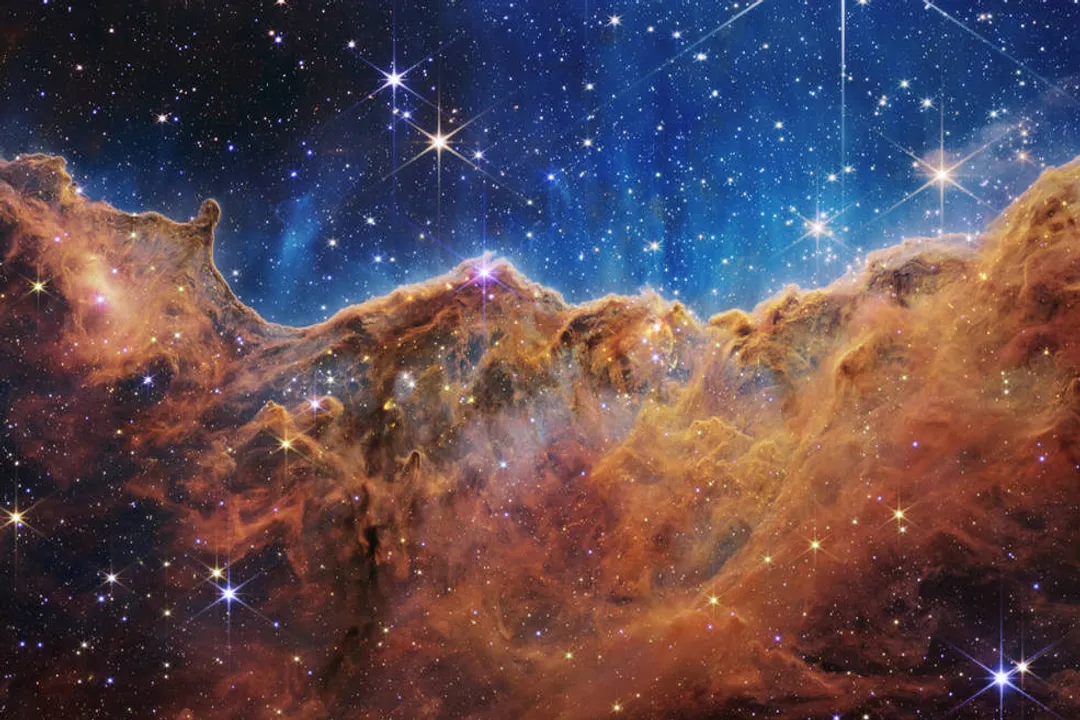
Approximately half of the total interstellar gas mass is concentrated into dense clouds, often called nebulae, which occupy only about 2% of the galaxy’s volume. Within these dense regions, the gas pressure must remain comparable to the surrounding, much hotter gas for the clouds to remain gravitationally bound and not instantly dissipate.
Here is a summary contrasting the major phases of the ISM, based on typical conditions found in the plane of the Milky Way:
| Constituent | Typical Temperature (Kelvin) | Approximate Density (atoms/cm$^3$) | Primary Location/Observation |
|---|---|---|---|
| Coronal Gas | or lower | Diffuse, heated by supernova explosions | |
| Atomic Hydrogen (HI) | $1 - 100$ | Everywhere; best seen via radio line | |
| Molecular Clouds () | $10^3 - 10^5$ or higher | Star-forming regions (Dark Nebulae) | |
| Dust Grains | N/A (1% of total mass) | Everywhere; observed via light absorption/emission |
The hottest component is the Coronal Gas, found in vast regions between the denser clouds, reaching temperatures between one million and ten million Kelvin. This extreme heat is primarily a result of energy injected by massive star explosions (supernovae).
The less dense, but more volumetrically dominant, gas is often categorized as Diffuse Interstellar Gas, primarily neutral atomic hydrogen (). This gas typically hovers around and has densities ranging from one to a hundred atoms per cubic centimeter. We primarily detect this gas through its characteristic radio emission line.
At the opposite extreme are the Molecular Clouds, the coldest and densest structures. Temperatures here can plummet to as low as —colder than midnight on Pluto. Even at their peak density, they are vacuums by terrestrial standards, but they hold about 50% of the total interstellar gas mass because they are so much denser than the diffuse gas. Most of this hydrogen is molecular (), chemically bonded, as opposed to the neutral atoms () found in warmer regions. These clouds are also chemically rich, containing hundreds of different molecules, identified via their unique radio and infrared emission lines, such as carbon monoxide ().
# Seeing the Invisible
Given the low density, how can astronomers map and study this material? The ISM reveals itself through its interaction with the electromagnetic radiation produced by stars. These interactions create the luminous clouds we call nebulae.
# Interacting with Light
Three primary forms of interaction define how we observe the ISM:
- Emission Nebulae: These are hot, ionized clouds, often found surrounding young, massive stars with surface temperatures in the tens of thousands of degrees. The intense ultraviolet light from these stars excites the gas, causing it to glow brightly, often displaying the characteristic red spectral line of hydrogen (as seen in parts of the Orion Nebula).
- Dark Nebulae: These are dense, cold clouds rich in dust. The dust concentration is so high that it becomes opaque, effectively blocking the visible light from all the stars situated behind it, creating a dark silhouette against the starfield. A classic example is Barnard 86.
- Reflection Nebulae: These clouds are composed of dust surrounding a star but are not dense or hot enough to glow themselves. Instead, the dust scatters the star’s light toward us. Because the individual dust grains scatter shorter, bluer wavelengths of light much more efficiently than longer, redder wavelengths, these nebulae always appear vividly blue (the Pleiades are a famous example). By the same logic, stars viewed through a dust cloud will appear redder because the blue light has been scattered away from our line of sight.
This wavelength-dependent scattering is known as extinction, which dims a star's apparent brightness, and reddening, which shifts its observed color toward the red end of the spectrum.
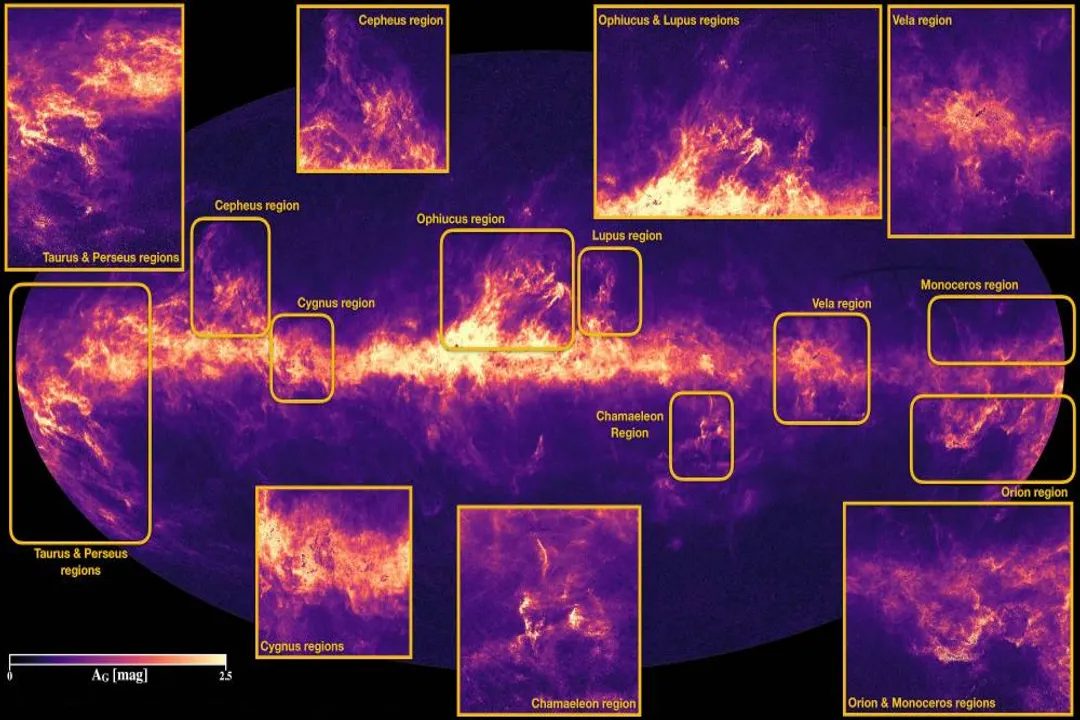
The European Space Agency’s Gaia mission has dramatically advanced our ability to map this extinction in three dimensions across the Milky Way by precisely measuring the distance and color of hundreds of millions of stars. Furthermore, Gaia has measured Diffuse Interstellar Bands (DIBs)—specific absorption features in the starlight that astronomers attribute to organic molecules in the ISM. The correlation between DIB strength and extinction gives astronomers clues about the mixture of gas and dust along any given line of sight.
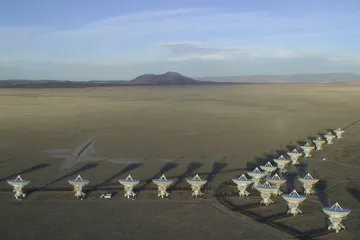
It is important to note that the concept of "darkness" is relative. While a dark nebula is opaque to visible light, it is often luminous in the infrared spectrum, as the dust absorbs starlight and re-radiates that energy as heat. To fully grasp the structure of the ISM, astronomers must use multiple wavelengths, moving from optical to radio to infrared observations.
# Star Birth and Galactic Recycling
The Interstellar Medium is far more than just empty space or pretty clouds; it is the nursery of the galaxy. The densest molecular clouds are the sites where gravity finally overcomes the internal pressure, causing a region to collapse and eventually form a new star and its surrounding planetary disk.
Once stars form, they begin the process of enriching and conditioning the ISM in turn. Massive stars conclude their lives in spectacular supernova explosions, scattering heavy elements—the products of their nuclear fusion—back into the galactic environment. These elements then become incorporated into new generations of dust grains and gas molecules, seeding the next cycle of stellar birth.
Consider the sheer difference between the dense stellar core and the surrounding medium. A star is incredibly compact, yet the space it occupies is minuscule compared to the surrounding environment. If all the ISM gas in the Milky Way were perfectly spread out, every cubic centimeter would contain less than one atom. This constant exchange—stars consuming the ISM to live, and dying to replenish it—is the engine of galactic evolution.
One subtle but vital role played by the dust component that is often overlooked is its capacity for shielding. In the extremely tenuous gas phase, molecules are easily torn apart by the harsh ultraviolet radiation emitted by nearby hot stars. Dust grains, however, are excellent absorbers of this UV radiation. As a dust grain absorbs this high-energy light, it shields any molecules—including complex ones vital for prebiotic chemistry—that might be clinging to its surface or hiding immediately behind it in the cloud's core. This protective blanket allows chemical complexity to persist in the dark heart of a molecular cloud, providing a necessary, stable environment for the earliest stages of planetary material to assemble before the protostar fully ignites.
The ISM, therefore, represents the continuous cosmic memory of a galaxy. It holds the ashes of dead stars, the raw material for new ones, and the chemical building blocks that will ultimately form planets and perhaps, life. Understanding its structure, density variations, and chemical signatures, as mapped by missions like Gaia, provides a critical timeline for the physical history and ongoing life of the Milky Way.
Related Questions
#Citations
What Is a Nebula? | NASA Space Place – NASA Science for Kids
Scientists Say: Interstellar medium
What is in between the stars? - Gaia - ESA Cosmos
The Interstellar Medium – MCC AST - Maricopa Open Digital Press
Lecture 11: Interstellar Medium
1. interstellar gas and dust - JILA