Why do Reflection Nebulae, composed of dust surrounding a star, characteristically appear vividly blue?
Answer
Dust grains scatter shorter, bluer wavelengths of light more efficiently
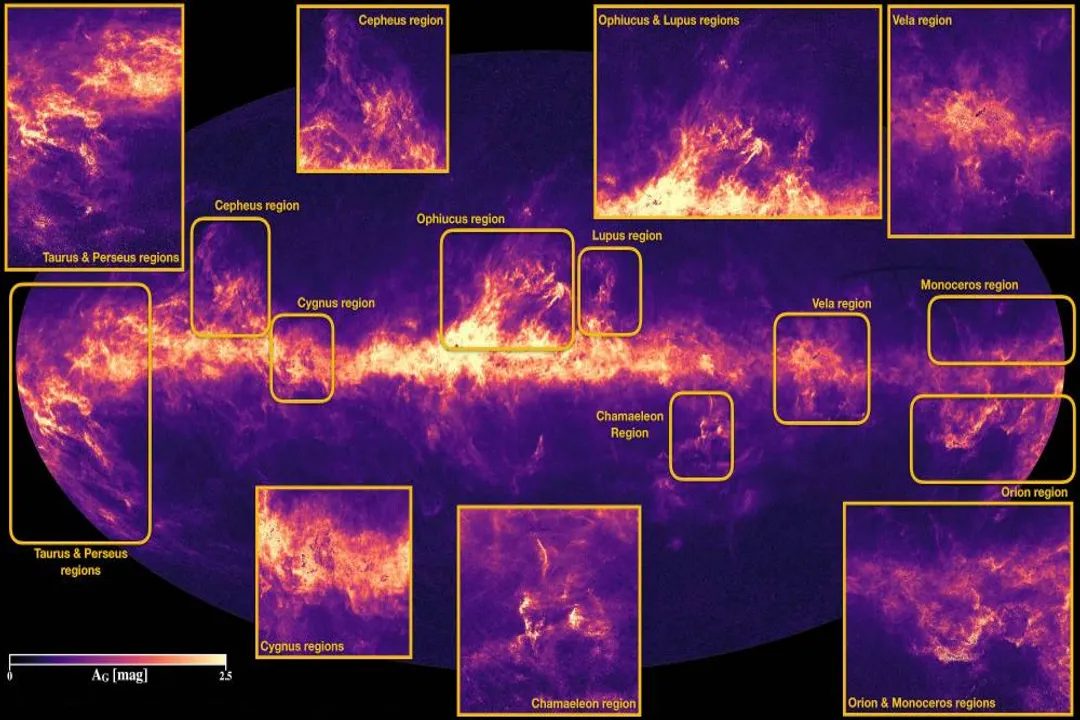
Reflection Nebulae are formed by dust surrounding a star that is neither hot enough nor dense enough to emit its own visible light. Instead, the light from the nearby star is scattered toward the observer by the interstellar dust grains. This scattering is not uniform across all wavelengths; it is highly dependent on the size of the particles. Shorter wavelengths, corresponding to blue light, are scattered much more effectively by these minute dust grains than longer, redder wavelengths. This preferential scattering causes the nebula to be illuminated with a distinct blue hue, a process related to extinction and reddening.
Related Questions
What percentage of the Interstellar Medium’s total mass is attributed to solid dust grains?What two light elements account for approximately 98% of the total mass within the ISM gas component?What is the hottest major phase of the ISM, reaching temperatures between $10^6$ and $10^7$ Kelvin?What percentage of the total interstellar gas mass is concentrated within dense structures known as Molecular Clouds ($ ext{H}_2$)?Why do Reflection Nebulae, composed of dust surrounding a star, characteristically appear vividly blue?Which specific emission line is primarily used by astronomers to detect the presence of neutral atomic hydrogen ($ ext{HI}$)?How does the density of the lowest-density regions of the ISM compare to the density of air we inhale?What vital protective function does the dust component of the ISM provide within molecular clouds?What is the term used for the phenomenon where interstellar dust dims a star's apparent brightness due to wavelength-dependent scattering?Which European Space Agency mission has advanced the 3D mapping of extinction and measured Diffuse Interstellar Bands (DIBs)?