What determines the color of stars?
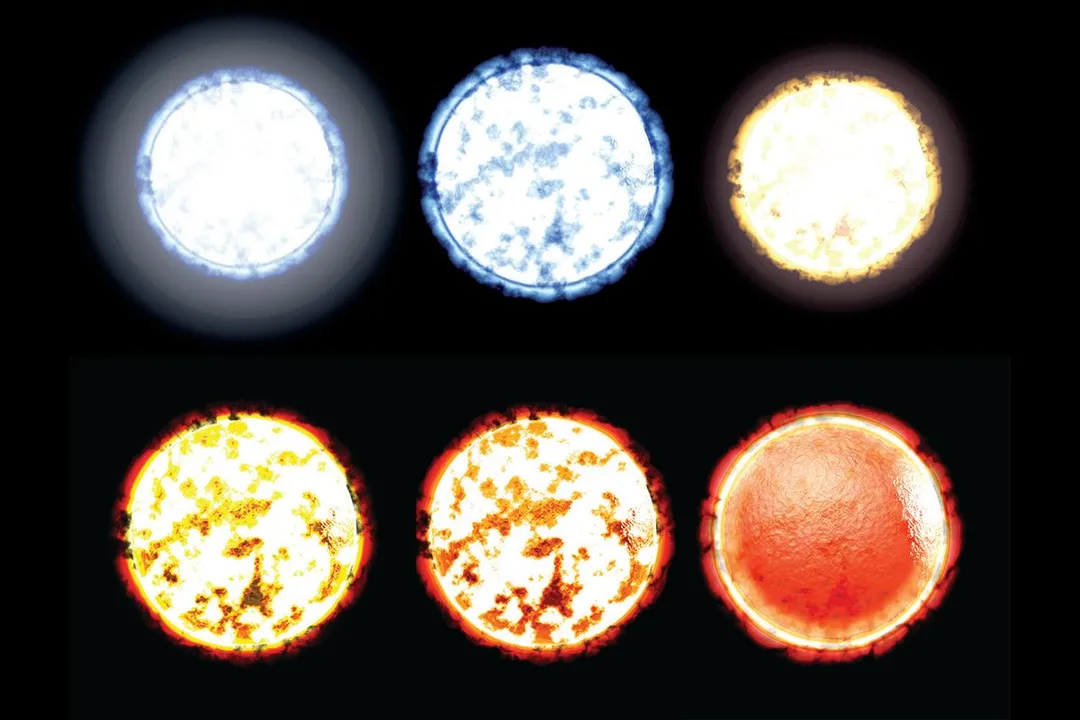
The varied colors splashing across the night sky, from the deep crimson of a distant giant to the sharp blue-white of a young, massive star, are far from random. These hues are not illusions created by distance or atmospheric tricks, though those elements play a small part. Fundamentally, a star’s perceived color is a direct and precise indicator of its surface temperature. This principle is rooted in physics, specifically how hot objects radiate energy across the electromagnetic spectrum, a behavior often described by black-body radiation.
When you heat a piece of metal, you witness this in miniature: it first glows a dull red, brightens to orange, then yellow, and if it could get hot enough without melting, it would progress toward blue and eventually appear intensely white. Stars follow this exact progression. Cool stars, those with surface temperatures around 3,000 Kelvin (K), radiate most intensely in the long, redder wavelengths, appearing orange or deep red. Conversely, the hottest stars, which can exceed 40,000 K, peak in the short, blue wavelengths, radiating significant energy into the ultraviolet region. The color we see is simply where the star emits the most light within the narrow band our eyes detect.
# Surface Heat
The relationship is absolute: hotter equals bluer, cooler equals redder. This isn't merely an aesthetic quality; it speaks to the engine inside. A star’s temperature is almost entirely dictated by its mass. More massive stars sustain far higher core pressures and fusion rates, resulting in much higher surface temperatures and, consequently, a blue or blue-white appearance. Lower-mass stars burn more slowly and cooler, leading to their reddish hue.
Consider a few benchmarks. Our own Sun, with a surface temperature hovering around 6,000 K, emits its peak radiation in the green portion of the visible spectrum. However, it does not look green to us. The Sun is so energetic that its light output is strong across the entire visible spectrum—red, green, and blue are all emitted with high intensity—so our eyes integrate this mixture and perceive the star as white. If we could view the Sun from space, away from the filtering effects of our atmosphere, it would clearly shine white. From Earth’s surface, the atmosphere preferentially scatters the shorter, bluer wavelengths, leaving the transmitted beam slightly richer in the longer, redder wavelengths, which is why the Sun appears somewhat yellow to us.
At the extremes, we see giants like the red supergiant Betelgeuse, which has a relatively cool surface of about 3,700 K, causing it to peak in the red and appear orange. On the hot end, stars like Spica, classified as blue-white, possess temperatures in excess of 25,000 K.
| Intrinsic Color | Approximate Temperature (K) | Example Star | Stellar Type Range |
|---|---|---|---|
| Blue | 25,000 – 40,000+ | Spica, Sirius (9,400 K) | O, B |
| White | ~10,000 | Vega | A |
| Yellow-White | ~6,000 | Sun | G |
| Orange | ~4,000 | Aldebaran | K |
| Red | 2,000 – 3,500 | Betelgeuse (3,400 K) | M |
# Color Indices

While we can visually categorize stars, astronomers require far more precision than simple color names. Because the actual measured quantity is the brightness of the star through specific color bands, they have devised systems to quantify color directly from these measurements. This process involves using standardized filters, commonly U (ultraviolet), B (blue), and V (visual, corresponding roughly to yellow/green light).
The key metric derived from this is the color index, most famously the B–V index. This index is calculated by subtracting the magnitude (brightness value) measured through the V filter from the magnitude measured through the B filter (). Because the magnitude scale is inverted—smaller numbers mean brighter objects—the interpretation is crucial:
- If is a large positive number (e.g., +2.0), the star is much brighter in the V (yellow/red) filter than the B (blue) filter, meaning it is cool and red.
- If is a small or negative number (e.g., -0.4), the star is brighter in the B (blue) filter than the V filter, meaning it is hot and blue.
By convention, a star like Vega, with a surface temperature of about 10,000 K, is set to have a zero color index (). The Sun, being cooler than Vega, has a positive index of about +0.65. This mathematical approach allows astronomers to make statements based on directly measurable photometric data, which then reliably translates to intrinsic surface temperature.
# Stellar Classification

Temperature, as revealed by color, is the foundation of stellar classification, which organizes stars from the hottest to the coolest using letters: O, B, A, F, G, K, M. Type O stars are the hottest and most blue, while Type M stars are the coolest and most common, often appearing red. This sequence isn't arbitrary; each letter class is further subdivided using numerals (0 to 9, where 0 is hotter).
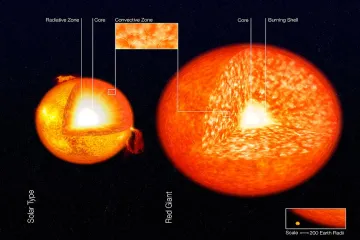
Crucially, color alone doesn't tell the whole story of a star's life. A spectral type (like G2) only defines temperature and luminosity class (like V for main sequence) further refines the star's physical state. For instance, a cool star—say, one with a temperature of 3,500 K—could be a faint red dwarf (a small, main-sequence M star) or a truly colossal red supergiant like VY Canis Majoris. Both are red because their surfaces are cool, but their sizes and total energy output are vastly different. Stellar evolution ensures that a star's color changes over its lifetime; a star will shift from its main sequence color (e.g., yellow for the Sun) into a red giant or supergiant phase as it ages.
# Perception Limits
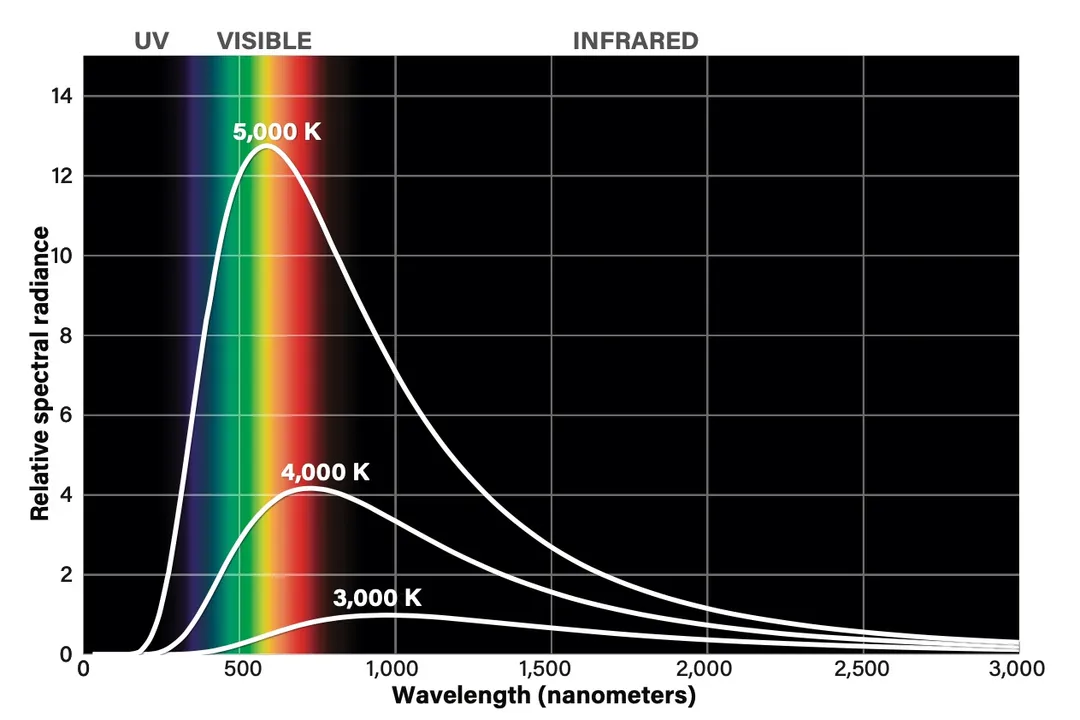
While the physical source of the color is temperature, how we see that color is a biological outcome. The reason we see stars in a rainbow of colors but miss two crucial extremes—green and violet—lies in the structure of the human eye and the physics of the star’s emission curve.
Our eyes possess rods (for brightness) and cones (for color). At the low light levels provided by most stars, the cones are not sufficiently activated, so even if a faint star is physically blue, we perceive it as white because only the rods are registering its presence. This explains why only the brightest stars reveal any noticeable tint to the unaided eye.
The issue with green stars relates back to the Sun being a 'green' star (peaking in green but emitting all visible light). Because our visual system has evolved under the Sun’s broad, near-white output, we do not register any stellar peak in the green as pure green; instead, the presence of strong blue and red light washes out that peak perception. For extremely hot, blue-white stars, the emission spectrum drops off so steeply at the short-wavelength end that there isn't enough violet light to register separately; the mix of dominant blue with other visible wavelengths results in a blue or blue-white appearance rather than pure violet.
# Observing Contrast
When aiming to see stellar color visually, two practical factors become important: Earth’s atmosphere and the limitations of human vision. The atmosphere causes the familiar twinkling effect, which can sometimes make a star briefly flash different hues as the light path is distorted.
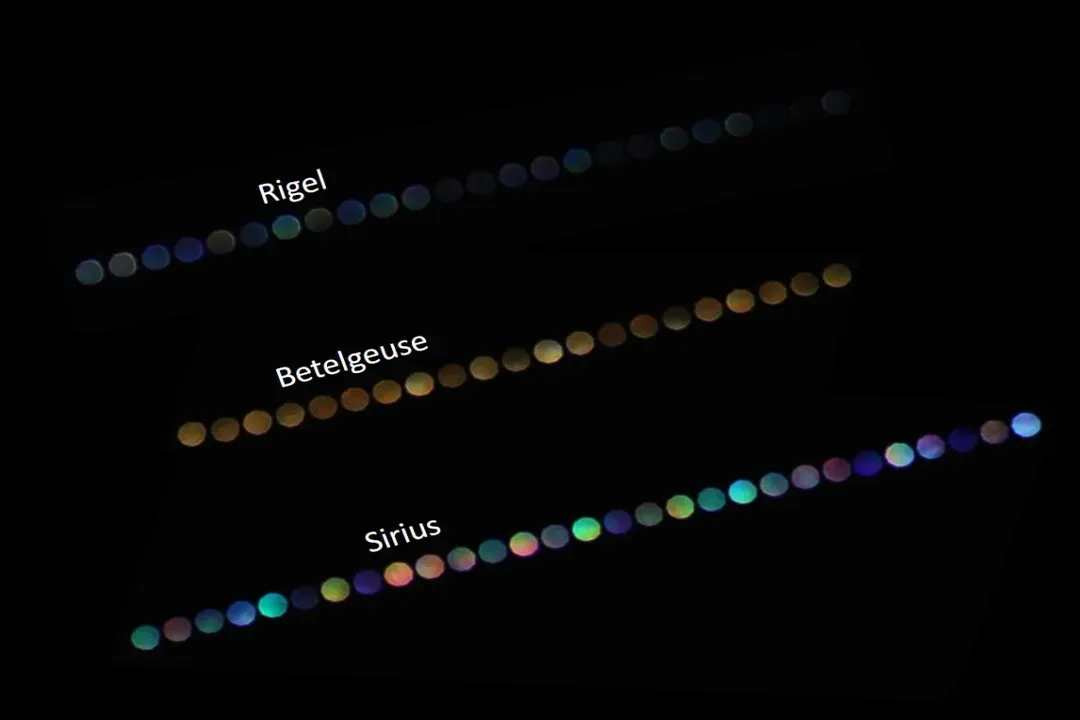
To maximize the chance of seeing intrinsic color, one must seek dark skies and allow their eyes about an hour to become fully dark-adapted so the color-sensitive cones have the best chance of activating. Furthermore, if you use a telescope, intentionally de-focusing the image slightly transforms the star’s light from a pinpoint source into a small, colored disc, which can dramatically enhance the perception of its hue against the dark background. For truly striking visual confirmation of the temperature-color link, look for binary star systems that exhibit distinct colors, such as Albireo (Beta Cygni), which clearly separates into a glowing orange star and a blazing blue star, providing an immediate side-by-side comparison of vastly different surface temperatures.
#Videos
The Colors of Stars - YouTube
Related Questions
#Citations
Magnitude and Color - Las Cumbres Observatory
What gives stars their colors? - Astronomy Magazine
Colors of Stars | Astronomy - Lumen Learning
What factors dictate the color of stars? : r/askscience - Reddit
What Determines a Star's Color? - Slooh
Star colours explained for beginners | BBC Sky at Night Magazine
The Colors of Stars - YouTube
Measuring the Color of Stars - HunterLab Horizons Blog