What determines how a star evolves and how fast it burns fuel?
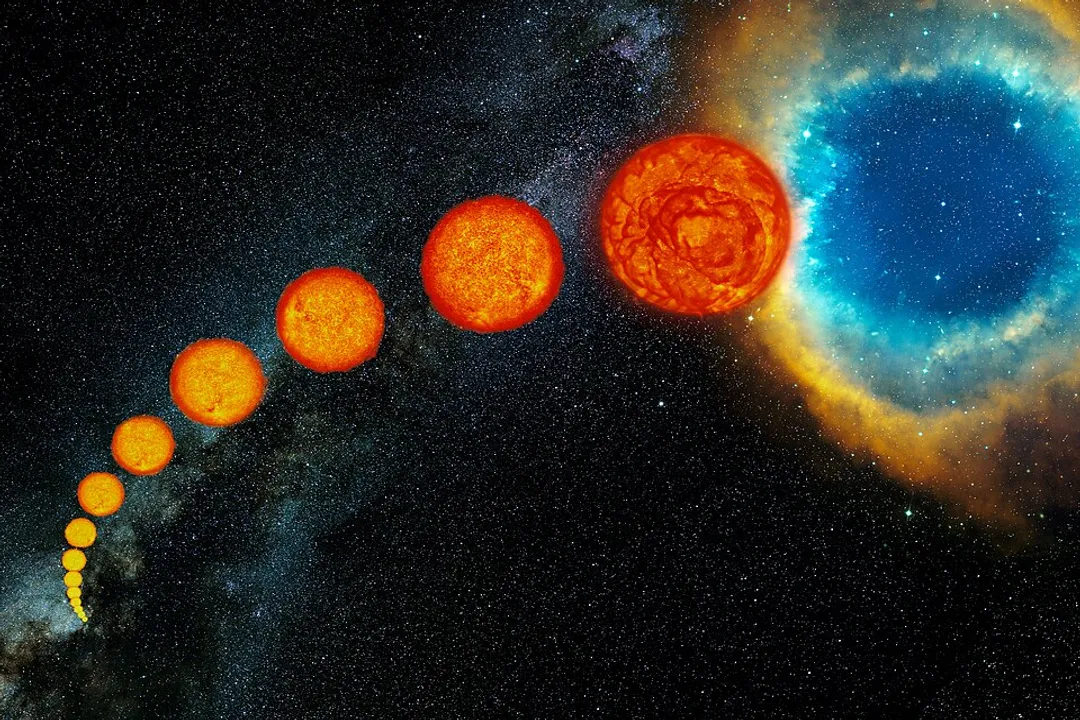
The destiny of any star, from its fiery birth to its final, cold state, is dictated almost entirely by one fundamental property: its mass. This initial mass sets the stage, determining not only how long the star will shine but also the precise pathway it takes through its stellar evolution, including the startling speed at which it consumes its nuclear fuel.
# Birth Cloud
Every star begins its existence within the cold, vast expanses of interstellar space, housed in enormous clouds of gas and dust called molecular clouds or nebulae. These stellar nurseries can be immense, sometimes spanning hundreds of light-years and holding the mass equivalent of up to six million Suns. Within these clouds, the gas clumps together, and as these fragments grow, their self-gravity intensifies. Friction caused by this continuous gravitational collapse heats the material, leading to the formation of a protostar, a baby star shrouded in dust. This initial phase is often accompanied by dynamic activity, such as T Tauri stars, which show variability linked to the accretion of surrounding material. Some young variables, known as FU Orionis stars, experience extreme brightening due to rapid accretion, while others, UX Orionis stars, dim when orbiting clumps of dust temporarily eclipse the protostar.
# Core Ignition
The development of a protostar continues until its mass is sufficient to initiate the universe’s defining stellar process: nuclear fusion. For a star to officially begin its life as a shining entity, its core must achieve incredible temperatures—about 10 million kelvin—to force hydrogen nuclei to fuse together, creating helium. This conversion of mass into energy, following , releases a massive outward pressure.
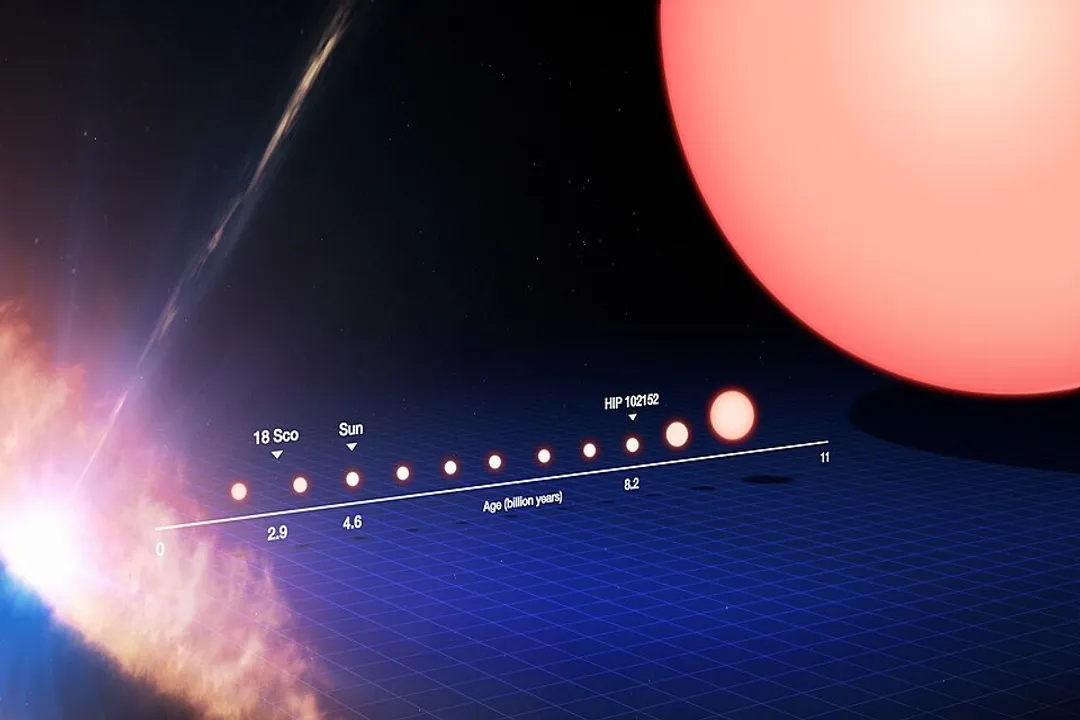
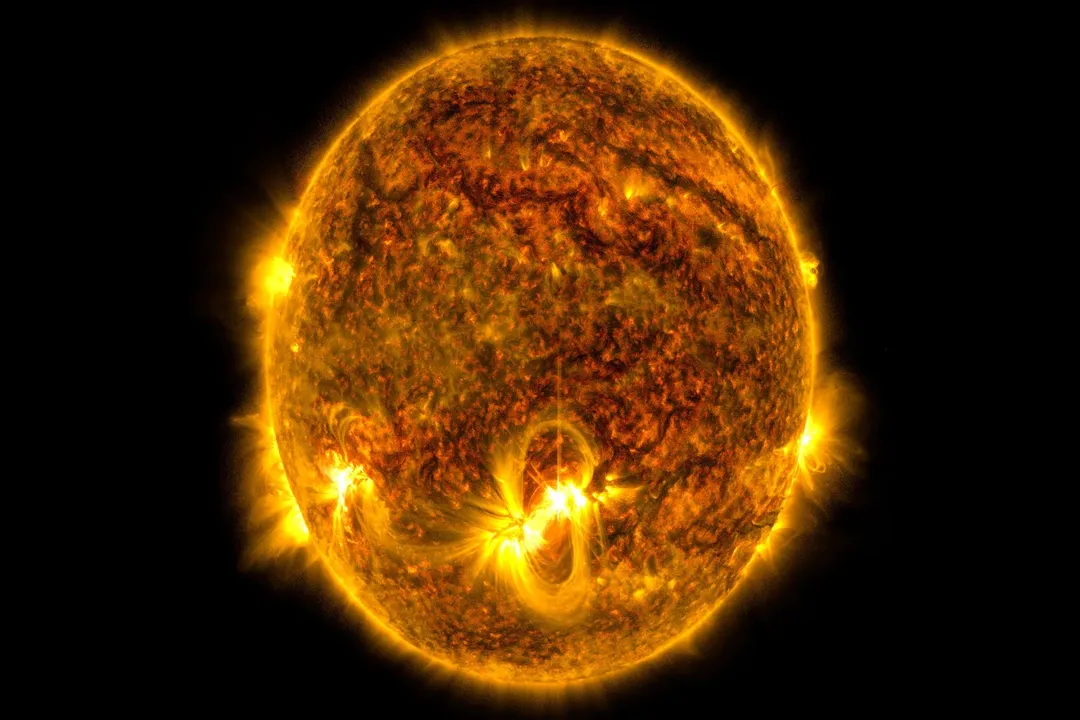
This outward pressure finds itself in a tug-of-war with the star’s inward crush of gravity. When these forces achieve hydrostatic equilibrium, the star stabilizes and settles onto the main sequence. This stable phase, where the star fuses hydrogen into helium in its core, is the longest part of its life. Our own Sun, a yellow dwarf star, is currently in the middle of this phase, expected to spend about 10 billion years here.
# Main Sequence Life
During the main sequence, the star’s structure is maintained by this careful balance. If the core cools slightly, gravity compresses it, increasing the temperature and pressure, which in turn speeds up the fusion rate until the original balance is restored, albeit at a slightly smaller size. This self-regulating mechanism ensures the energy output remains relatively steady. The interior of a main sequence star is structurally divided into a central nuclear burning core, a surrounding convective zone, and often a radiative zone, depending on the star's mass.
# Fuel Consumption Physics
While the Sun will last for nearly 10 billion years, the lifespan of other stars varies drastically based on their mass. Stars that are much less massive than the Sun might endure for hundreds of billions or even trillions of years, outliving the current age of the universe. Conversely, the most massive stars, categorized as giants or supergiants, live hard and die young, sometimes lasting only a few million years.
The crucial factor is the rate of fuel consumption, which is not linear but escalates sharply with mass. A more luminous star can release energy at a rate thousands of times greater than the Sun, and while it has more fuel available, gravity compresses its interior to much higher temperatures and pressures. This leads to fusion rates that increase far more steeply than the star’s added mass might suggest.
A key aspect that contributes to this effect is the relative size of the burning volume within the star. For larger stars, the cube of the radius (scaling volume and gravitational compression) outpaces the square of the radius (scaling surface area). This means a greater percentage of a high-mass star’s total material is located within the highly compressed, hot regions capable of fusion compared to a lower-mass star. Thus, more of its fuel is actively participating in fusion at any given moment, dramatically shortening its tenure on the main sequence, much like a more powerful engine in a car consumes its limited fuel supply much faster than an economy model.
# Changing Fuel
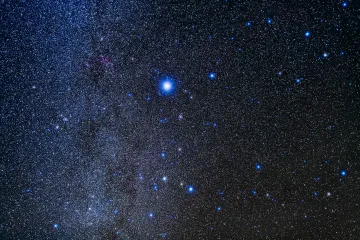
The main sequence ends when the hydrogen fuel in the core is exhausted, replaced by inert helium "ash". The core contracts under gravity, heating up. This triggers hydrogen fusion to begin in a shell surrounding the helium core, causing the star to leave the main sequence, expanding and cooling into a red giant or red supergiant.
What happens next is dictated by the core's mass:
Low-to-Mid Mass Stars (like the Sun): These cores do not become hot or dense enough to fuse the helium, or they only manage it briefly. For stars around the Sun's mass, helium fusion ignites suddenly in a helium flash, powering the star briefly before it moves to the horizontal branch. After consuming the core helium, fusion continues in shells around an inert carbon/oxygen core, leading to the Asymptotic Giant Branch (AGB) phase. These stars are extremely luminous because the shell burning is close to the surface, causing the star to swell to enormous sizes, sometimes larger than Mars’ orbit.
High-Mass Stars (): These stars have enough gravitational squeeze to ignite progressively heavier elements in their cores—carbon, then neon, oxygen, and silicon—creating an "onion-like" structure of burning shells around an increasingly dense core. This rapid, layered fusion process is quick; the entire sequence from carbon burning to an iron core can take just a few hundred years.
# Giant Endings
For lower-mass stars, the endgame is characterized by dramatic mass loss. After the AGB phase, insufficient mass remains to ignite further fusion past carbon and oxygen. The star sheds its swollen outer layers, forming a glowing shell of gas known as a planetary nebula. This spectacular event reveals the extremely hot, small core, which cools over billions of years to become a white dwarf. White dwarfs are Earth-sized but sun-massed objects, supported against further collapse by electron degeneracy pressure. They shine only from residual heat, eventually theorized to become cold, dark black dwarfs—though the universe is not old enough for any to exist yet.
The AGB phase is associated with highly variable stars like Mira variables, which pulsate over periods of 100 days or more and shed significant mass, enriching interstellar space with heavy elements.
# Super Heavy Fate
When the core of a truly massive star finally produces iron, the process halts catastrophically. Fusing iron consumes energy rather than releasing it, eliminating the outward thermal pressure that balanced gravity. The iron core collapses instantly until nuclear forces briefly halt the implosion, causing the infalling layers to rebound in a stupendous explosion known as a supernova. For a few months, this single event can outshine an entire galaxy.
The remnant depends on the core's final mass, constrained by the Chandrasekhar limit ( for electron degeneracy to fail):
- If the remnant core is less than about three solar masses, it becomes an ultra-dense neutron star—a city-sized sphere of packed neutrons resisting gravity via neutron degeneracy pressure. Some rapidly spinning neutron stars appear as pulsars due to periodic radiation beams sweeping past Earth.
- If the core exceeds this limit, gravity overwhelms even neutron degeneracy, leading to collapse into a black hole, an object with gravity so strong that light cannot escape its event horizon.
# The Binary Influence
Stellar evolution is generally determined by initial mass, but this path can be fundamentally derailed if a star exists in a close binary system. If two stars orbit closely, the larger star—as it expands into a giant—can exceed the Roche limit separating their gravitational domains. Matter then spills over, transferring mass onto its companion star, a process called accretion. Since mass is the primary driver of evolution, this mid-life injection of new material completely alters the recipient star’s predicted life track and final outcome. For example, mass transfer can push a white dwarf over the Chandrasekhar limit, turning its typical nova explosion into a far more energetic Type Ia supernova.
# Observational Snapshot
Since stellar lifetimes span millions or billions of years, we cannot watch a single star evolve from birth to death in real-time. Instead, scientists rely on constructing an evolutionary narrative by observing countless stars across the galaxy at various life stages, like assembling a narrative from thousands of snapshots of humans at different ages.
This is where variable stars become indispensable "experimental laboratories". Certain types, like Cepheid variables, pulsate with a period directly related to their true luminosity (the Period-Luminosity relation). When an observer measures the period of a distant Cepheid, they instantly know its absolute brightness. Combined with its measured apparent brightness, this relationship allows astronomers to calculate the star's distance, a measurement otherwise extremely difficult to obtain. Furthermore, by monitoring the subtle changes in the periods of stars like Mira variables over decades or centuries, researchers are able to catch evolutionary events, like thermal pulses, that happen on timescales much shorter than a millennium, providing direct evidence of post-main sequence changes that would otherwise only exist in computer simulations. This active observation, from T Tauri variables to pulsating white dwarfs, directly refines the computer models that underpin our understanding of these immense timescales.
Related Questions
#Citations
Star Basics - NASA Science
Stellar evolution - Wikipedia
Stellar Evolution - | The Schools' Observatory
Stellar Evolution - aavso
ELI5: why do stars last millions of years rather then burn through all ...
Burning Out Stars - stellar evolution - Astronomy Stack Exchange
Star - Formation, Evolution, Lifecycle | Britannica
Stellar Evolution: Main Sequence - University of Oregon
The Life Cycle of Stars | National Air and Space Museum