How to tell how fast a star is moving?
The movement of distant stars, measured in hundreds of kilometers per second, is not something we can observe directly by watching their points of light drift across the night sky over a few decades. Instead, determining stellar speed relies on a clever application of physics that analyzes the light reaching us, treating it as an extremely precise speedometer. This technique hinges on the Doppler effect, a phenomenon familiar from everyday life. [2][3]
The analogy often used involves sound: think about the pitch of an ambulance siren. As the vehicle speeds toward you, the sound waves are compressed, making the pitch higher; as it moves away, the waves stretch out, and the pitch drops. [3] Light behaves identically, but instead of affecting pitch, the motion alters the wavelength of the light itself. [1][3]
# Light Shift
When a star is moving away from Earth, the light waves it emits are stretched out, shifting their perceived wavelengths toward the longer, or redder, end of the electromagnetic spectrum. This is known as redshift. [1][5] Conversely, if a star is heading toward our planet, its light waves are compressed, shifting the wavelengths toward the shorter, or bluer, end of the spectrum—a phenomenon called blueshift. [1][5]
The crucial realization is that this shift isn't just a theoretical possibility; it is a measurable reality for nearly every star we observe. [3] The degree of this shift—how far the spectrum has moved from where it should ideally be—is directly proportional to the star's speed along our line of sight. [5] This speed is formally called the radial velocity. [3][5]
# Spectral Fingerprints
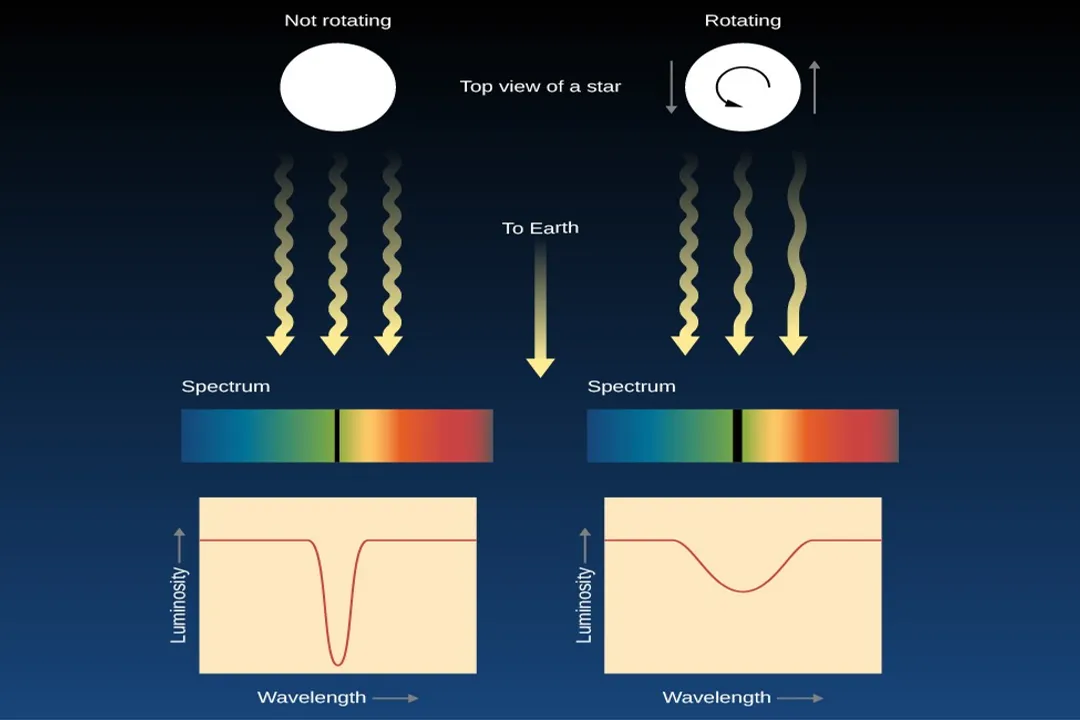
To measure this tiny shift accurately, astronomers need a fixed reference point. They find this by examining the star's spectrum. [5] A star's light, when spread out by a spectrograph attached to a telescope, reveals a continuous band of color crossed by dark lines. [3][5] These dark lines are absorption lines, created when cooler gases in the star's outer atmosphere absorb specific wavelengths of light unique to the elements present, like hydrogen or helium. [5]
Every element has a known, unique set of spectral lines when observed in a laboratory here on Earth, providing us with a precise "fingerprint" for that element. [5] For instance, the Balmer series of hydrogen creates specific lines at exact wavelengths if the source is stationary relative to the observer. [5]
When observing a distant star, the entire pattern of these absorption lines is shifted—all lines move together toward the red or blue end of the spectrum. [1][5] By comparing the measured wavelength () of a known line to its standard laboratory wavelength (), astronomers can calculate the fractional shift, , which then yields the radial velocity. [5] The newer, highly sensitive instruments attached to telescopes like the James Webb Space Telescope can detect these minuscule shifts with incredible precision. [1]
# Two Dimensions Motion
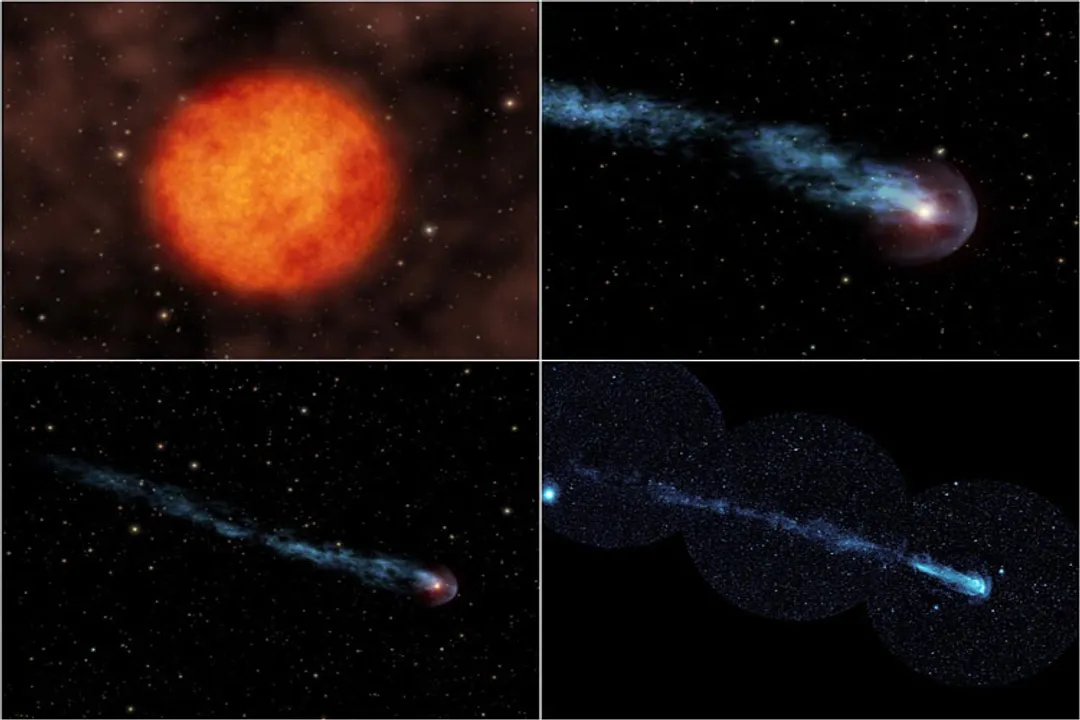
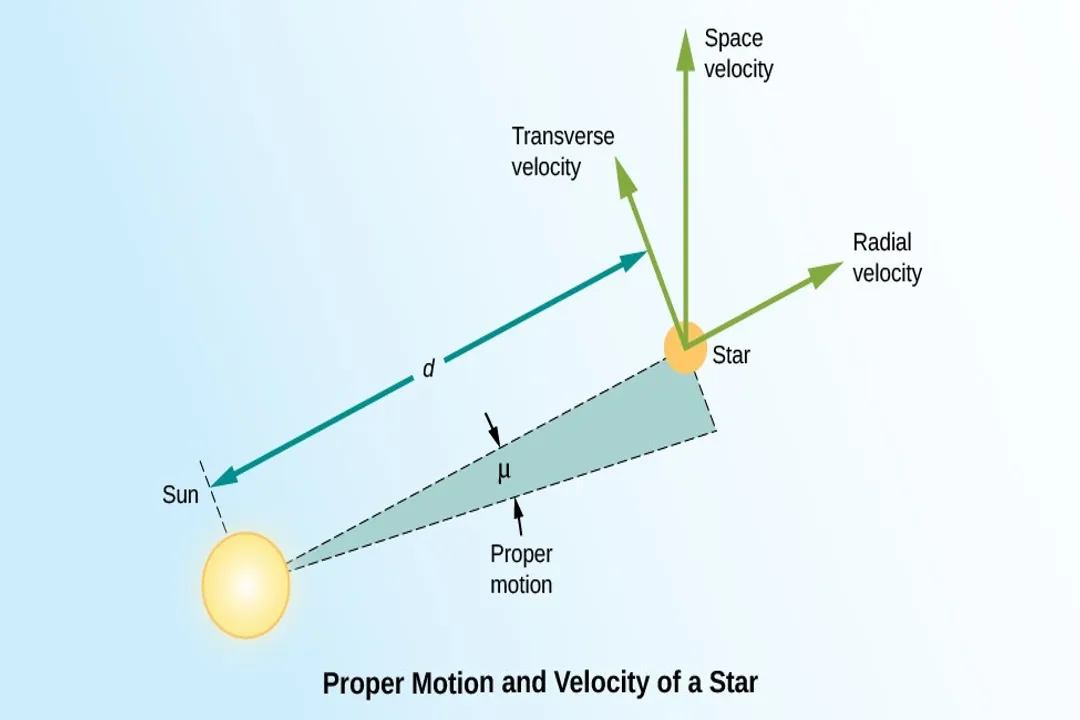
The Doppler measurement, while powerful, only tells us about motion directly toward or away from us—the line-of-sight speed. [3] A star could be zipping past us almost perpendicular to our line of sight, and its radial velocity would register as zero, even if it is moving incredibly fast transversely. [8] To determine the star's true speed in three dimensions, astronomers must measure two separate components of motion: the radial velocity (using the Doppler effect) and the transverse velocity (motion across our field of view). [8]
The challenge of measuring total velocity is compounded by the fact that our entire Solar System is also moving within the Milky Way galaxy. [8] Consequently, the measured radial velocity for any given star is actually its velocity relative to the Sun. [8] If we needed a velocity relative to the galactic center, further positional and velocity data for the Sun would have to be factored in, illustrating that all measured stellar motion is inherently relative to a chosen reference frame. [8]
# Tangential Speed Tracking
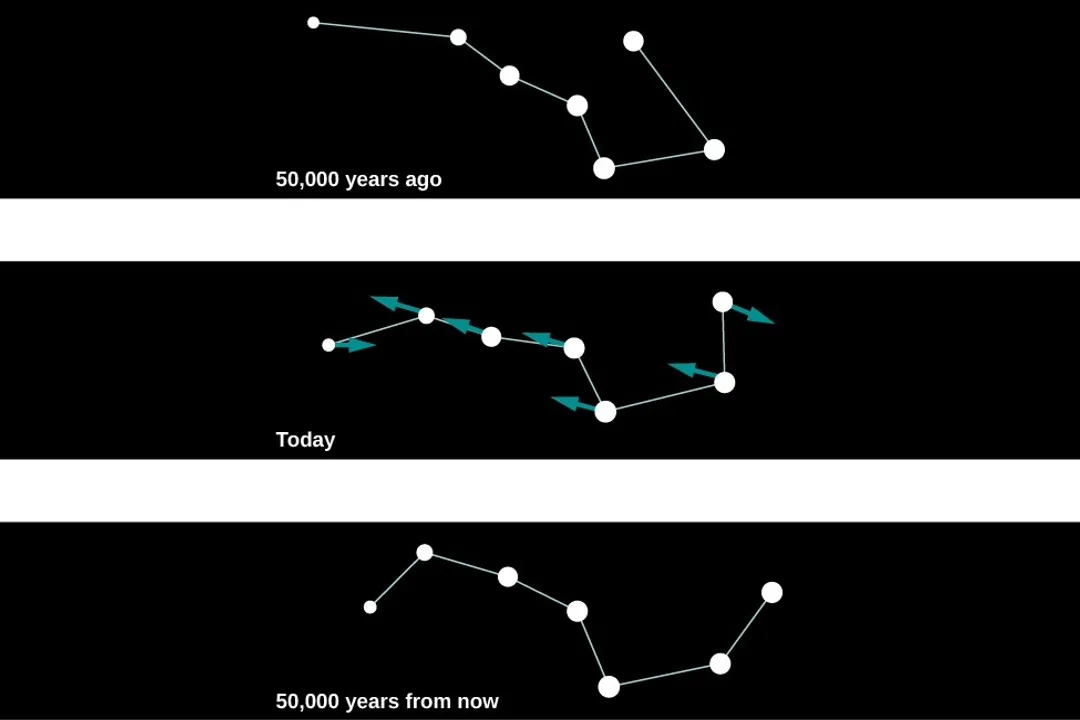
The second component, the velocity across the line of sight, is known as proper motion. [8] Unlike the instantaneous shift provided by the Doppler effect, proper motion must be determined over long periods. This requires taking highly accurate positional images of a star over many years, sometimes even decades. [8] Astronomers compare the star's position in the sky in an old photograph or catalog entry with its current position. [8] If the star has moved significantly relative to much more distant background objects (like distant galaxies or quasars that appear fixed), that angular change over time reveals its tangential speed. [8]
For nearby stars, proper motion can be significant, resulting in noticeable changes in their positions relative to constellations over centuries. For example, Barnard's Star is famous for having one of the largest measured proper motions in the sky. [8] The actual calculation involves converting the measured angular movement (usually in arcseconds per year) into a velocity using the star's known distance. [8]
# Total Velocity Synthesis
Once both components are quantified—the radial velocity () from the spectrum and the transverse velocity () from proper motion charting—the star's true, absolute speed through space can be calculated. [8] Since the radial motion (along the line of sight) and the transverse motion (perpendicular to the line of sight) are at right angles to each other, the total velocity () is found using the Pythagorean theorem:
This synthesis provides the complete picture of the star's current path and speed relative to our local celestial neighborhood.
# Measuring Accuracy
The precision with which we can measure these speeds varies greatly depending on the star's brightness, distance, and the quality of the observational equipment. [6] For very bright, nearby stars, astronomers can achieve astonishing accuracy in measuring radial velocity, sometimes determining the speed to within a few meters per second. [6]
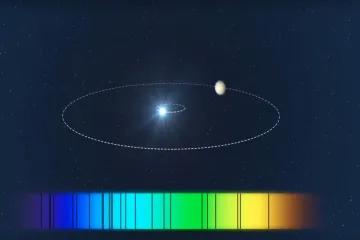
However, for proper motion, the timescale of observation is the limiting factor. A star moving relatively slowly across our line of sight may require many decades of observation before its angular shift is large enough to measure accurately, even with modern instruments. [8] Conversely, radial velocity changes can sometimes be monitored over a shorter period, especially if the star is part of a binary system where orbital motion causes regular, rapid shifts in the Doppler signature. [7]
It is interesting to consider that the measurements themselves are constantly being refined as reference catalogs improve. When astronomers measure the proper motion of a star, they are comparing its position against other stars believed to be stationary background objects. If those background stars also have small, uncataloged proper motions, the resulting calculated for the target star will be slightly off, an inherent uncertainty built into position-based astronomy that improves only as we better map the entire local stellar population. [8]
Furthermore, while the Doppler shift formula gives us the radial speed, the underlying assumption is that the star is a single point source whose emitted light is only affected by its own velocity. In reality, stellar features like starspots or flares can slightly modulate the spectrum. Though typically minor, these surface features can sometimes induce small, localized variations in the measured line profile, requiring sophisticated modeling to isolate the true bulk motion from these temporary surface effects. [4] The ability to measure these motions across the vastness of space—from nearby neighbors to stars hurtling within globular clusters—highlights the profound effectiveness of analyzing light itself as the primary source of kinematic information. [2]
#Videos
How Fast Do Stars Move Due To Proper Motion? - Physics Frontier
Related Questions
#Citations
Doppler Shift of a Star's Spectrum - NASA Science
How does Doppler effect help to find out a distance to the star?
The Doppler Effect in Astronomy - British Astronomical Association
Mass and Movement - How Stars Work - Science | HowStuffWorks
Using Spectra to Measure Stellar Radius, Composition, and Motion
How fast can a star move? How do astronomers measure ... - Quora
How fast is this star moving | Wyzant Ask An Expert
How Fast Do Stars Move Due To Proper Motion? - Physics Frontier
Proper Motion