How to tell if a star is older?
Determining the age of a star is one of astronomy’s most persistent challenges. Unlike a tree, we cannot simply count rings, and unlike a human, we cannot interview it about its past. Stars are colossal engines of nuclear fusion, and their outward appearance—their color, brightness, and apparent size—can be misleading because a star's life cycle is overwhelmingly dictated by one factor: its initial mass. [5][7] A massive star lives fast and dies young, while a smaller, dimmer star can shine steadily for trillions of years. [5]
# Stellar Models
The fundamental tool for estimating stellar age relies on sophisticated computer models of stellar evolution. [7] These models track what happens to a star from its birth in a nebula through its main sequence phase—the long period where it fuses hydrogen into helium in its core—and into its later stages as a giant or dwarf. [7]
Stars spend the vast majority of their active lives on the main sequence on the Hertzsprung-Russell (H-R) diagram, a plot of stellar luminosity against surface temperature. [7] As hydrogen depletes in the core, the star slowly begins to change its internal structure, causing its position on the H-R diagram to shift away from the "zero-age main sequence" line. [7] A star's precise location relative to this theoretical starting line, combined with what we know about the physics of fusion, gives astronomers a strong clue about how much time it has already spent burning hydrogen. [7]
The initial mass is the key variable in these calculations. [5] A star about ten times the mass of our Sun will only last about 20 million years, whereas the Sun itself has a total main-sequence lifespan of roughly 10 billion years. [5] Even slightly smaller stars, like red dwarfs, can linger for far longer than the current age of the universe. [5]
# Cluster Dating
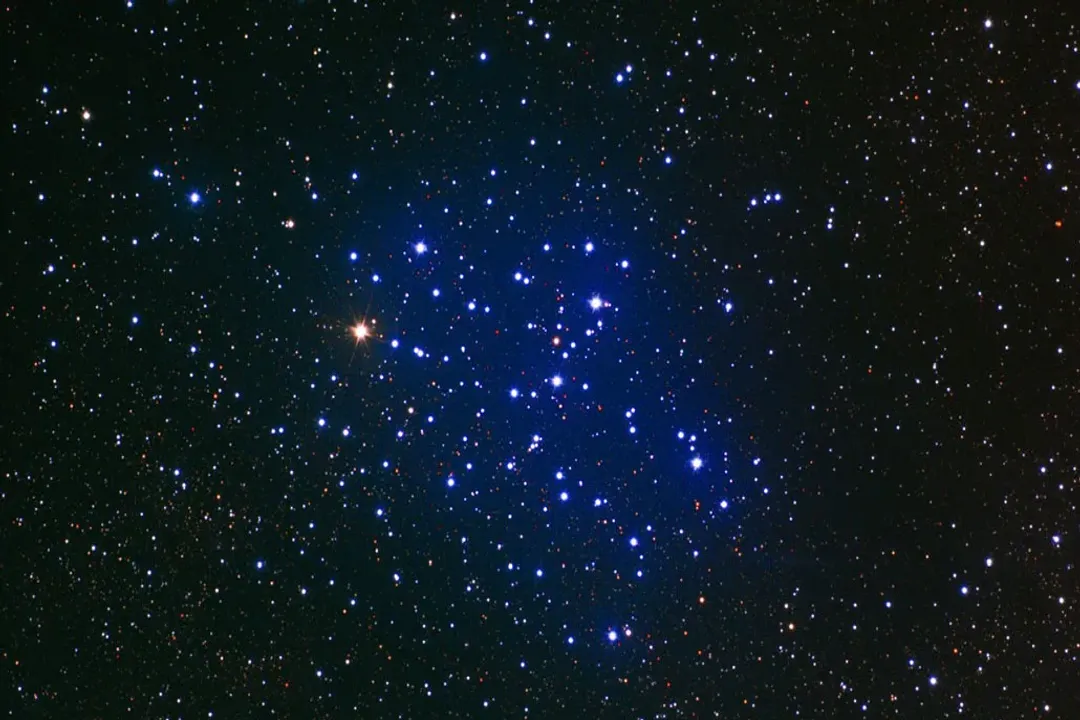
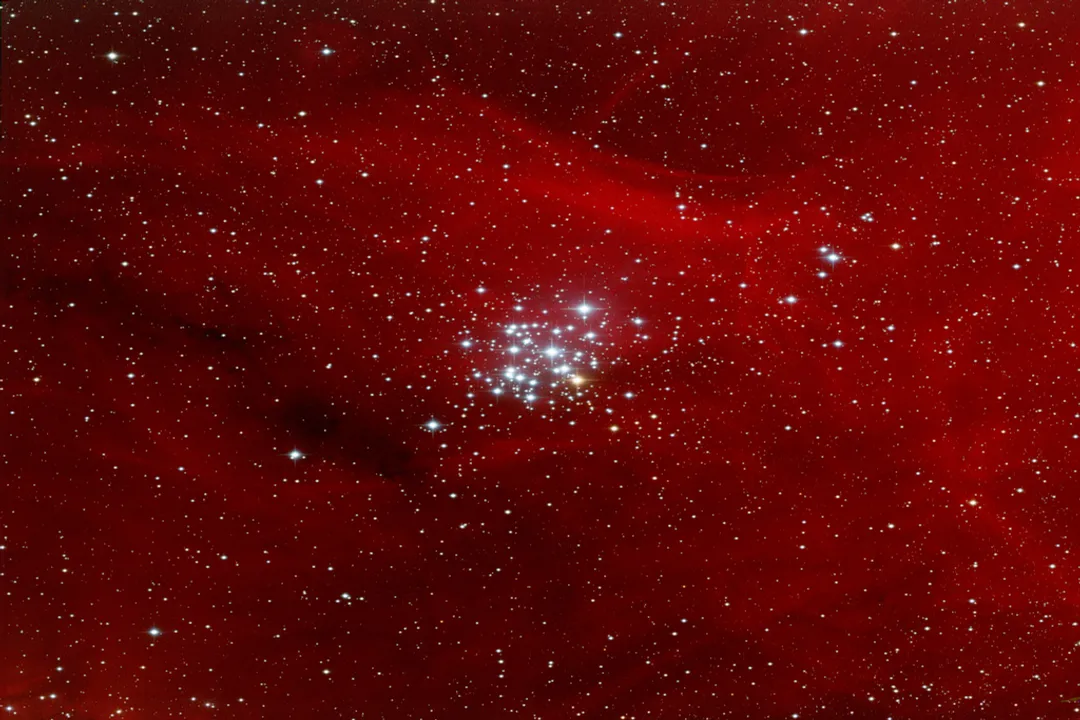
For dating large groups of stars, the most reliable method involves looking at star clusters. [1][2] Stars within a cluster are born at nearly the same time from the same cloud of gas and dust, meaning they all share the same age. [1][2]
When astronomers plot the stars of a cluster on an H-R diagram, they look for the main-sequence turnoff point. [7] This point marks the location of the most massive stars in the cluster that are just now running out of core hydrogen and beginning to evolve off the main sequence. [7] Since we can accurately calculate how long a star of that specific mass should live, that turnoff point effectively sets the age of the entire cluster. [1][7] Every star dimmer and less massive than the turnoff point is, by definition, younger than the turnoff point itself, though only by a small margin. [7] This method provides an anchor age against which models can be tested, offering a high degree of confidence. [7]
Imagine two seemingly identical stars, both G-type main sequence stars floating in isolation. One shows slightly less Lithium in its spectrum than the other. Because Lithium fusion occurs relatively quickly in the core as soon as hydrogen burning begins, the star that has already depleted more of its surface lithium is likely the older twin, even if their current surface temperatures and brightness appear indistinguishable from a distance. [1]
# Spectral Analysis
When a single, isolated star is observed, detailed spectral analysis plays a significant role. [4] A star's spectrum is its fingerprint, created by light passing through its outer atmosphere, revealing the presence and quantity of various elements. [4]
One critical element astronomers search for is Lithium. [1][4] Lithium is easily destroyed by fusion at relatively low temperatures compared to hydrogen. [1] Therefore, younger stars retain more lithium in their outer layers, while older stars have consumed much of it, either by mixing it down to hotter interior layers or through gradual depletion. [1][4] If a star’s spectrum shows a noticeable lack of lithium, it strongly suggests it has already experienced a significant portion of its main-sequence lifetime. [1][4] This method requires extremely high-quality data, as the spectral lines indicating these trace elements can be very faint. [4]
# Rotation Clocks
Another fascinating indicator that gives a clue to a star's age relates to its spin rate. [1] Young stars generally rotate much faster than older stars of the same mass. [1] This is due to a process called magnetic braking. [1] As a star rotates, its magnetic field sweeps stellar wind particles out into space. These particles, carrying away some of the star’s angular momentum, act like a brake over billions of years, gradually slowing the star's spin. [1]
For stars similar to the Sun, rotation rates have been calibrated against cluster ages, creating empirical "spin-age" relations. [1] If you measure a G-type star spinning quite slowly, the statistical evidence points toward it being considerably older than a rapidly spinning counterpart of the same type. [1] However, this method is more effective for younger stars; the rate of slowing decreases as the star gets older, making it less precise for truly ancient objects. [1]
# Internal Seismology
Perhaps the most precise modern technique involves studying asteroseismology, which is essentially the study of "starquakes". [3] Just as geologists study Earth's interior using seismic waves from earthquakes, astronomers study the internal structure of stars by monitoring tiny variations in their brightness caused by sound waves oscillating within the star. [3]
These internal oscillations depend heavily on the star's internal structure, particularly how much helium has built up in the core versus how much hydrogen remains available for fusion. [3] By carefully measuring the frequencies of these stellar "tones," scientists can map the internal composition profile of a star with remarkable accuracy. [3] Since the composition changes systematically as fusion proceeds, this method directly maps the star's evolutionary progress, providing an age estimate with much smaller error bars than relying on surface appearance alone. [3] This technique requires long-term, high-precision photometric data, often gathered by space-based telescopes, but it offers the clearest window into the star’s deep interior state. [3]
# Analyzing Light Signatures
When looking at spectra, astronomers also look at the overall energy distribution across different wavelengths, which relates back to temperature and luminosity. [4] The spectrum itself is a record of nuclear activity. [4] While the main sequence tells us the star is fusing hydrogen, what happens after that stage is very apparent in the spectrum. For instance, as stars bloat into red giants, their outer layers cool significantly, changing the appearance of the spectral absorption lines dramatically. [7]
For older, more evolved stars—those that have already left the main sequence—their spectral classification becomes a more potent age indicator than for their main sequence counterparts, simply because the physical changes associated with post-hydrogen burning are more dramatic and less mass-dependent in their immediate changes. [7]
While analyzing a solitary field star relies on predicting its evolutionary path based on limited data points like estimated mass, composition, and spin, dating a cluster provides a crucial anchor point based on simultaneous formation. It’s the difference between estimating a person's age based on a snapshot versus knowing their birth certificate date because you know everyone they were born with. [7]
The primary difficulty in determining the age of any individual star that isn't part of a well-studied cluster remains the ambiguity of its initial mass. [5] Since mass dictates the entire timeline, any error in determining that initial mass translates directly into an uncertainty in the calculated age. [5] Furthermore, astronomers must also account for how much the star has changed over time due to internal mixing processes, which can differ slightly even between stars that formed with the exact same mass. [5] Combining these diverse techniques—observing spin, checking surface chemistry for elements like Lithium, and, where possible, analyzing internal oscillations—is what allows modern astronomy to assign meaningful ages to these distant, brilliant objects. [1][3][4]
#Videos
How Do We Measure the Ages of Stars? With Astrophysicist Ruth ...
Related Questions
#Citations
How do scientists calculate the age of a star? - Science News
eli5 how do we KNOW how old stars are? : r/explainlikeimfive - Reddit
How to Learn a Star's True Age | Center for Astrophysics
How do we know a star's age based on its spectrum? [duplicate]
How do scientists determine the ages of stars? Is the technique ...
How Do We Measure the Ages of Stars? With Astrophysicist Ruth ...
Measuring the Age of a Star Cluster | ASTRO 801
How old is a Star? - Telescope Live
How do astronomers determine if a star or galaxy is old or ... - Quora