Do massive stars evolve faster than average stars?
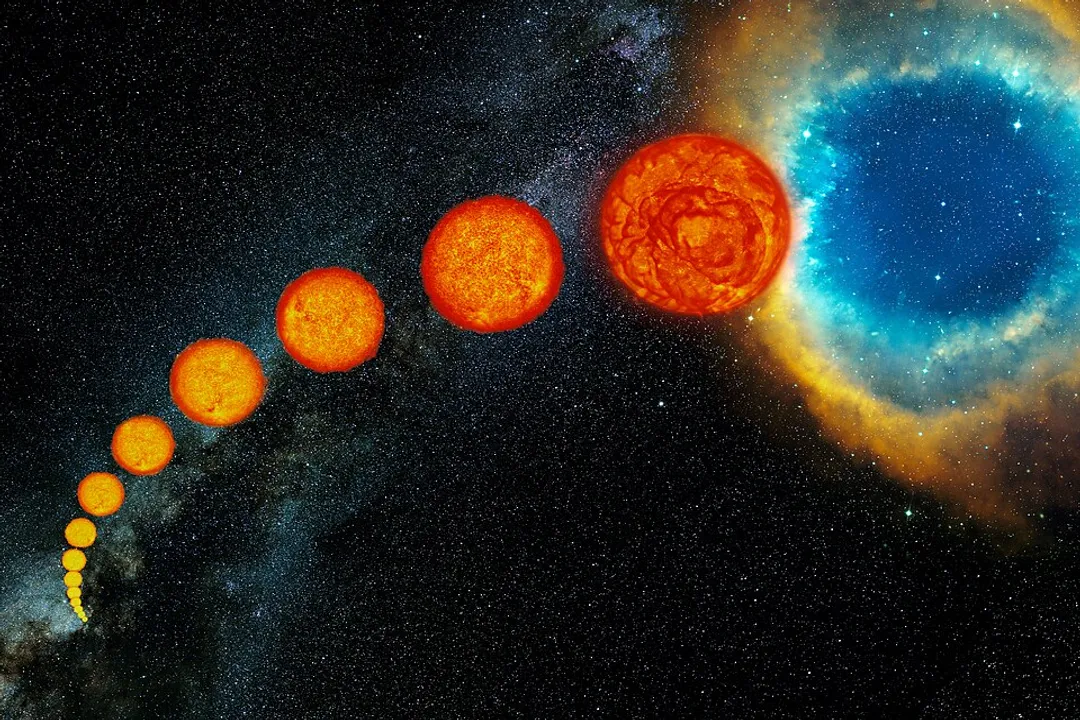
The stellar life story is one of constant transformation, a process we call stellar evolution. When we look up at the night sky, we see countless points of light, but not all stars are created equal, nor do they age at the same pace. The fundamental driver of a star’s fate and timeline is its initial mass, leading to a clear, yet dramatic, answer: Yes, massive stars evolve significantly faster than average stars.
This speed difference is not a minor deviation; it is an order-of-magnitude difference that dictates whether a star ends its existence in a gradual fade or a cataclysmic explosion. The more massive a star is, the more voracious its appetite for fuel, turning its vast stores of hydrogen into energy at a breakneck pace.
# Mass Dictates Fate
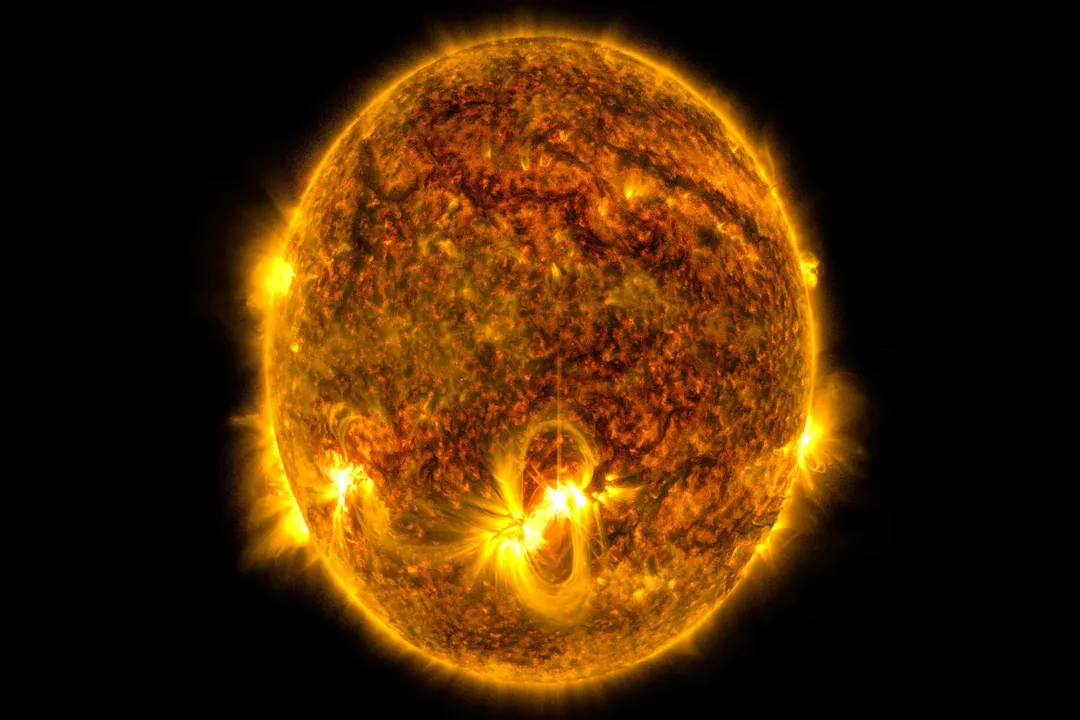
Stars begin life in vast, cold clouds of gas and dust, known as nebulae or molecular clouds. Gravity initiates the collapse, squeezing this material until the core gets hot and dense enough to ignite sustained nuclear fusion, marking the birth of a true star. Once fusion begins, balancing the inward crush of gravity with the outward push of radiation pressure establishes a state of hydrostatic equilibrium, and the star settles onto the main sequence.
On the main sequence, stars—including our Sun, a yellow dwarf star—spend the majority of their existence fusing hydrogen into helium in their cores. However, this stability is entirely dependent on mass. Mass determines the core temperature and, consequently, how fast the star burns its nuclear fuel.
The relationship is beautifully simple: greater mass means greater gravitational compression, which translates directly to a hotter core and a higher rate of energy production. This rapid energy expenditure means massive stars live hard and die young, while their smaller cousins are fuel-efficient spendthrifts, conserving energy for eons.
# Lifespan Extremes
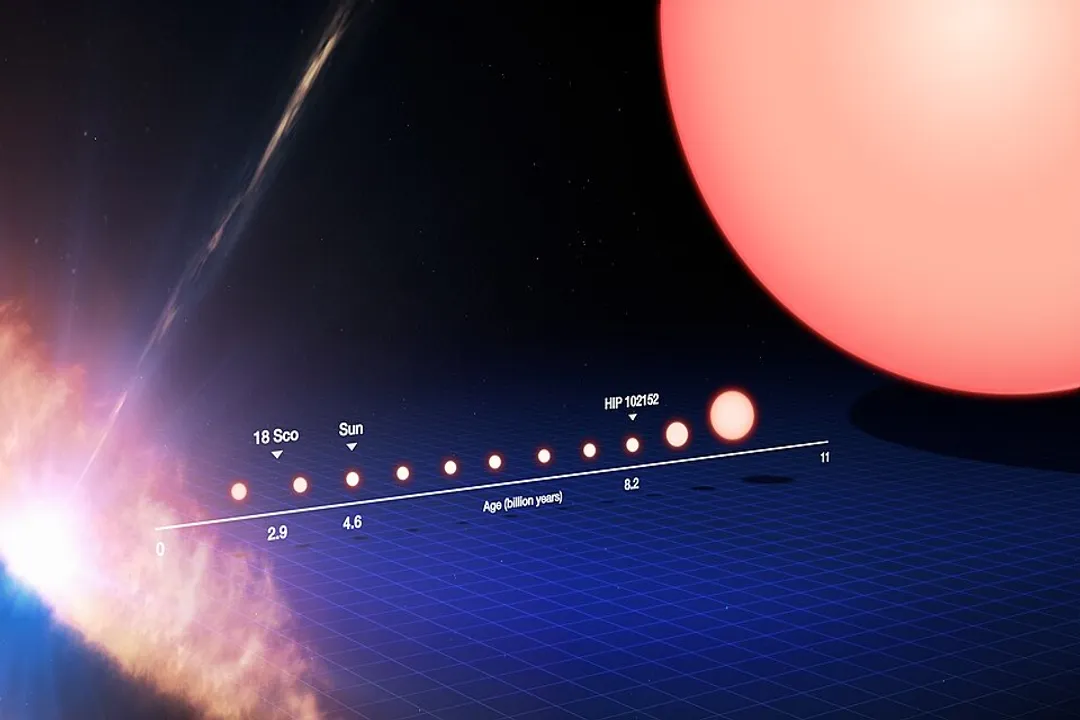
The main sequence lifetime is the most predictable—and longest—part of a star's life, yet the variation across mass classes is staggering.
Consider the average star, like our Sun, which is expected to remain on the main sequence for approximately 10 billion years. At about 5 billion years old, the Sun is considered middle-aged, having used up roughly 12 percent of its core hydrogen supply, the point at which evolution off the main sequence begins.
In sharp contrast, stars significantly more massive than the Sun race through this phase:
- A star five times the Sun’s mass (a B-type star) might only last about 100 million years on the main sequence.
- An even heftier 10-solar-mass O-type star might depart the main sequence in as little as 20 million years.
At the other end of the spectrum are the small, cool stars known as red dwarfs. These are the most common type of star, and they are incredibly economical with their fuel. Their models suggest lifespans ranging from hundreds of billions to trillions of years. This projected longevity exceeds the current age of the universe, estimated around 13.7 billion years, meaning no red dwarf has ever died of old age; any that exist today are effectively brand new from a cosmic perspective.
The post-main sequence evolution for massive stars proceeds with the same accelerated velocity. While the Sun’s transition to a red giant takes billions of years, for a giant star, the journey from leaving the main sequence to its final destructive moment can be over in a cosmic blink.
# Low-Mass Evolution: A Gentle Retreat
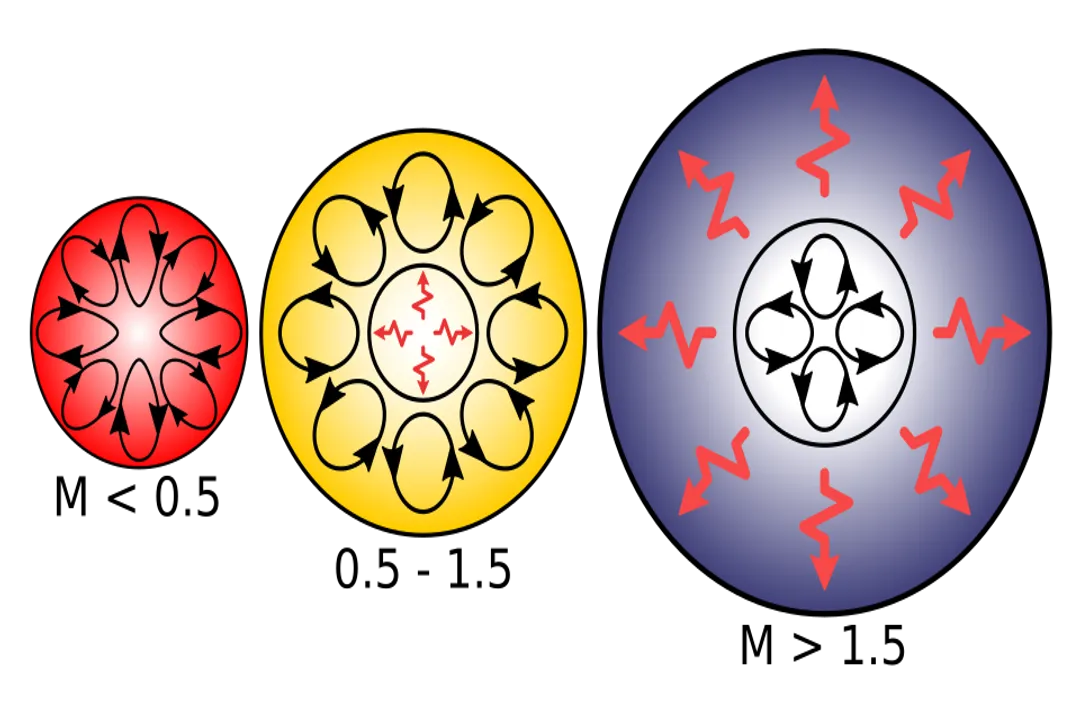
For stars near or below the Sun's mass (roughly $0.6$ to $8$ times solar mass), the evolution off the main sequence is a relatively drawn-out affair, characterized by expansion and shedding layers.
When hydrogen in the core is depleted, the core contracts, heating up until the surrounding shell begins fusing hydrogen. This causes the outer layers to swell dramatically, transforming the star into a red giant. The Sun is projected to follow this path in about 5 billion years, potentially engulfing the inner planets, including Earth.
For Sun-like stars, once helium ignition begins in the core (sometimes with a brief, powerful event called the helium flash in lower-mass cases), the star may shrink and briefly heat up before the helium fuel runs out. After the helium is converted to elements like carbon and oxygen, the star enters a second period of instability on the asymptotic-giant-branch (AGB), puffing up into a second, larger red giant phase while fusing elements in surrounding shells.
This process culminates in the star shedding its expanded outer layers to form a beautiful, expanding cloud of gas called a planetary nebula. What remains is the small, hot core—a white dwarf. This white dwarf slowly radiates away its leftover heat over untold eons, eventually becoming a theoretical, cold black dwarf.
# High-Mass Evolution: The Onion Core
Stars more massive than about $8$ to $10$ solar masses bypass many of the gentle phases seen in Sun-like stars, accelerating straight into a highly luminous supergiant stage. Because they possess significantly more mass, their cores reach temperatures high enough to fuse elements much heavier than helium, building up layers like an onion.
The fusion chain progresses rapidly: Hydrogen fuses to Helium, which fuses to Carbon and Oxygen. In the most massive stars, fusion continues through Neon, then Oxygen, and finally Silicon. Each subsequent fusion stage yields less energy than the last and lasts for a progressively shorter time.
The critical turning point is the formation of an iron core. Iron is the stopping point because fusing iron nuclei consumes energy rather than releasing it. Once the core is mostly iron, the energy supply vanishes instantly. Gravity, which has been held in check by thermal pressure, wins the final, violent battle.
The core collapses catastrophically. For a star that has reached the iron-fusing stage, the time until the explosion can be reduced to mere hours or days. This implosion rebounds off the ultra-dense core, triggering a supernova explosion so energetic it briefly outshines entire galaxies. The remnant is either an incredibly dense neutron star or, if the initial mass was high enough, a black hole.
# The Speed of Instability
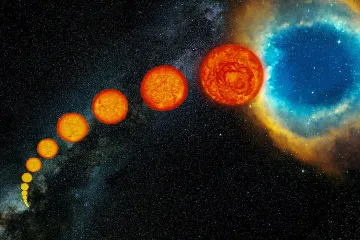
To truly grasp how much faster massive stars evolve, we must look at the post-main sequence period. For the Sun, the journey from leaving the main sequence to becoming a red giant, and then progressing through the subsequent phases, spans billions of years, meaning the vast majority of its life is spent fusing hydrogen steadily. For a star like the Sun, roughly $90%$ of its entire existence is spent on the main sequence.
For a high-mass star, this proportion is dramatically inverted. The time spent fusing heavier elements is so short that, observationally speaking, these stars seem to jump from the main sequence directly into a supernova. The time scale shrinks from billions of years down to millions, then thousands, and finally to a matter of days for the final stages. If our Sun were to evolve at the rate of a $15$ solar mass star, the last $5$ billion years of its life would pass in less than a year of Earth time, and its final collapse would be over before you finished reading this sentence. This disparity shows that while all stars adhere to the same physical laws, the greater the mass, the less time the star has to obey those laws before reaching its destructive end.
It is fascinating to consider the cosmic budget allocated to each star type based on this evolution. Low-mass stars, like red dwarfs, are budgeted for trillions of years of relatively low-energy output, effectively existing in a state of near-eternal stability. Massive stars, conversely, are granted a colossal initial mass but are forced to spend it all at an unsustainable rate. They convert a higher fraction of their total mass into energy () via fusion, but they do so with an extreme efficiency factor—meaning they radiate far more energy per second than a low-mass star—resulting in a drastically compressed timeline. This isn't merely burning fuel; it’s a desperate attempt to resist crushing gravity using the available nuclear energy source as quickly as possible.
# Deduction from Snapshots
We cannot simply wait around to watch a star transition through these life stages; the timescales are too long relative to human observation spans—a star like the Sun’s main-sequence life is roughly $10^8$ times longer than a person’s life. Therefore, astronomy relies on observing countless stars at different ages and piecing the timeline together, much like inferring the human life cycle from thousands of static photographs.
This "snapshot" methodology, combined with computer modeling, allows scientists to map out the Hertzsprung-Russell (H-R) diagram. By comparing star clusters that formed at roughly the same time, astronomers can observe the "turn-off" point—the point where the most massive stars have already left the main sequence and begun their giant phase. The position of this turn-off point reveals the cluster's age. For example, a cluster with no stars brighter than $1,000$ times the Sun's luminosity must be older than one that still hosts stars brighter than $10,000$ times the Sun's luminosity, because the brighter ones used up their fuel faster and evolved away sooner.
The fact that massive stars move across the H-R diagram in fundamentally different paths than low-mass stars post-main sequence—for instance, moving nearly horizontally versus vertically—is direct evidence of their different internal physics; high-mass stars can fuse heavier elements smoothly, avoiding the structural hiccups seen in Sun-like stars as they transition between fuel sources.
Ultimately, the speed of evolution is a direct consequence of mass: it provides the initial fuel but forces a fiery, accelerated consumption of that fuel, ensuring the most massive stars burn out in a spectacular, yet brief, flash compared to their long-lived, modest counterparts. The elements essential to our own existence—the carbon, oxygen, and others that make up our planet and bodies—were forged inside these massive, fast-living furnaces before being scattered across space by their explosive deaths.
Related Questions
#Citations
Stellar evolution - Wikipedia
Stellar Evolution - | The Schools' Observatory
Star Basics - NASA Science
Can a massive star become a red giant more than once?
20.4 Evolution of Stars More Massive than the S
The Life Cycle of Stars | National Air and Space Museum
The Origin, Structure, and Evolution of the Stars - BYU Studies