Why are more massive stars brighter?
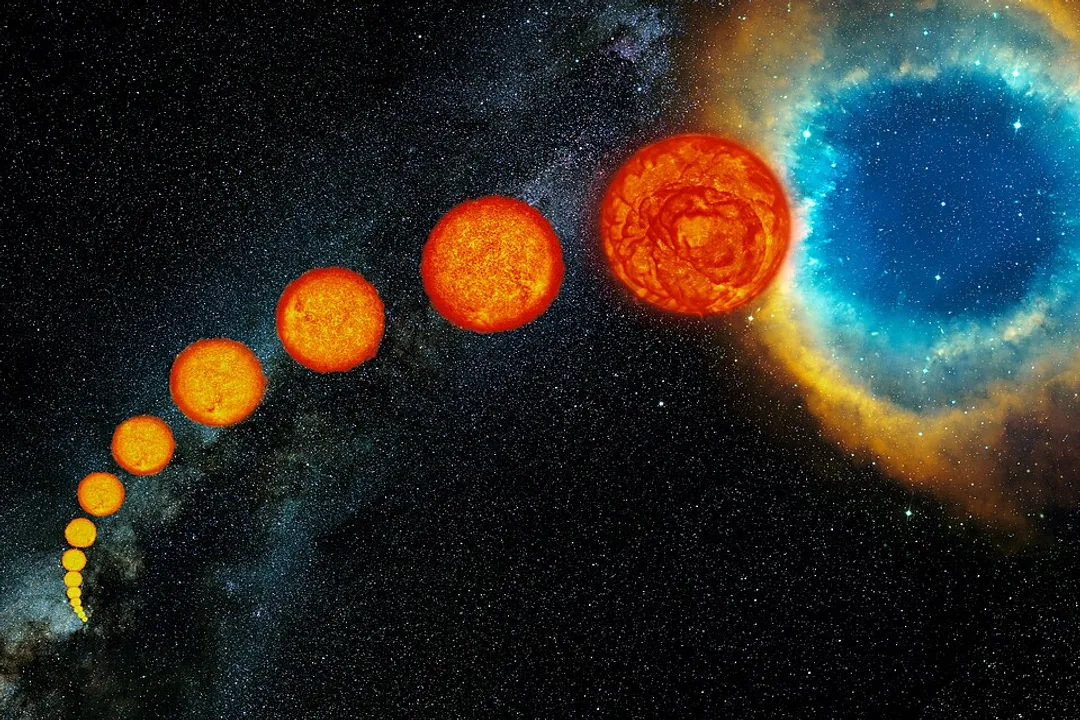
The reason stars packing significantly more mass than our Sun shine with such astonishing brilliance comes down to the extreme physics governing their cores. When we observe the night sky, the difference between a faint star and a celestial beacon is not a subtle tuning of output; it's a radical difference in the rate at which they convert mass into pure energy. [10] The simple relationship is that greater mass leads to vastly greater luminosity, but understanding why requires looking deep inside the stellar furnace.
# Core Pressure
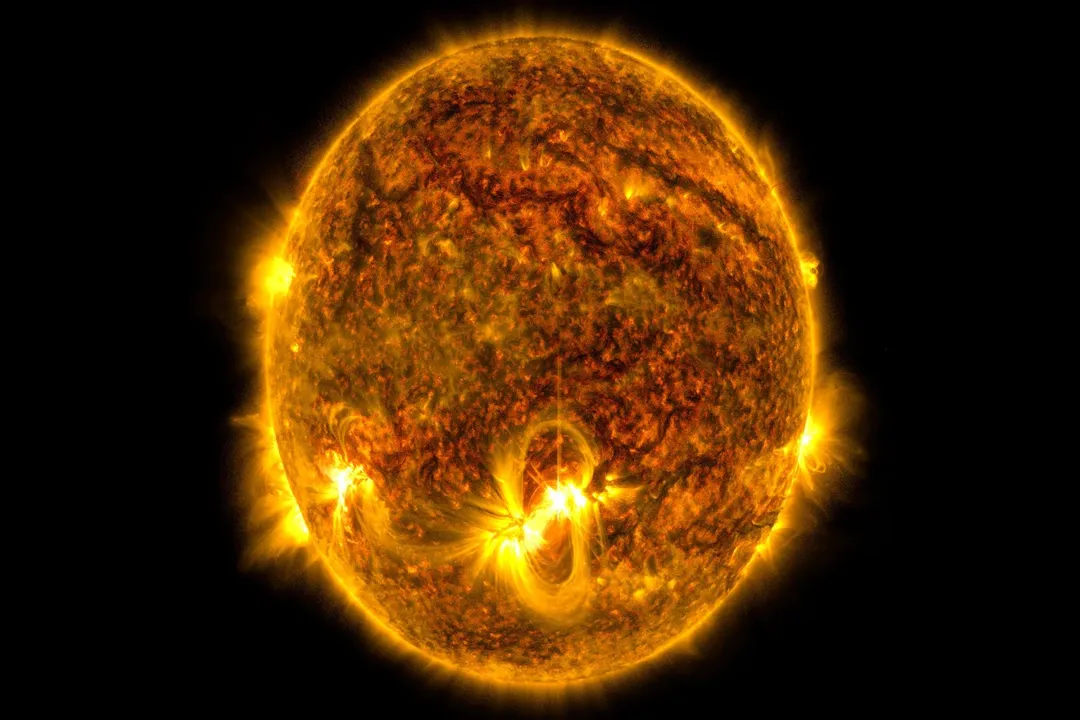
A star exists in a constant, violent battle between the inward pull of its own gravity and the outward push generated by the heat of nuclear fusion in its core. [3] When a star is formed with more raw material—more mass—gravity exerts a far stronger inward crush on the center of the star. [4] This crushing force translates directly into much higher core pressure and, critically, much higher core temperatures. [3]
Think of it like a controlled explosion. If you squeeze the components of a firecracker tighter before igniting it, the resulting blast is exponentially more powerful, not just linearly stronger. For stars, this temperature increase is the key to unlocking massive energy output. Stars similar to our Sun fuse hydrogen primarily through the proton-proton chain reaction, which is relatively slow and steady. [3] However, in a star where the core temperature surpasses about $18$ million Kelvin, the carbon-nitrogen-oxygen (CNO) cycle becomes the dominant energy producer. [3] The CNO cycle uses carbon, nitrogen, and oxygen as catalysts to fuse hydrogen into helium, and it is incredibly sensitive to temperature—its reaction rate escalates fiercely with even small rises in heat. [3]
This temperature dependence is why a star just a few times more massive than the Sun can produce light thousands of times brighter. It’s not just burning fuel faster; it’s utilizing a fundamentally more efficient and explosive reaction pathway enabled by the higher gravitational pressure. [4]
# Luminosity Relation
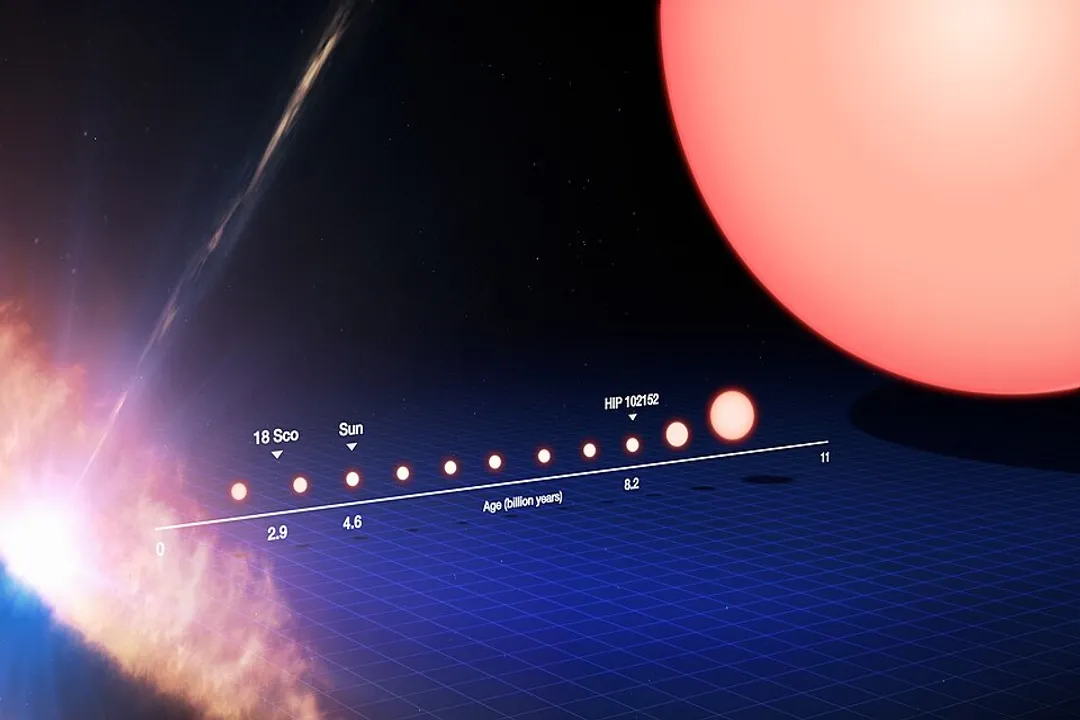
Astronomers have quantified this relationship through what is known as the Mass-Luminosity Relation. For stars on the main sequence (the phase where they fuse hydrogen in their core, like our Sun), luminosity () scales with mass () raised to a power, often approximated around . [3][4]
This power relationship is the mathematical explanation for the visual dominance of massive stars. If we take a star that is $10$ times the mass of the Sun (), we might intuitively expect it to be only $10$ times brighter. However, using the power of $3.5$, that star is actually expected to be , or roughly $3,162$ times more luminous than the Sun. [3] This means that finding just a handful of these giants can account for the entire light output of a small stellar cluster, while millions of Sun-like stars would be required to match that same brilliance. This massive output gap is why in any given stellar population, the few massive, bright stars dominate our view of the universe, even though they represent a tiny fraction of the total star count. [2][4]
# Surface Appearance
The intense energy generated deep within the core must escape, creating enormous outward radiation pressure that inflates the star. [4] Since the core is producing so much more energy per second, the star's surface must radiate that energy away to maintain equilibrium. [2][7] This necessary high rate of energy emission results in significantly higher surface temperatures compared to less massive stars. [4]
Our Sun has a surface temperature of about $5,800$ Kelvin, giving it a yellowish-white appearance. A star with $10$ or $20$ times the Sun's mass burns so much hotter—often exceeding $20,000$ or $30,000$ Kelvin—that its peak emission shifts into the blue and ultraviolet parts of the spectrum. [4] These stars are literally too hot to be yellow or red; they shine with an intense, brilliant blue-white light. [4] Therefore, when you look at a cluster of stars and see the brightest ones shining distinctly blue, you are directly observing the visual signature of high mass and extremely high core fusion rates. [2]
# Mass Density Paradox
One aspect of stellar physics that often surprises people is the relationship between mass and average density, especially when comparing the most massive main sequence stars to stars like our Sun. [5] One might assume that if you add more mass, the star must become denser overall due to increased gravity. While the cores of massive stars are indeed unimaginably dense, the star as a whole can sometimes be less dense than a star of moderate mass. [5]
For instance, the star Vega, which is about $2.1$ times the Sun's mass, is actually less dense on average than the Sun. [5] This counterintuitive result occurs because the immense energy generation in the massive star creates such powerful outward pressure that it forces the star to inflate to a much larger physical radius than the Sun has at its stage. [5] The increase in radius outstrips the increase in mass, leading to a lower bulk density. This illustrates that while the internal engine is intensified by mass, the external structure—the star's observable size—is also dramatically increased, offsetting the density gained from gravity alone. [5]
# Fuel Consumption
The downside to this incredible brightness is the rate at which the fuel is consumed. The extreme core conditions that allow massive stars to shine so brightly also ensure that they burn through their hydrogen supply in a cosmic blink of an eye. [7]
While a star like the Sun has a main-sequence lifespan stretching into the billions of years (estimated at about $10$ billion years), [7] a star $20$ times the mass of the Sun might only last for $10$ million years. [7] This rapid consumption dictates the entire stellar life cycle; massive stars quickly exhaust their core hydrogen and move on to fusing heavier elements in layers, leading to spectacular, swift deaths as supernovae. [7]
This short existence has a profound implication for our view of the cosmos: the majority of stars in the universe today are not the brilliant giants. They are the long-lived, low-mass red and yellow dwarfs that can patiently fuse their fuel for trillions of years. [7] The massive, bright stars are the spectacular, short-lived teenagers of the stellar population, appearing briefly and intensely before fading quickly into stellar remnants. [7]
#Videos
Why Would The Size Of A Star Affect Its Luminosity? - Physics Frontier
Related Questions
#Citations
What makes a relatively small star more luminous than a large one?
Star Basics - NASA Science
The Mass-Luminosity Relationship | ASTRO 801
3.2 How the mass of a star affects its luminosity - The Open University
Why are main sequence stars more massive than the Sun less ...
Why are some stars vastly brighter than others in this image? - Quora
Stellar evolution - Wikipedia
G. C. Sloan: Main Sequence Stars, Giants, and Supergiants
Why Would The Size Of A Star Affect Its Luminosity? - Physics Frontier