What color light do stars exceeding 20,000 Kelvin primarily emit?
Answer
Intense, brilliant blue-white light
The visible appearance of a star is directly linked to its surface temperature, which in turn is driven by the energy generated in the core. Our Sun, with a surface temperature around 5,800 Kelvin, emits light appearing yellowish-white. Massive stars generate so much more internal energy that their surfaces must reach much higher temperatures, often exceeding 20,000 or 30,000 Kelvin, to radiate that energy outward and maintain equilibrium. At these extreme temperatures, the peak emission of light shifts significantly toward the shorter wavelength end of the spectrum, resulting in the observed intense, brilliant blue-white light.
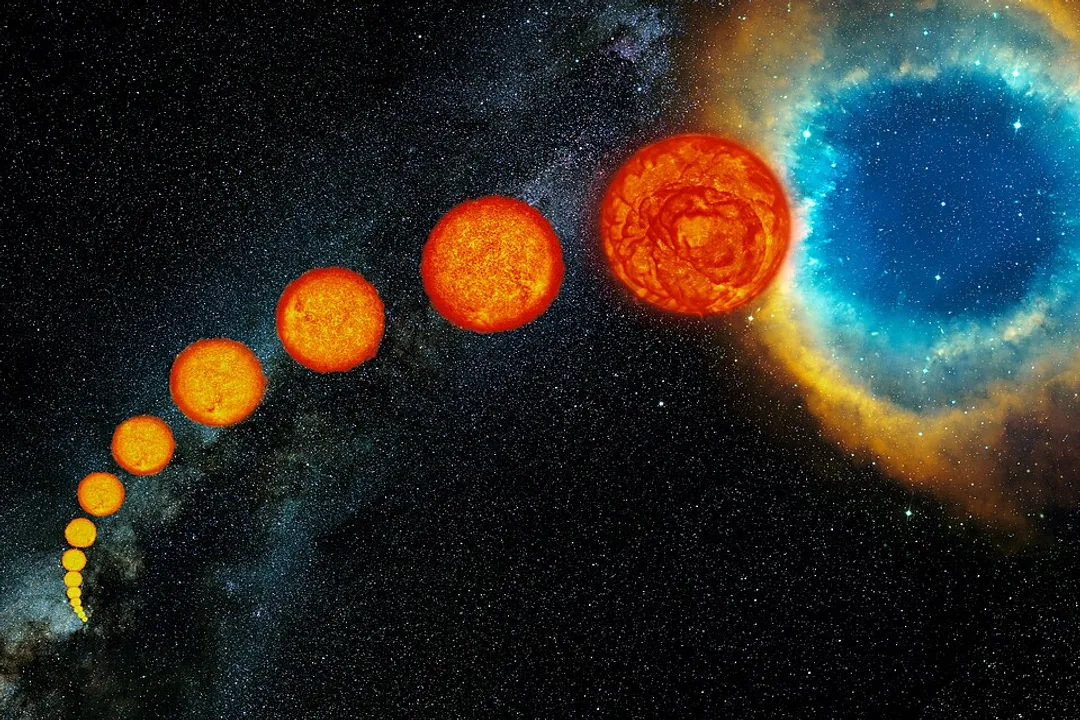
#Videos
Why Would The Size Of A Star Affect Its Luminosity? - Physics Frontier
Related Questions
What fusion cycle dominates when core temperature surpasses 18 million Kelvin?What exponent approximates the scaling for luminosity (L) based on mass (M) for main sequence stars?How much brighter is a 10 M☉ star expected to be using the M^3.5 relation?What color light do stars exceeding 20,000 Kelvin primarily emit?What direct result of greater mass leads to the higher core temperatures required for extreme fusion?Why is the star Vega, at 2.1 times the Sun's mass, sometimes less dense overall than the Sun?How does the main-sequence lifespan of a star 20 times the Sun's mass compare to the Sun's 10 billion years?Which stars represent the majority of the total star count in the universe, despite their low brilliance?What is the primary hydrogen fusion reaction used by stars similar to our Sun?To what factor is the reaction rate of the CNO cycle fiercely sensitive?What opposing force balances the inward pull of gravity in a stable star?