Why does nuclear fusion stop abruptly when a massive star's core produces iron?
Answer
Fusing iron consumes energy rather than releasing it.
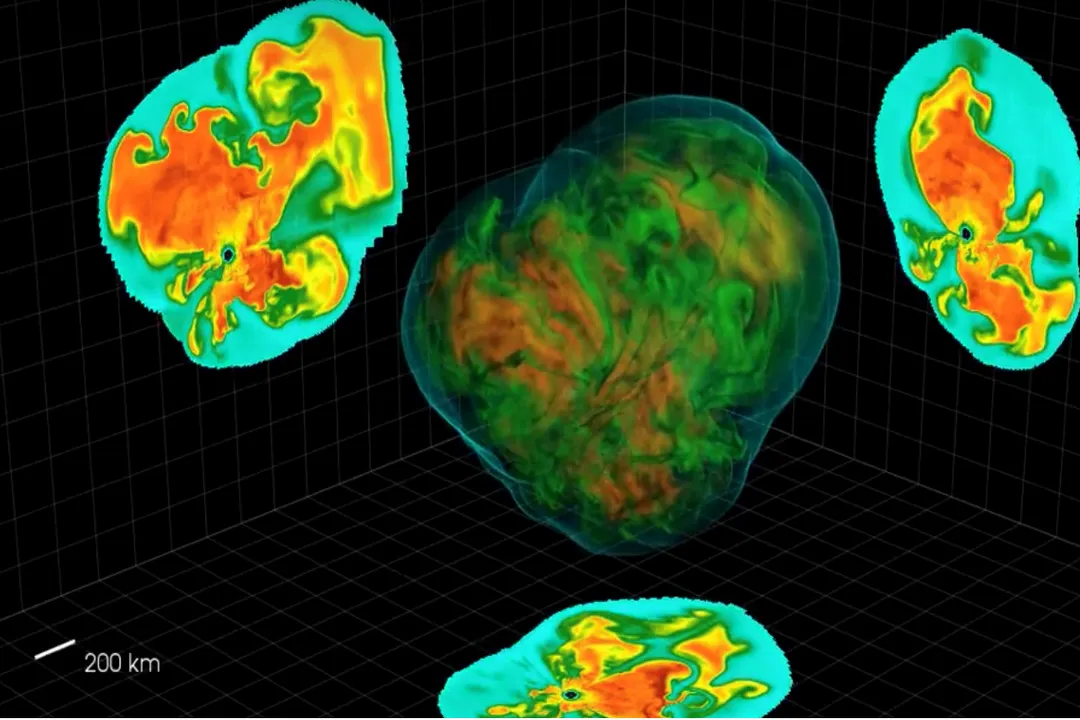
The process of nuclear fusion continues sequentially, building up heavier elements until the core is composed entirely of iron. Iron represents the terminal element in this chain because it possesses the most stable nucleus among all elements. Unlike the fusion of lighter elements (like hydrogen into helium or helium into carbon), fusing iron nuclei does not release the necessary thermal energy required to counteract the immense, relentless inward crush of gravity. Instead, attempting to fuse iron requires an input of energy, meaning the core loses its primary source of outward pressure support, leading inevitably to catastrophic collapse.
Related Questions
What is the minimum mass threshold for a star to be considered massive?Why does nuclear fusion stop abruptly when a massive star's core produces iron?How quickly does the gravitational collapse occur once the iron core forms?What density level does the collapsing core reach before halting to form a nascent neutron star?What particle torrent propels and energizes the supernova shockwave during rebound?What classification is given to the spectacular explosion marking the end of a massive star's life?What is the likely outcome for stars exceeding 25 to 30 solar masses during core collapse?What is the approximate upper mass limit for a collapsing core to form a stable neutron star?What phenomenon causes many neutron stars to be observed as rapidly spinning objects emitting regular pulses?Which elements, heavier than iron, are synthesized in the neutron-rich environment of a supernova explosion?