Which elements, heavier than iron, are synthesized in the neutron-rich environment of a supernova explosion?
Answer
Gold and uranium
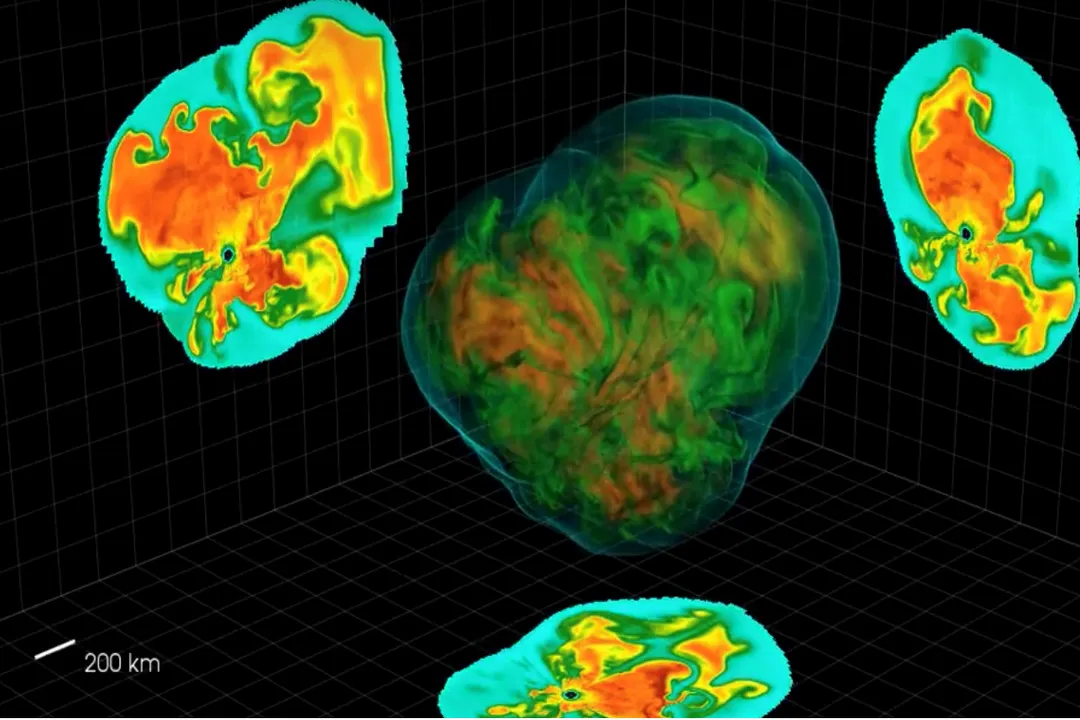
While fusion within the star's lifetime produces elements up to iron, the synthesis of elements heavier than iron requires extreme, neutron-rich conditions that are only achieved during the violent moments of a core-collapse supernova explosion. The chaotic environment created by the exploding stellar envelope and the intense neutrino flux facilitates rapid neutron capture processes. This mechanism is responsible for forging some of the heaviest elements found in the universe, specifically including precious metals like gold and massive radioactive elements such as uranium, seeding the cosmos with the building blocks for future planetary systems.
Related Questions
What is the minimum mass threshold for a star to be considered massive?Why does nuclear fusion stop abruptly when a massive star's core produces iron?How quickly does the gravitational collapse occur once the iron core forms?What density level does the collapsing core reach before halting to form a nascent neutron star?What particle torrent propels and energizes the supernova shockwave during rebound?What classification is given to the spectacular explosion marking the end of a massive star's life?What is the likely outcome for stars exceeding 25 to 30 solar masses during core collapse?What is the approximate upper mass limit for a collapsing core to form a stable neutron star?What phenomenon causes many neutron stars to be observed as rapidly spinning objects emitting regular pulses?Which elements, heavier than iron, are synthesized in the neutron-rich environment of a supernova explosion?