What is the life expectancy of a high mass star?
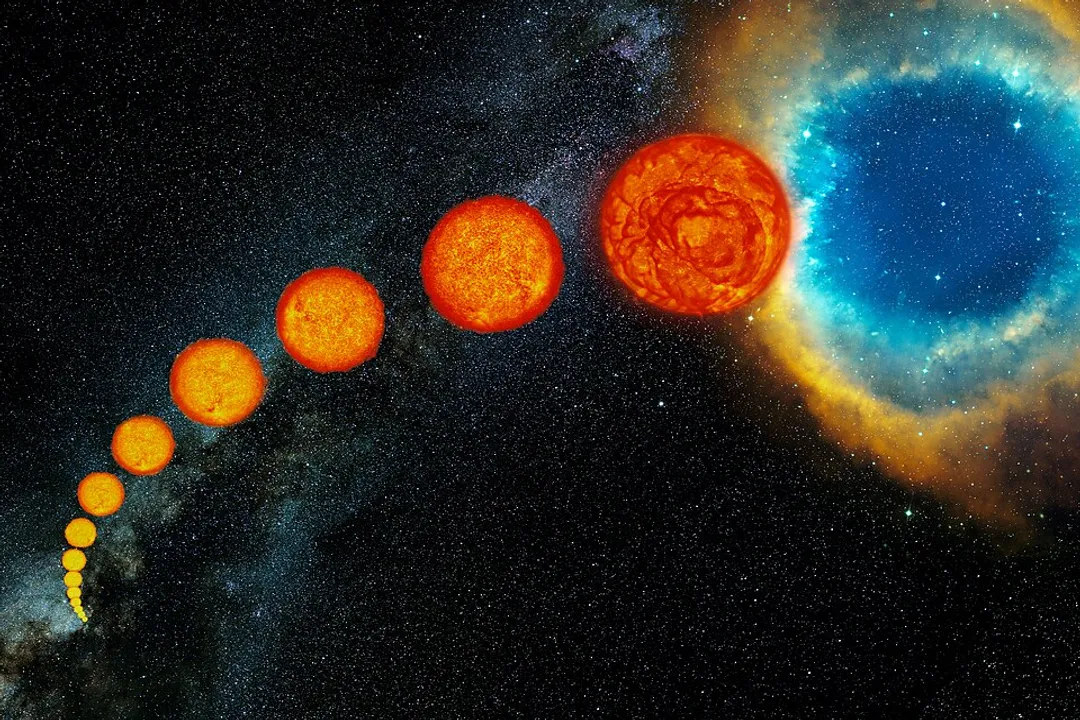
The lifespan of a star is one of the most dramatic variables in the cosmos, fundamentally determined not by age, but by its initial mass. [6] When we talk about high-mass stars, we are discussing stellar giants whose very existence is a brilliant, yet incredibly short, spectacle compared to average stars like our Sun. [3][9] These celestial behemoths live fast and die young, a concept that seems counterintuitive at first glance when one considers they start with a larger reservoir of hydrogen fuel. [1]
# Mass Thresholds

To properly frame the discussion, we first need a working definition of what constitutes a "high-mass star" in astronomical terms. Generally, stars are classified relative to the Sun's mass (). [2] While the exact boundary can vary slightly depending on the evolutionary stage being discussed, a high-mass star is typically considered one beginning its life with at least eight times the mass of the Sun, or . [5][9] Objects below this threshold, like the Sun which will live around 10 billion years on the main sequence, follow a much slower path. [8] Stars significantly more massive, perhaps 20 times the Sun's mass or more, exhibit the most extreme examples of rapid stellar burnout. [7]
# Fuel Consumption Paradox

The central mystery of massive star life expectancy revolves around a paradox: why does having more fuel lead to a shorter life? The answer lies in the physics of fusion pressure and core temperature. [1] In a high-mass star, gravity is immense, leading to significantly higher core temperatures and pressures than in a Sun-like star. [1][9]
This immense internal pressure forces the star to burn its hydrogen fuel via the CNO cycle (Carbon-Nitrogen-Oxygen cycle), which is far more efficient and vastly faster than the proton-proton chain used by lower-mass stars like the Sun. [1] Although a star begins with twenty times the hydrogen of the Sun, its luminosity—the total energy it outputs per second—is perhaps a thousand times greater. [2][7]
The relationship between mass and luminosity is not linear; it follows a steep power law, often approximated as luminosity being proportional to mass raised to the power of 3.5 or even higher ( or greater). [2] This means a small increase in mass results in a disproportionately massive increase in energy output, leading to an exponentially faster depletion of fuel. [2][9] The star is essentially living at a fever pitch, pouring out energy at a rate unsustainable for billions of years. [3]
# Timescales and Duration
The result of this furious energy output is a main-sequence lifetime that is staggeringly short on a cosmic timescale. [4]
Consider the comparison:
- A star with a mass similar to the Sun () resides on the main sequence for roughly (ten billion) years. [8]
- A low-mass red dwarf, perhaps , can sustain its burn for trillions of years. [4]
- A star of might manage a main-sequence existence of only 100 million years. [7]
- A true heavyweight, like a star, might exhaust its core hydrogen in as little as 10 million years. [7]
If we frame the comparison using ratios rather than absolute years, the contrast becomes sharper. For many high-mass stars, the entire hydrogen-burning phase—the longest part of any star's life—can be condensed into a period spanning just a few million years. [4] It's a spectacular cosmic sprint rather than a slow marathon. [3]
If we think about the relative timescales, an interesting observation emerges. Because the mass-luminosity relation dictates such rapid consumption, the factor by which a star is heavier than the Sun often dictates a lifespan that is vastly shorter than years. For instance, if a star were exactly 10 times the Sun's mass and its luminosity scaled precisely with , its life would be th of the Sun's $10$ billion years, resulting in $10$ million years—a common figure cited for such objects. [2][7] However, since luminosity often scales even steeper than , the actual lifespan is frequently shorter than this simple model predicts. [2]
# Evolutionary Stages

The short life of a massive star is punctuated by extremely rapid transitions between evolutionary stages. [5] Once the core hydrogen is depleted, the star does not slowly transition to a red giant like the Sun will; instead, it undergoes a rapid sequence of core-burning phases for heavier elements—helium, carbon, neon, oxygen, and silicon. [5] Each subsequent fuel source burns faster than the last, with the silicon-burning phase sometimes lasting only a single day. [5] This rapid layering and burning process is what characterizes the final stages of massive stellar evolution. [6]
# The Violent End
This condensed life cycle inevitably culminates in a catastrophic end: a core-collapse supernova. [6] Because these stars are so massive, their cores eventually become iron, an element that cannot release energy through fusion. [5] Without the outward thermal pressure generated by fusion to counteract the overwhelming inward pull of gravity, the core collapses almost instantaneously. [6] The resulting rebound shockwave blasts the star's outer layers into space, an event bright enough to briefly outshine an entire galaxy. [6] What remains is either an incredibly dense neutron star or, if the progenitor was massive enough (often ), a black hole. [5] The lifespan of the star, therefore, is inextricably linked to the violence of its demise; slower-burning stars never achieve the mass necessary to trigger this extreme collapse. [6]
Related Questions
#Citations
Why do some very, very massive stars live longer than stars ... - Reddit
Main Sequence Lifetime | COSMOS
What is the longest a star can live? | by Ethan Siegel - Medium
The Lives of the Longest Lived Stars | astrobites
Stellar evolution - Wikipedia
Star Basics - NASA Science
Calculate Lifespan of a Star - Rechneronline.de
How long do stars usually live? | Scientific American
High mass star - Las Cumbres Observatory