Do high mass stars form faster than low mass stars?
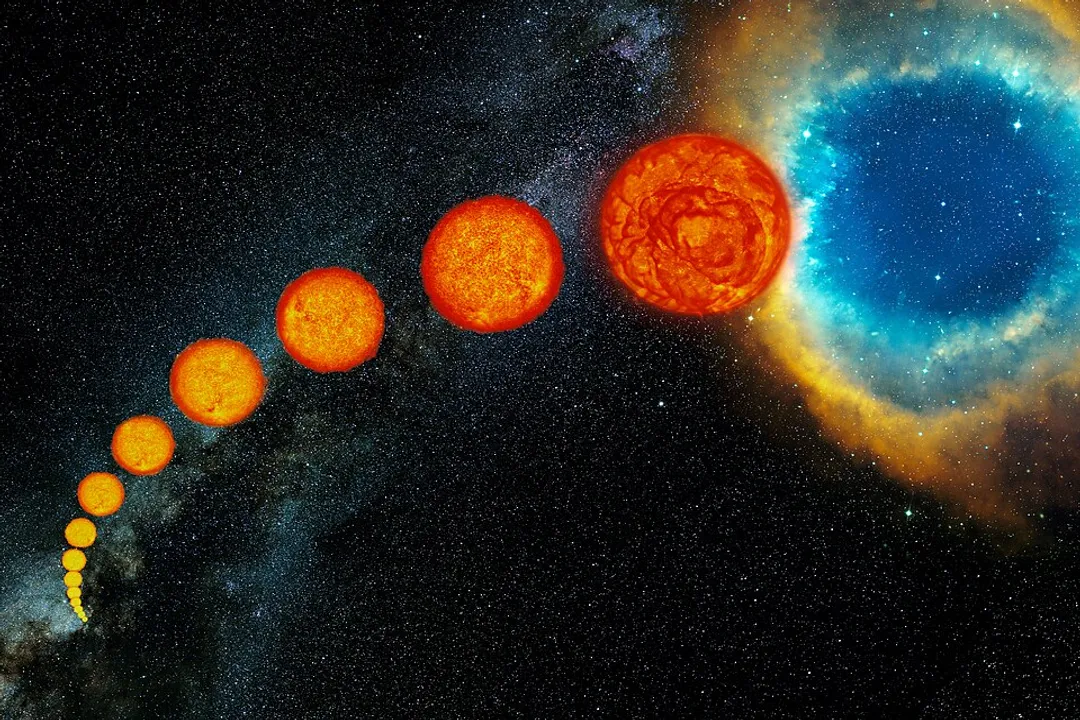
This is a fundamental question in astrophysics, and the answer, supported by observations and models, is a definite yes: high-mass stars form considerably faster than their lower-mass stellar cousins. While it might seem counterintuitive—after all, they need to gather significantly more material—the sheer power of gravity in these massive building blocks accelerates the process of assembly dramatically.
# Assembly Speed
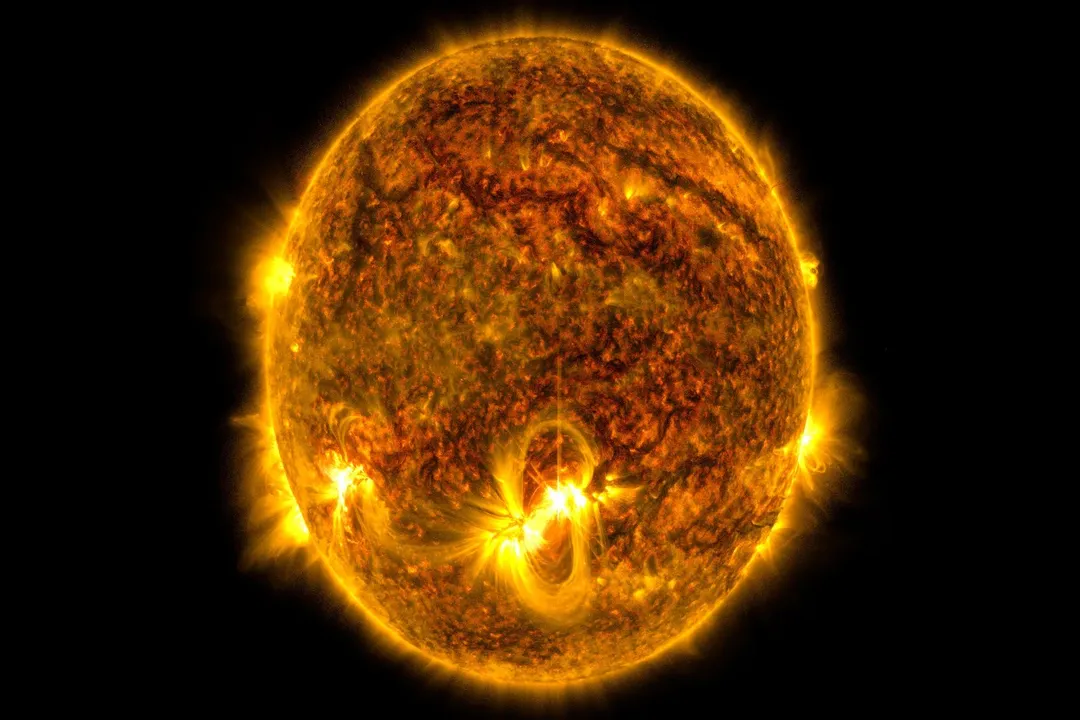
The journey from a cold, diffuse cloud of gas and dust to a stable, hydrogen-fusing star is called the pre-main sequence contraction phase. For stars like our Sun, this gathering and stabilization period takes a substantial amount of time, often around 50 million years. Compare that to a star fifteen times the Sun's mass; it can plummet down to the main sequence in as little as 60,000 years. This difference in timescale is the most telling evidence that mass directly dictates the speed of formation.
The primary driver behind this rapid assembly is the star's final mass dictating the strength of its gravitational pull while it is still a protostar. When a dense core within a molecular cloud begins to collapse, a larger initial mass means a much stronger gravitational attraction exerted on the surrounding envelope of gas and dust. This intense gravity translates directly into a higher accretion rate—the speed at which new material falls onto the growing protostar. More mass means material falls inward faster, shortening the time required to reach the critical mass necessary to initiate core fusion.
# Contraction Physics
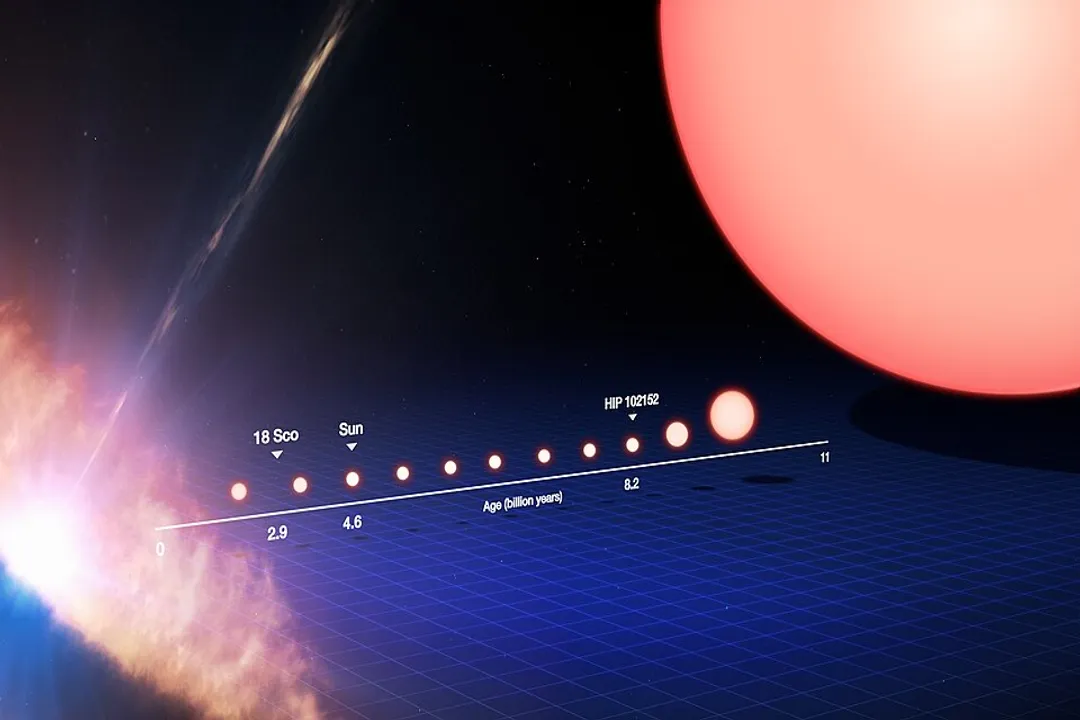
The timescale for a protostar to contract toward a stable configuration—the Zero-Age Main Sequence (ZAMS)—is governed by how quickly the released gravitational potential energy can escape as heat and light. For any given object, the formation time () is roughly proportional to , where is mass, is radius, and is luminosity. The contraction time is dominated by the final stages where the star is achieving hydrostatic equilibrium.
For high-mass protostars, the interior gets so hot that the material becomes highly transparent to photons. This allows energy to escape primarily through radiation. These massive objects contract at an almost constant luminosity, which is itself strongly dependent on mass, often following a relationship where is proportional to . Because the luminosity () scales so steeply with mass, the contraction timescale () scales inversely, roughly as . This steep inverse relationship is why adding just a little more mass leads to a much quicker final contraction.
Low-mass protostars, in contrast, are cooler inside and more opaque to radiation. Their energy transport outwards is often limited by convection rather than pure radiation. They contract while maintaining a nearly constant surface temperature, which causes their luminosity to drop as they shrink, leading to significantly longer contraction timescales. For these smaller objects, the relationship governing the contraction timescale leads to them reaching the ZAMS much later than their massive neighbors.
To put this in perspective, consider the difference in the assembly process:
| Star Type (Relative Mass) | Assembly Driver | Luminosity Scaling (Approx.) | Contraction Timescale () |
|---|---|---|---|
| Low Mass (e.g., ) | Convection limited | Low, falling | Long |
| High Mass (e.g., ) | Radiation dominated | Very High () | Short () |
This physical behavior means that if you were observing a stellar nursery, you would see the massive stars quickly transition from being obscured protostars to shining main-sequence stars, while the less massive stars linger in the pre-main sequence phase far longer.
# Life Span Reversal
The same physical law that dictates faster formation time—the massive core creating intense pressure and heat—also dictates an incredibly brief total lifespan. High-mass stars are indeed the celestial equivalent of a supercar: they are built fast and they burn out even faster.
The core of a massive star is vastly hotter than a Sun-like star's core, which drives nuclear fusion at an exponential rate. While our Sun has a main-sequence lifespan of about 10 billion years, a star just five times the Sun's mass might last only about one hundred million years, and a massive O-type star (10 solar masses) might depart the main sequence in a mere 20 million years. For the very most massive stars, the total life can be less than a million years.
This rapid consumption is necessary because the intense inward pressure from the star's greater gravity requires a massive energy output from the core just to maintain balance against collapse. Lower-mass stars, like M-dwarfs, have a gentle core pressure, fuse their fuel slowly, and can potentially shine for trillions of years, far longer than the universe has currently existed.
This relationship between mass and fuel consumption is quantified in the Mass-Luminosity relation, , where the exponent '' varies but generally shows that luminosity increases much faster than mass. For instance, an O-star might have 60 times the mass of the Sun but possess $1.4$ million times the luminosity. This means it burns its fuel $1.4$ million times faster, even though it only has 60 times the fuel supply, resulting in a drastically truncated existence.
# Post-Main Sequence Haste
The difference in evolutionary pacing doesn't stop once core hydrogen is exhausted; massive stars accelerate through their subsequent life phases as well. Low-mass stars, after leaving the main sequence, ascend the red giant branch relatively slowly before fusing helium in their cores (often with a sudden "helium flash" if they are small enough).
High-mass stars, however, bypass or rush through these stages. Their cores reach the temperatures required for helium fusion before electron degeneracy pressure can significantly stabilize the core, meaning helium ignition happens smoothly, not explosively. As they proceed to fuse heavier and heavier elements—carbon, neon, oxygen, silicon—the timescale for each successive burning stage shrinks drastically. The carbon-burning phase might last only a hundred years, and the final stages leading up to iron formation can occur over mere hundreds of years. Iron is the endpoint for fusion energy release; once an iron core forms, collapse is inevitable, leading to a catastrophic supernova, often before the star even swells into a full-fledged red supergiant, in the case of the largest objects.

# Observing the Formation Window
The fact that high-mass stars form rapidly and then live short, spectacular lives has a direct observational consequence: they are inherently rare. These massive stars, such as the luminous O- and B-type stars, spend an incredibly small fraction of their total existence in the observable pre-main sequence phase compared to smaller stars.
If a low-mass star spends 50 million years collecting mass and settling down, and a high-mass star spends 60,000 years doing the same, and the high-mass star then burns out in 20 million years, while the low-mass star burns for 10 billion years, it becomes clear that massive stars are only observable in star-forming regions for a cosmic blink of an eye. They achieve the necessary stability and then explode, often before we have a long window to study their pre-supernova evolution. This short observable window explains why, even though the Milky Way contains billions of stars, the number of currently existing high-mass stars is relatively small compared to the vast population of longer-lived, lower-mass stars like K- and M-type dwarfs. They simply do not linger long enough to accumulate in large numbers in any given observational snapshot of the galaxy.
#Videos
Why Massive Stars Form Faster Than Low Mass Stars - YouTube
Related Questions
#Citations
20.4 Evolution of Stars More Massive than the S
Why Massive Stars Form Faster Than Low Mass Stars - YouTube
Why do larger mass stars form quicker? - Astronomy Stack Exchange
Stellar evolution - Wikipedia
The Lives of High Mass Stars - NMSU Astronomy
Star Basics - NASA Science