What are the very dense remains of high mass stars?
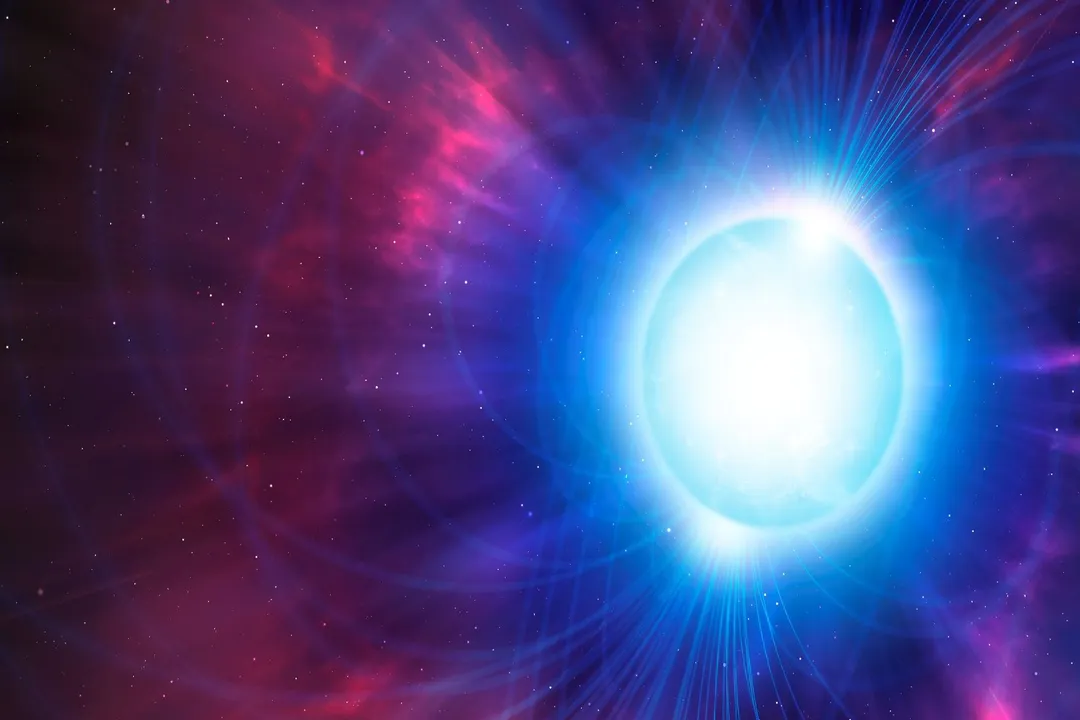
The final moments of a truly massive star are among the most violent and transformative events in the cosmos, culminating in the creation of celestial objects that defy everyday comprehension. When a star significantly larger than our Sun exhausts its nuclear fuel, it undergoes a catastrophic gravitational collapse. This implosion triggers a supernova explosion, and what remains at the center is not a gentle ember but an ultra-compact remnant known as a neutron star. [4][8][9] These are the very dense remains that push the limits of matter itself, existing in a state where gravity has crushed normal atomic structure into something entirely new. [2][5]
# Stellar Demise
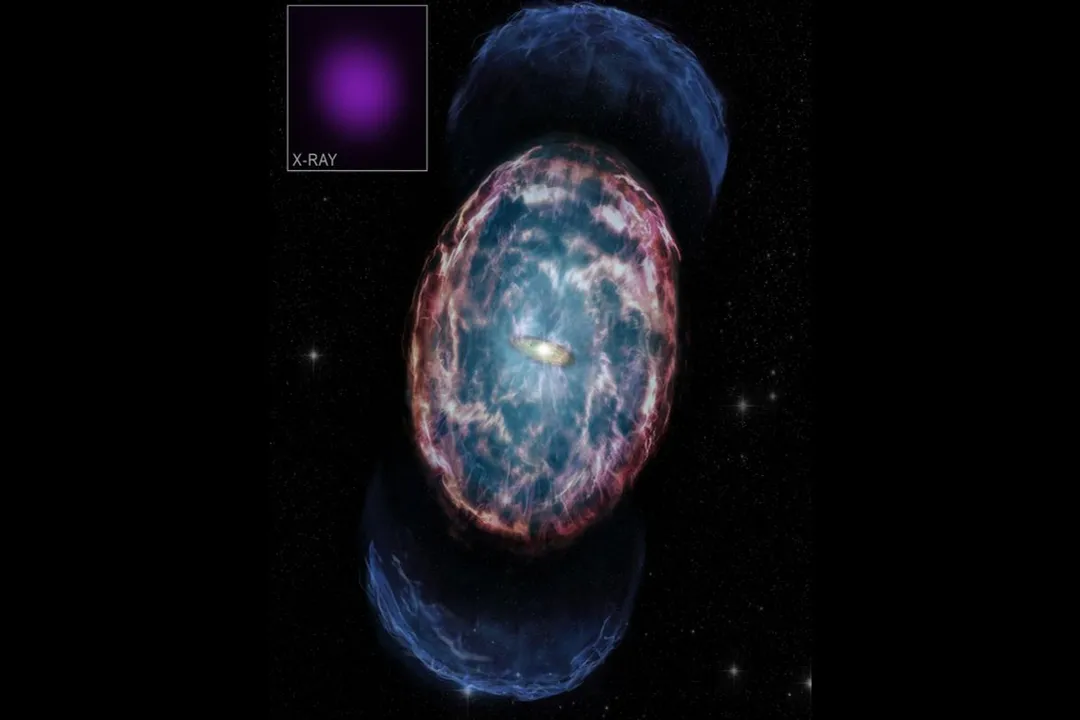
The path to forming such an extreme object begins with stars born with masses typically ranging from about eight to twenty times the mass of our Sun. [9] Throughout their active lives, these giants maintain stability by balancing the inward crush of gravity with the outward pressure generated by nuclear fusion in their cores. [4] Once the core fuel runs out, this balance is lost instantaneously. Gravity gains the upper hand, causing the core to collapse inward incredibly rapidly. [4]
This implosion is so powerful that it compresses the core to densities previously unseen outside the very first moments of the universe. [5] The intense pressure overcomes the fundamental forces that keep atoms separate. Electrons are forced into the protons, combining to form neutrons in a process called inverse beta decay. [1][5] If the remaining stellar core mass falls within a specific, narrow range—generally calculated to be between $1.4$ and approximately $3$ solar masses—this immense pressure is sufficient to halt further collapse, at least temporarily, creating a neutron star. [1][2] If the mass exceeds this upper limit, the collapse continues until a black hole forms. [1] This process of core collapse and subsequent rebound is what results in the bright, energetic supernova explosion observed across vast distances. [8]
# Extreme Compression
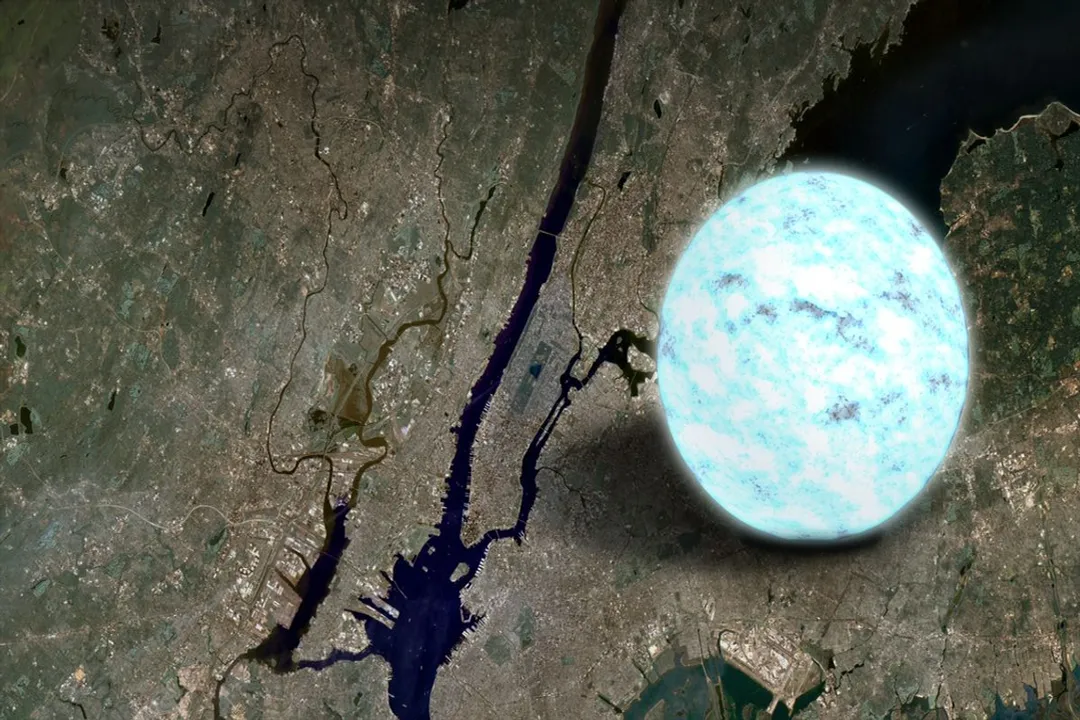
The defining characteristic of a neutron star is its staggering density, a property rooted in its near-total composition of neutrons. [1][5] To visualize this requires abandoning terrestrial scale entirely. Imagine taking something as massive as our Sun, which is over $330,000$ times the mass of Earth, and squeezing it down to the size of a typical metropolitan area. [2] That level of compression leads to a density so extreme that a single teaspoon of this material—often referred to as neutronium—would possess a mass equivalent to billions of tons, or perhaps a few cubic kilometers of terrestrial rock. [2][7]
This matter exists under conditions far outside our everyday experience. The density is so high that the gravitational attraction is immense, and the constituent particles—the neutrons—are packed together so tightly that they are essentially touching. [1][7] This is not simply compressed solid matter; it is a quantum object governed by the rules of degeneracy pressure, where the Pauli Exclusion Principle, which normally prevents two identical fermions (like neutrons) from occupying the same quantum state, provides the final resistance against complete gravitational collapse. [1] While the sources confirm the overwhelming presence of neutrons, [1][5] it's fascinating to consider that the physics literature suggests that even deeper within the core, these neutrons might further break down into a soup of quarks, though the primary structure remains overwhelmingly neutron-based for the observed objects. [1][7]
# Tiny Giants
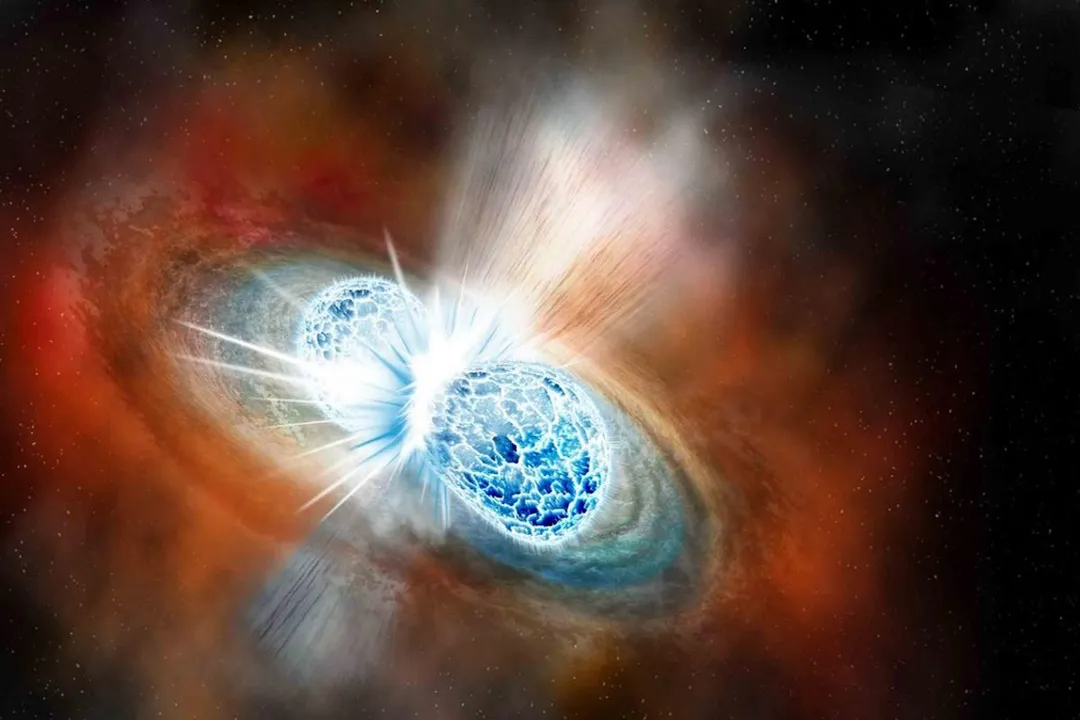
The sheer density translates directly into a surprisingly small physical size for an object holding the mass of several Suns. A typical neutron star has a diameter estimated to be only about $10$ to $15$ miles across, which is roughly the size of a major city like Manhattan or a small European capital. [1][2][4]
To place the relationship between mass and size into clearer perspective, we can see how it compares to other stellar endpoints:
| Stellar Remnant | Typical Mass (Solar Masses) | Typical Diameter (Miles) | Matter State |
|---|---|---|---|
| White Dwarf | (Earth-sized) | Electron Degenerate Matter | |
| Neutron Star | to $3$ | Neutron Degenerate Matter | |
| Black Hole | $> 3$ (Minimum) | Event Horizon (Varies) | Singularity |
When looking at this table, one can appreciate the massive leap in compactness. A white dwarf remnant of about $1.4$ solar masses is roughly the size of Earth, while a neutron star of only a slightly higher mass is reduced to the size of a city. This represents a compression factor of millions to one over a short mass range. This small physical footprint combined with enormous mass creates conditions that generate extreme physical effects across its surface and immediate surroundings. [2]
# Physical Extremes
Beyond density, neutron stars inherit and amplify the most extreme characteristics of their progenitor stars, resulting in environments unlike any other stable object in the universe. Their gravitational fields are second only to black holes. [2] The surface gravity is so intense that standing on a neutron star would instantly crush any ordinary object or person—the gravitational acceleration is billions of times stronger than Earth's. [2]
Furthermore, as the star collapses, the principle of conservation of angular momentum dictates that its rotation must speed up dramatically, much like an ice skater pulling in their arms. [2] While the parent star might have taken weeks or months to complete one rotation, the newly formed neutron star can spin hundreds of times every second. [2] These rapidly spinning, highly magnetized objects are frequently observed as pulsars, beaming radiation out from their magnetic poles like cosmic lighthouses. [2] If these beams sweep past Earth, we detect them as regular pulses of radio waves or other electromagnetic radiation. [2]
The magnetic fields generated are equally astonishing. They can be trillions of times stronger than Earth's magnetic field. [2] Some particularly powerful neutron stars, known as magnetars, possess fields so strong they warp space-time around them, potentially having field strengths a quadrillion times greater than Earth's. [2] These powerful magnetic fields channel the charged particles escaping the surface, creating the intense beams observed in pulsars. [2]
# The Remnant Line
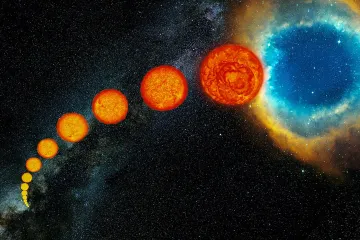
Neutron stars occupy a specific and critically important niche in stellar astrophysics—they are the middle ground between the stellar corpses of lower-mass stars and the ultimate gravitational endpoint. Stars less massive than about eight solar masses usually shed their outer layers, leaving behind a white dwarf, supported by electron degeneracy pressure. [1][9] If the star is extremely massive, the collapse proceeds past the neutron star stage, creating a black hole. [1] The neutron star, therefore, is the direct outcome of a delicate, high-mass supernova where the forces of gravity are powerful enough to overcome electron resistance but are narrowly checked by the more robust neutron degeneracy pressure. [1][5] This narrow band of possible outcomes is what makes the mass measurement of these remnants so scientifically valuable; it directly tests our understanding of the strongest forces in nature, sometimes referred to as the equation of state for super-dense matter. [1] It is a compelling realization that the difference between a city-sized object and a point of infinite density is often just a fraction of a solar mass left behind after the explosion. [1]
# Observing the Faint
Detecting these incredibly small, incredibly dense objects is a profound challenge. Because they are so small—a few dozen kilometers across—they do not shine brightly in visible light after the initial supernova fades. [2] Modern astronomy relies on detecting their more energetic emissions. The most famous signatures come from the aforementioned pulsars, where the regular timing of the pulsed radiation allows for precise measurement of their spin rates and any slight changes over time. [2] Scientists also use X-ray observatories to detect radiation emanating from the incredibly hot surfaces of young neutron stars or from the accretion disks formed if the neutron star is in a binary system with another star. [2] Studying the thermal radiation and the X-ray bursts from these systems provides crucial empirical data that constrains theoretical models about the internal structure and composition of these collapsed cores. [2]
The universe presents these collapsed cores as extreme laboratories. They are not simply the end of a star's life; they are objects where matter itself is compressed to a state that cannot be replicated on Earth, offering direct observational evidence about nuclear physics at densities far exceeding those found in atomic nuclei. [1][7] Understanding the formation and properties of these stellar remnants gives us essential insight into the structure of the cosmos and the fundamental limits of matter under extreme pressure. [9]
#Videos
Neutron Stars – The Most Extreme Things that are not Black Holes
Related Questions
#Citations
Neutron star - Wikipedia
Neutron Stars - Imagine the Universe! - NASA
Neutron stars are incredibly dense remnants of massive stars
What are neutron stars? - Space
Neutron Stars – The Most Extreme Things that are not Black Holes
Neutron Stars: Fascinating Remnants of Massive Star Explosions
How is neutron star matter so dense that a teaspoon of it weighs 10 ...
Supernova explosions - Las Cumbres Observatory
Very High-Mass Stars | AMNH