What are the remains of a mass star?
The fate of a star hinges critically on its starting mass, and for the most luminous and hefty members of the galactic population, their demise is anything but quiet. When a massive star exhausts the nuclear fuel in its core, it undergoes a catastrophic gravitational collapse, the direct result of which is the creation of some of the universe's most extreme physical states: a neutron star or a black hole. [5][7] Before these exotic objects are formed, however, the star violently sheds its outer layers in a spectacular supernova explosion. [2] Understanding the remains requires tracing this three-step process: the trigger, the explosion, and the resulting compact object. [3][9]
# Stellar Mass
Stars are broadly categorized based on their mass relative to our Sun. Stars similar in mass to the Sun meet their end more gently, puffing off their outer layers to become planetary nebulae surrounding a cooling white dwarf. [5][6] A star is generally classified as massive if its initial mass exceeds about eight times the mass of the Sun. [5] These high-mass stars burn through their fuel much faster, often leading to successive burning stages in their cores—fusing elements up to iron—before collapse becomes inevitable. [9] Iron fusion consumes energy rather than releasing it, which provides no outward pressure to counteract the crushing weight of the star's own gravity. [3] This lack of thermal support is the trigger point for the star's death. [1]
# Core Collapse
Once the iron core forms, the internal pressure supporting the star vanishes almost instantaneously. Gravity takes over, causing the core to collapse inward at speeds reaching nearly a quarter of the speed of light. [3] As the core shrinks from a size comparable to Earth down to just a few tens of kilometers, the density increases astronomically. [1] When the density reaches that of an atomic nucleus, the collapse is violently halted when the nuclei literally smash together. [3] This sudden stop causes the infalling outer layers of the core to rebound off the incompressible inner region, driving a shockwave outward that tears the star apart in a Type II Supernova. [2][3] What remains after this cosmic detonation depends entirely on the mass of that collapsed core material that did not escape in the explosion. [7]
# Neutron Stars
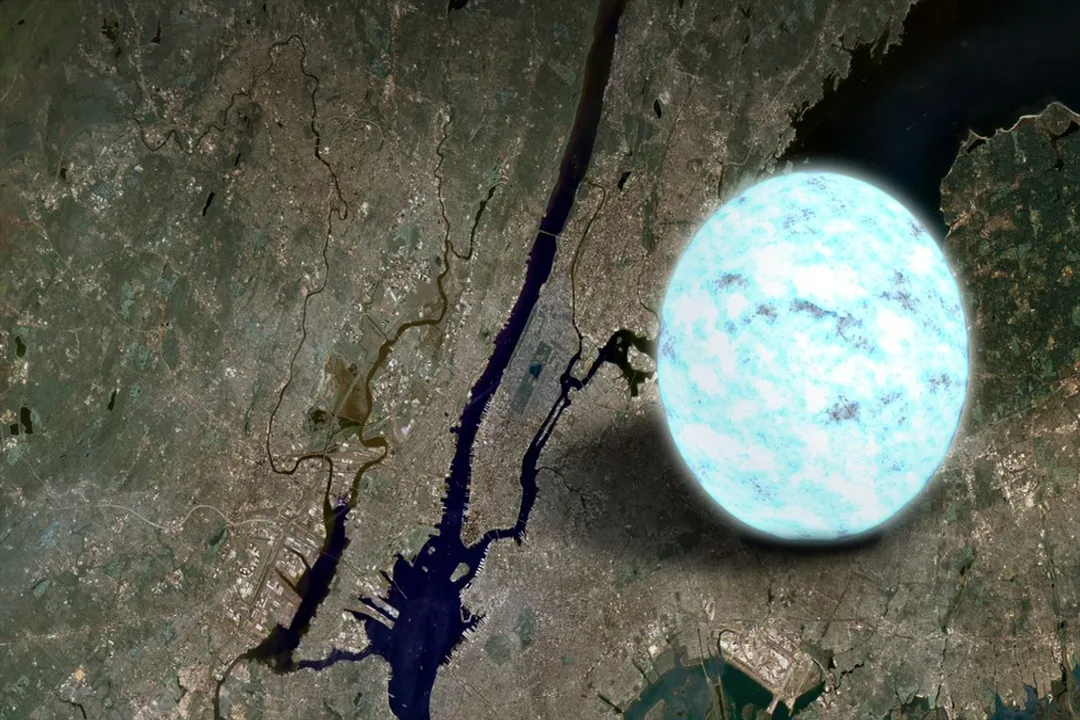
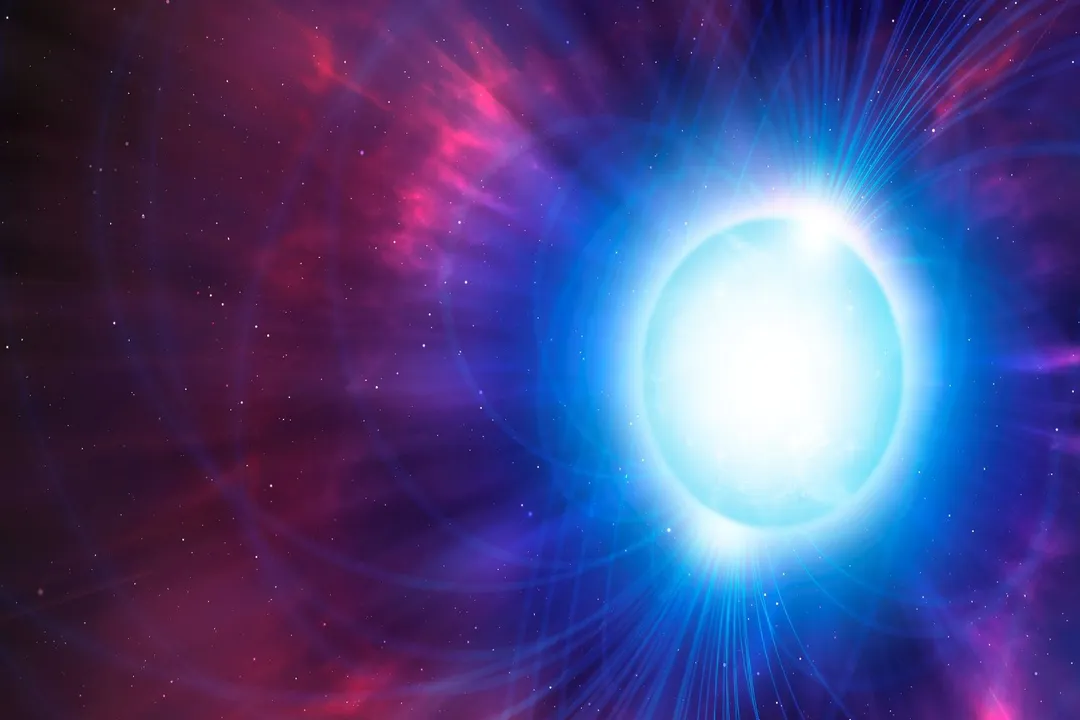
If the mass of the collapsed core is between about $1.4$ and $3$ times the mass of the Sun, the tremendous pressure forces electrons to combine with protons, effectively squeezing the material into a ball composed almost entirely of neutrons. [1][4] This object is the neutron star. [4] Despite containing more mass than the Sun, a neutron star is often only about $20$ kilometers across—the size of a small city. [4][6] The density achieved here is staggering; a single cubic centimeter of neutron star material would weigh billions of tons. [4] This object is stabilized by neutron degeneracy pressure, a quantum mechanical effect that prevents neutrons from occupying the same state. [1]
Consider that the surface of a neutron star is often described as a crystalline crust of heavy nuclei resting on a sea of degenerate neutrons. This structure implies a material strength incomprehensibly greater than any known substance on Earth—it’s matter pushed to the absolute brink of stability before fluidizing into the superfluid interior. [4]
The maximum mass a neutron star can sustain before collapsing further is known as the Tolman-Oppenheimer-Volkoff (TOV) limit, which is estimated to be around $2$ to $3$ solar masses, though the precise value is still a subject of ongoing research. [3][7]
# Black Holes
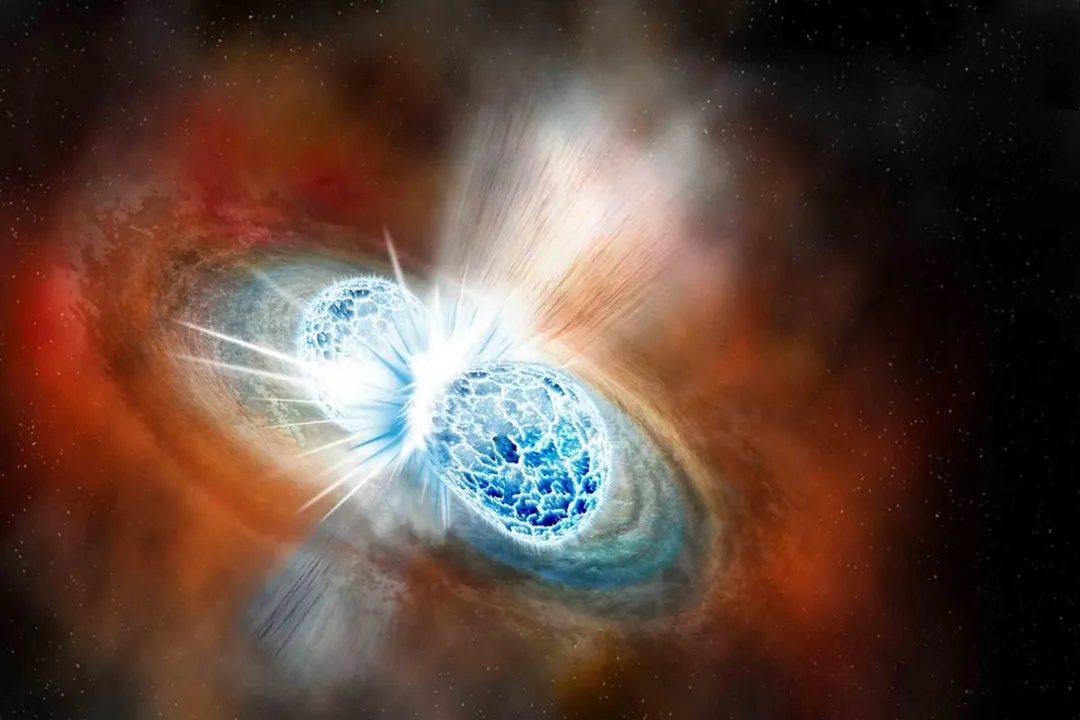
If the original star was extremely massive—perhaps beginning its life at over $20$ to $25$ solar masses—the remnant core after the supernova may exceed the TOV limit. [7] In this scenario, there is no known force in the universe strong enough to halt the gravitational collapse. [1] The core shrinks past the point where even neutron degeneracy pressure can offer resistance, continuing to collapse down to a single point of infinite density called a singularity. [7]
Surrounding this singularity is the event horizon, a boundary in spacetime from which nothing, not even light, can escape its gravitational pull. [1] This completely collapsed object is the black hole. [7] While we cannot observe the singularity itself, we detect black holes by observing their powerful gravitational effects on nearby stars and gas, or through the intense X-rays generated by material spiraling inward before crossing the horizon. [1]
# Ejecta Cloud
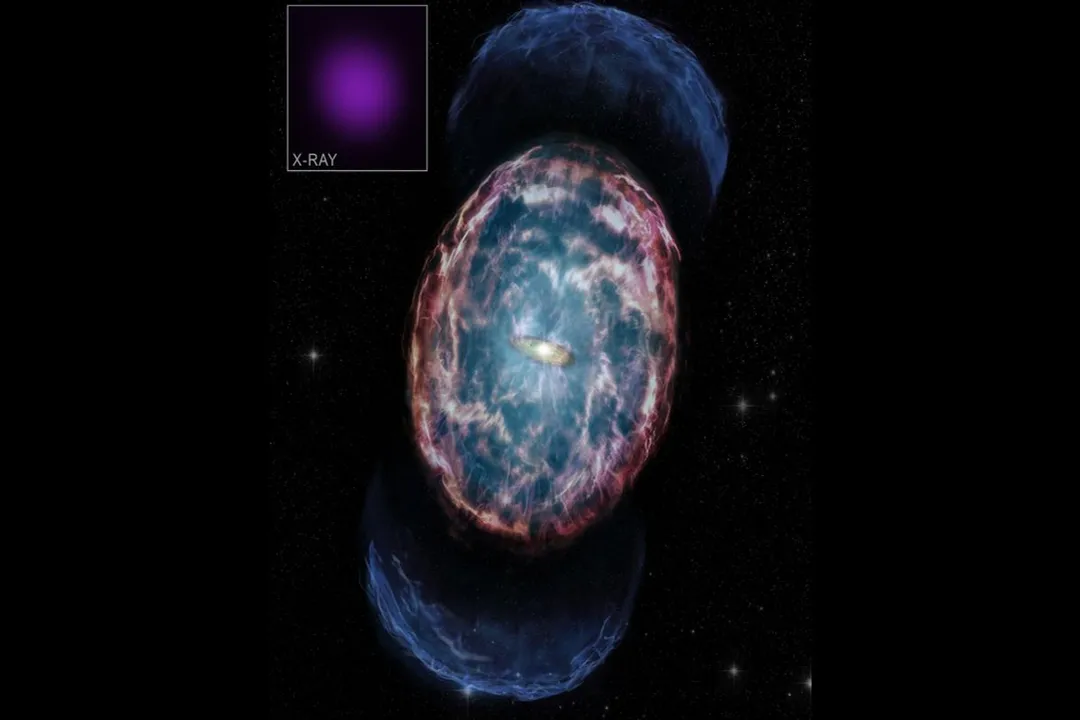
The remaining mass of the star—the explosion's ejecta—forms the third component of the star's remnants, known as the supernova remnant. [2] This material, consisting of ionized gas and dust heated to millions of degrees, expands rapidly into the surrounding interstellar medium. [6] These remnants can persist for tens of thousands of years, often exhibiting intricate, shock-heated structures visible across the electromagnetic spectrum. [2]
The material within these expanding clouds is fundamentally important to the cosmos. The star's life synthesized lighter elements, but the violence of the supernova explosion itself is responsible for creating elements heavier than iron, such as gold, silver, and uranium, through rapid neutron capture processes. [9]
The material ejected during these explosions, rich in elements heavier than iron that were forged either in the star’s life or during the collapse itself, acts as the raw material, seeded with the building blocks for future rocky planets and life. Every ounce of silicon, gold, or uranium on Earth was synthesized and scattered by these violent stellar deaths, linking the fate of distant supergiant stars directly to the composition of our own world. [2][9]
The study of these remnants—the dense neutron star or the invisible black hole, set against the backdrop of an expanding shell of enriched gas—provides astronomers with direct evidence of the extreme physics governing matter under pressures unattainable anywhere else in the observable universe. [3][5]
#Videos
Exploring The Mysterious Dead Stars Of The Universe - YouTube
Related Questions
#Citations
What's Inside a 'Dead' Star? - NASA Science
Supernova remnant - Wikipedia
[PDF] Stellar Remnants
What are neutron stars? - Space
Stellar Evolution - | The Schools' Observatory
Planetary Nebula - ASPIRE
Lecture 19: The Fate of Massive Stars
Exploring The Mysterious Dead Stars Of The Universe - YouTube