What is the mass of one star?
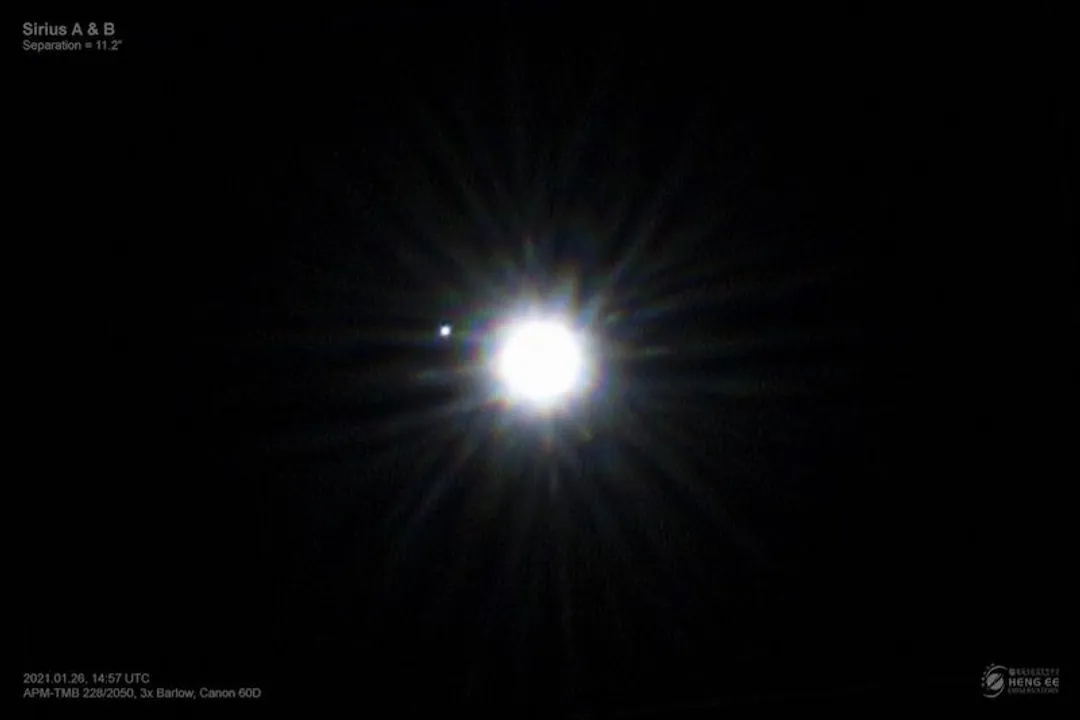
Stellar mass is the single most important characteristic defining a star’s life, dictating its temperature, its luminosity, and ultimately, its fate. [1][2] Astronomers quantify this mass, which is essentially a measure of how much matter an object contains, by using the mass of our own Sun as the universal yardstick, referred to as a solar mass (). [1][4] For context, one solar mass equals approximately kilograms, or about 333,000 times the mass of our home planet, Earth. [1] While the universe teems with an estimated septillion stars, with over 100 billion residing in the Milky Way alone, the mass of any single star can vary dramatically from this baseline. [2][3] The bright star Sirius, for example, clocks in at about . [1]
# Cosmic Scales
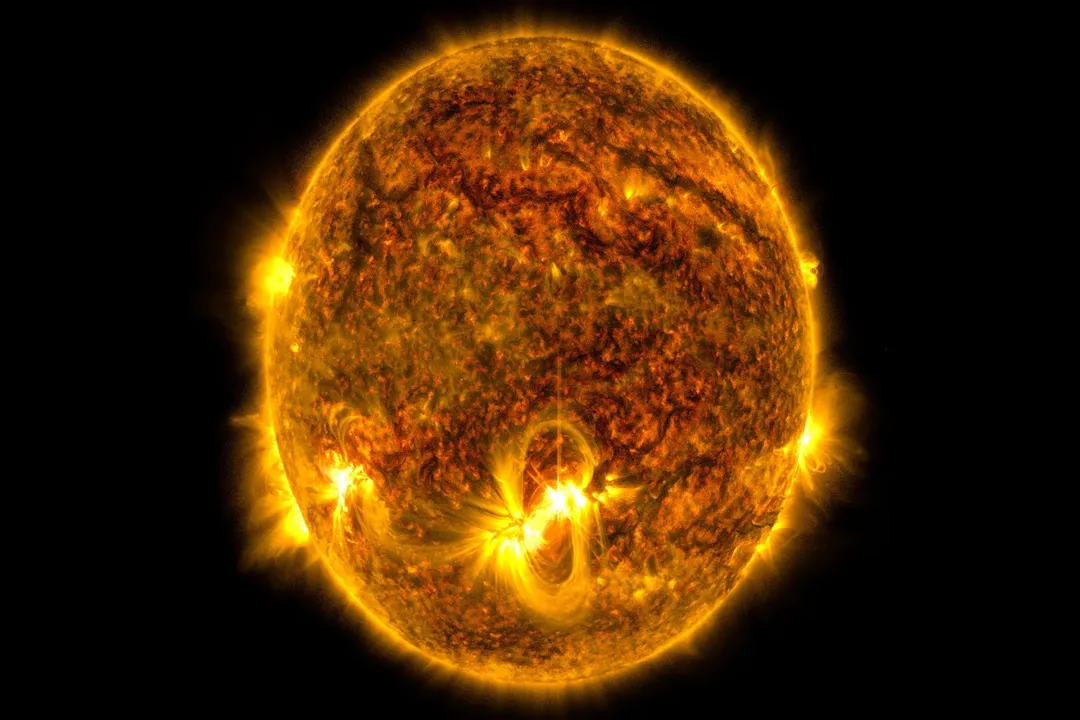
To grasp the sheer dynamic range in stellar masses, it is helpful to look at the extremes currently observed in the cosmos. The lower boundary of what qualifies as a true star—an object hot and dense enough in its core to sustain nuclear fusion of hydrogen into helium—is around $0.075$ to $0.09$ solar masses, or roughly 75 to 93 times the mass of Jupiter (). [1][2] Objects below this threshold, which cannot ignite sustained hydrogen fusion, are classified as brown dwarfs, occupying a grey area between giant planets and true stars. [1][3] On the opposite end of the scale are the monstrous beacons of the universe. Stars more massive than the Sun are rare, yet the most massive observed candidates, like in the cluster, challenge theoretical expectations with measured masses of . [1] Even the ancient, unobservable Population III stars, theorized to have formed from pristine material after the Big Bang, might have reached or more. [1] The massive stars of today, like (), live incredibly fast, burning through their fuel in mere millions of years compared to the trillions potentially allotted to the smallest red dwarfs. [1][2]
For general reference, here is a compilation of the mass boundaries derived from current understanding:
| Object/Classification | Mass in Solar Masses () | Notes |
|---|---|---|
| Jupiter () | Baseline for comparison. | |
| Smallest Known Star | . [1] | |
| Theoretical Minimum Star | Minimum for sustained fusion. [1][2] | |
| Sun (Average Yellow Star) | Mid-range on the main sequence. [2][3] | |
| Sirius A | Brighter component of the Sirius binary. [3] | |
| Upper Limit (Common) | Limited by Eddington Luminosity. [1] | |
| Most Massive Known Star | . [1] |
# Finding Mass
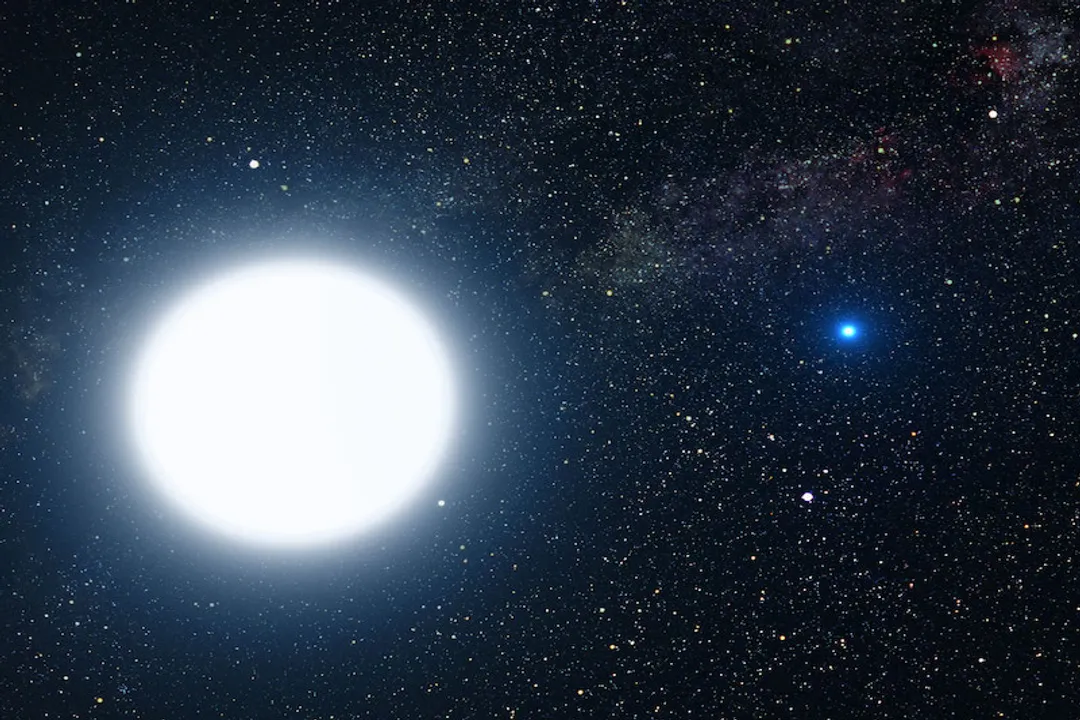
Directly placing a star on a cosmic scale is, of course, impossible. Astronomers must instead rely on gravity's effects, primarily through the analysis of orbital mechanics. [3] This method is most reliable for binary star systems, which are surprisingly common, making up an estimated 80% of all stars. [1][4]
# Binary Laws
In a binary system—two stars gravitationally bound and revolving around a common center of mass, or barycenter—we can determine the sum of their masses by observing just two properties: the average separation distance between them (the semi-major axis, ) and their orbital period (). [1][3] This calculation uses Newton's reformulation of Kepler's Third Law:
This formula works perfectly when is measured in astronomical units (AU), is in Earth years, and the resulting total mass () is in solar masses (). [3][4] For example, using the observed values for Sirius A and B—an average separation of about $19.8$ AU and a period of $50.1$ years—the combined mass comes out to approximately $3.09$ solar masses. [1]
The total mass only gives us the system's weight; to find the mass of each individual star, we need to know how far each star orbits from that barycenter. [1][4] Because the barycenter is always closer to the more massive component, the star with greater mass will have a smaller orbital radius and move more slowly than its companion. [4] For Sirius, the fainter companion, Sirius B, orbits about twice as far from the barycenter as Sirius A. This relationship means Sirius B has roughly half the mass of Sirius A. Coupled with the total mass of (as calculated in one example), this leads to Sirius A being around and Sirius B about . [1][3]
# Spectral Clues
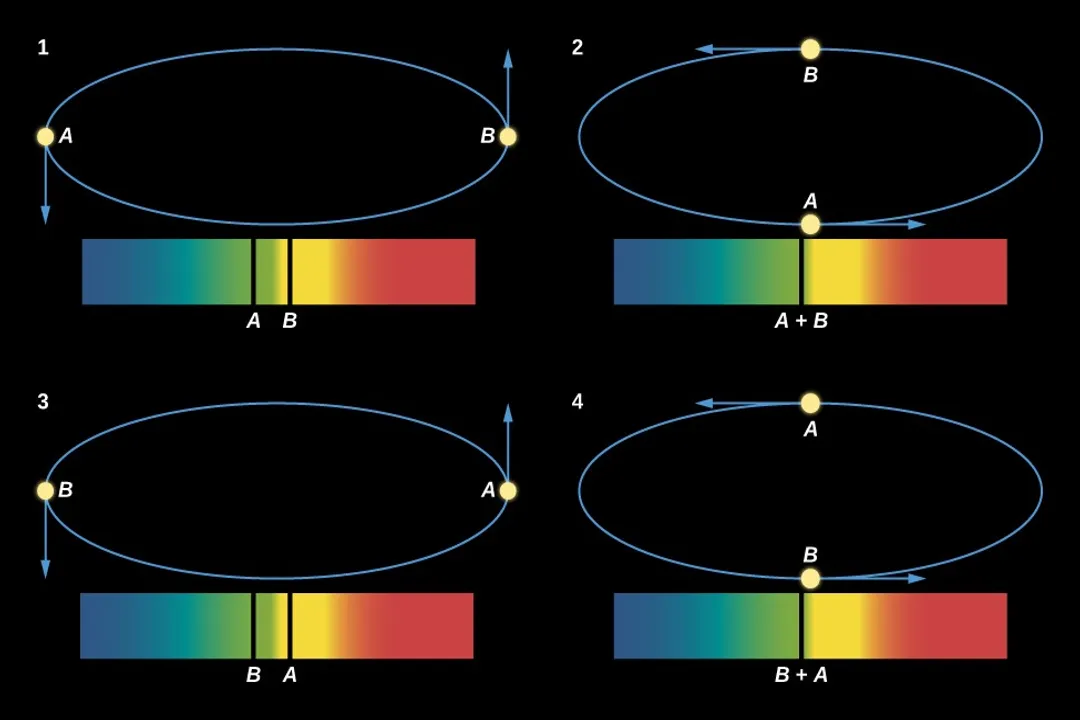
The method of measurement depends on how the binary system appears to us. Visual binaries, like Sirius, allow us to see both components and map their orbits directly. [3] However, many systems are too distant for visual separation. These are spectroscopic binaries, where the binary nature is revealed when observing the stars’ combined light spectrum. [3] As the stars orbit, one moves toward us while the other moves away, causing the spectral lines to alternately shift toward the blue end (blueshift) and the red end (redshift)—a phenomenon known as the Doppler effect. [3] Analyzing the periodic change in these radial velocities allows astronomers to construct a radial velocity curve, from which the orbital speeds, periods, and ultimately the individual masses can be extracted, even without seeing the stars separately. [3][4]
# Single Star Estimation
What about the stars that do orbit in isolation, like our Sun? For these single stars, the physical properties of their binary brethren become indispensable. [3] Once masses and luminosities () have been calibrated using binary systems, astronomers establish the mass-luminosity relation. [3] This empirical rule shows that for about 90% of main sequence stars, the more massive a star is, the more luminous it is. [3] Mathematically, this is approximated as luminosity being proportional to the mass raised to the $3.9$ power (), or often simplified to the fourth power (). [3]
This relation allows for mass estimation based on brightness alone. If a star's luminosity is known relative to the Sun, its mass in solar units can be calculated by taking the fourth root of its luminosity: . [3] This provides a powerful tool for surveying the galaxy, but it comes with a caveat. The fourth-power dependence means that a small error in measuring the luminosity translates into a larger error in the derived mass. If one star is only one-third the mass of another, it will be approximately $81$ times less luminous, meaning even slight uncertainties in that faint measurement compound quickly when working backward to the mass. [3] It is a necessary approximation for most stars, but the direct, gravity-based method from binary systems remains the gold standard for accuracy. [3][4]
# Mass and Destiny
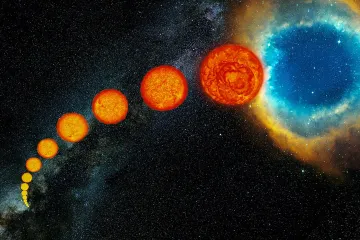
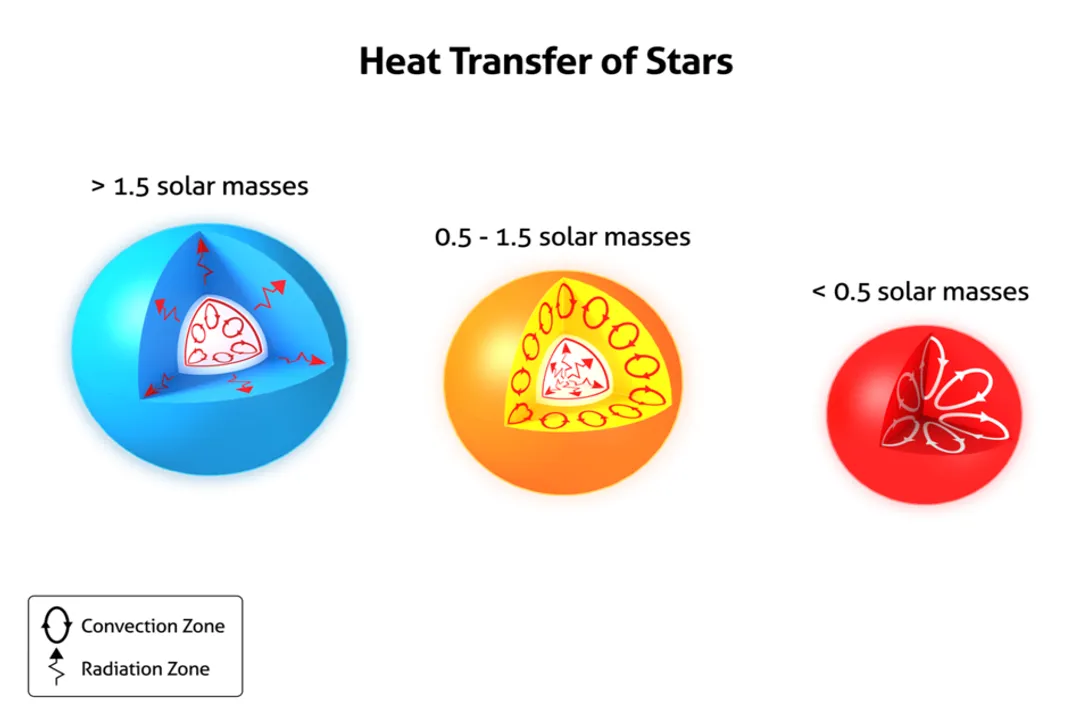
The mass a star begins with fundamentally dictates its entire life cycle, including how it shines and how it will end. [1][2] Stars spend the longest phase of their lives fusing hydrogen in their core, a stable period called the main sequence. [3] More massive stars achieve hotter, higher-pressure cores, causing them to consume their hydrogen fuel at an exponentially faster rate. [1][2] A star twice the Sun's mass can have over eleven times the Sun's luminosity, meaning it burns its fuel supply far more rapidly, resulting in a lifespan measured in millions of years, while the Sun has an expected main sequence life of about 10 billion years. [2] Low-mass stars, conversely, may persist for trillions of years. [1][2]
When the core hydrogen is exhausted, the star leaves the main sequence, and mass determines the path:
- Low-Mass Stars (under ): These stars eventually become red giants, fuse helium into carbon and oxygen, and end their lives by ejecting their outer layers as a planetary nebula, leaving behind a dense, cooling white dwarf core. [1][2] Our Sun is destined for this path. [2]
- Massive Stars (): These stars continue fusion past carbon, building up heavier elements like silicon, until the core produces iron. [1] Iron fusion consumes energy instead of releasing it, leading to catastrophic core collapse and a rebound explosion known as a supernova. [1] The dense remnant is either a neutron star or, for the most massive progenitors, a stellar-mass black hole. [1]

# Continuous Change
A star's mass is not static throughout its life. It is constantly being altered by two primary processes: losing mass or gaining it. [1] Stars shed material through stellar winds, which, in our Sun's case, expels about per year. [1] This loss accelerates dramatically in later evolutionary stages; for the Sun, mass loss spikes during the red giant and asymptotic giant branch phases, ultimately leading it to lose nearly half of its starting mass before settling as a white dwarf. [1] Alternatively, stars in close binary pairs can accrete matter from a companion, increasing their own mass in the process. [1] This accretion, or collision and merger, may even be the mechanism that allows some stars, like , to bypass the theoretical limit imposed by the Eddington luminosity, where outward radiation pressure would normally blow off a star's atmosphere. [1] In essence, the mass of a star is a dynamic ledger, tracked by measuring loss through wind and gaining through gravitational interaction, all of which points back to its initial birth mass as the primary determinant of its stellar biography. [1]
Related Questions
#Citations
Stellar mass - Wikipedia
Star Basics - NASA Science
[PDF] Sizes of Stars
Stars - Sun.org
Measuring Stellar Masses | Astronomy - Lumen Learning
The Masses of Stars - Astronomy Notes
Mass of Stars - Universe Today
The mass of a star is determined from binary star systems - EarthSky