What happens to the core of a high-mass star when it runs out of hydrogen?
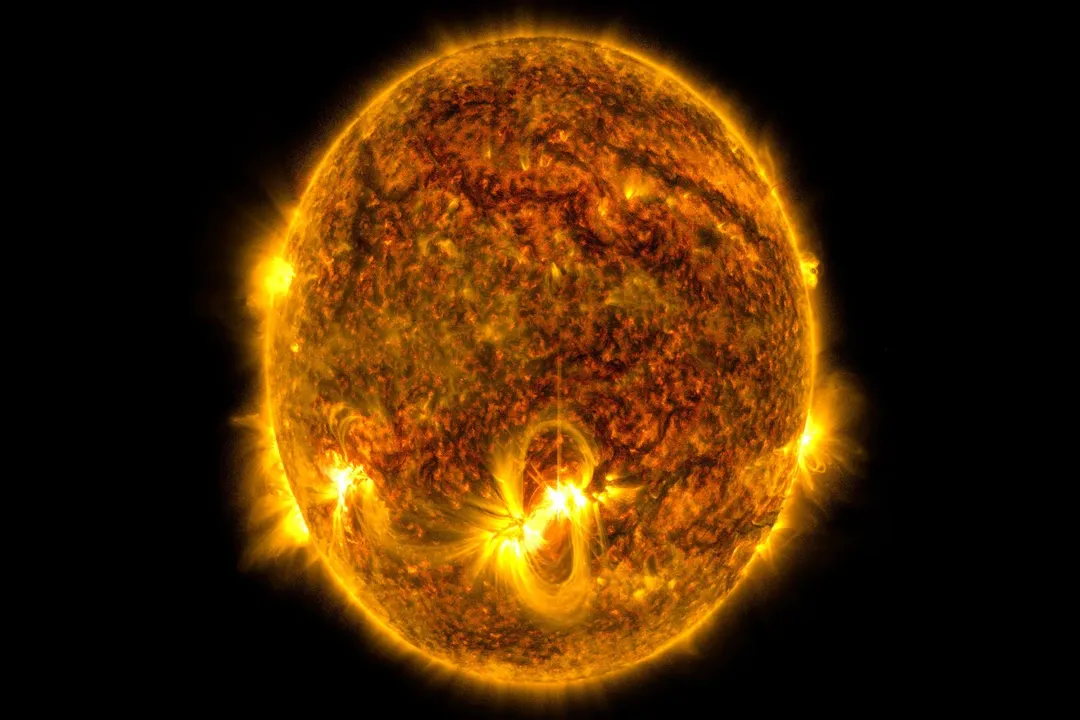
The stellar life of a high-mass star, one significantly heftier than our Sun, is generally a dramatic affair, but the true spectacle begins precisely when the hydrogen fuel in its very core runs dry. During its long tenure on the Main Sequence, the star maintained a delicate hydrostatic equilibrium, using the energy from fusing hydrogen into helium to resist the crushing inward force of its own gravity. Once that core hydrogen is entirely converted to inert helium ash, the engine sputtering in the center, the star doesn't simply switch off; it enters a furious new phase of structural reorganization.
# Fuel Exhausted
When the hydrogen fusion ceases in the star's center, the primary source of outward pressure vanishes from that region. Gravity, which has been patiently waiting for this moment, gains the upper hand, causing the now helium-rich core to begin contracting violently. This gravitational collapse is the key mechanism that drives the next stages of stellar evolution for any massive object that has exhausted its primary fuel supply.
# Core Heating
The contraction of the core does not happen in isolation; it is an intensely energetic process. As the mass of the core squeezes inward, the potential energy stored in that mass is converted into thermal energy, dramatically increasing the core's temperature and density. This heating is crucial because it sets the stage for the star's next act. While the core is shrinking and heating, the layer of gas just outside the core, which is still rich in unused hydrogen, finds itself compressed and heated to the required ignition temperature for fusion.
This onset of fusion in a shell surrounding the inert core marks a profound shift in the star's structure. The new energy pouring out from this hydrogen-burning shell is far more powerful than the previous core burning output. The star inflates massively, its outer layers ballooning outward across astronomical distances. The star transitions from its youthful Main Sequence state into a Red Supergiant, a phase characterized by an enormous, comparatively cool surface, even though the interior is burning hotter than ever before.
Here is where we see a major divergence in stellar destiny based purely on mass. For solar-mass stars, this expansion leads toward becoming a Red Giant, but for high-mass stars, the scale of this inflation is staggering, often enveloping orbits that dwarf our own solar system. This initial shell burning is a temporary reprieve, however, because the helium core continues to shrink beneath this new furnace.
An interesting consequence of this dual-layer activity—hydrogen burning in a shell and helium settling in the core—is the comparative timescale. The core hydrogen burning phase lasts the longest, perhaps millions of years for a massive star, but once that fuel is gone, the subsequent stages, driven by shell burning and core collapse, accelerate with startling speed. It is a cascade effect; each subsequent fusion cycle is shorter-lived than the one preceding it, as the star must achieve exponentially higher core temperatures to ignite the next element. This increasing instability is a hallmark of high-mass stellar death.
# Element Layers
The intense pressure and temperature generated by the contracting helium core eventually become sufficient to initiate the next step: helium fusion. When the core hits roughly , helium nuclei begin fusing together, primarily creating carbon, through a process known as the triple-alpha process.
Once the helium in the core is exhausted, the entire process repeats itself on an even grander, faster scale. The core, now composed primarily of carbon and oxygen, contracts again under gravity until it reaches the ignition point for carbon fusion. This sets up yet another set of concentric shells of fusion activity—an "onion-skin" structure where different elements burn simultaneously in layers surrounding the growing, heavier core.
For a high-mass star, this layering continues sequentially:
- Hydrogen fuses into Helium (outermost shell).
- Helium fuses into Carbon and Oxygen (next inner shell).
- Carbon fuses into heavier elements.
- Neon, Oxygen, and Silicon follow suit in progressively deeper shells.
This layered structure allows the star to sustain itself for a time, but each subsequent layer is shorter-lived. Where the hydrogen burning lasted for millions of years, the silicon burning stage—the penultimate step—might last only for a single day.
# Iron Limit
The rapid procession of fusion stages ends abruptly when the core material becomes iron (). Iron holds a unique, frustrating position in stellar nucleosynthesis: fusing iron consumes energy rather than releasing it. This is because iron is the most tightly bound nucleus in the universe; any attempt to combine iron nuclei (fusion) or split them (fission) requires an input of external energy to drive the reaction forward.
When the core turns to iron, it has reached a dead end for thermal energy production. The outward pressure that has supported the star for its entire life instantly disappears across the entire central mass. The star has no thermal mechanism left to fight the inward pull of gravity.
# Final Moments
With no opposing pressure, the iron core collapses catastrophically in a matter of seconds. The density reaches truly incomprehensible levels as the stellar material plunges inward. This collapse continues until the core is compressed so tightly that atomic nuclei are crushed together, halting the inward motion through neutron degeneracy pressure.
The shockwave generated by this sudden, hard stop rebounds outward through the rest of the star's layers. This intense rebound, coupled with a massive flood of neutrinos escaping the newly formed neutron core, drives the outer layers of the star into space in one of the universe's most violent events: a Type II Supernova.
The final remnant left behind depends entirely on the original mass of the star, or more precisely, the mass of that collapsed iron core. If the core remnant is between about and solar masses, it will stabilize as an incredibly dense neutron star. However, if the progenitor star was exceptionally massive, the core's gravity will overwhelm even neutron degeneracy pressure, and the collapse will continue unimpeded, resulting in the formation of a black hole. Thus, the moment hydrogen in the core is spent sets the clock ticking toward one of these two exotic, extreme endpoints.
#Videos
How Does A Star's Hydrogen Fuel Loss Impact Its Core? - YouTube
Related Questions
#Citations
Star Basics - NASA Science
When a star runs out of hydrogen, it begins using helium as fuel. Is ...
Star Life Cycle - ASPIRE
What happens to a high mass star after it runs out of hydrogen?
High mass star - Las Cumbres Observatory
Red Giant - ESA/Hubble
[PDF] Death of Stars
How Does A Star's Hydrogen Fuel Loss Impact Its Core? - YouTube
Stellar Evolution - | The Schools' Observatory
What will happen to the sun when it runs out of hydrogen? - Facebook