What happens when the core of a massive star collapses?
The dramatic death of a truly massive star is arguably the most energetic event in the known universe, a process that begins when the delicate balance between gravity and internal pressure finally tips. For stars significantly more massive than our Sun—those starting with at least eight times the Sun's mass, and up to potentially 90 times or more—the end stage is not a quiet fade, but a catastrophic core collapse leading to a supernova explosion.
# Stellar Evolution
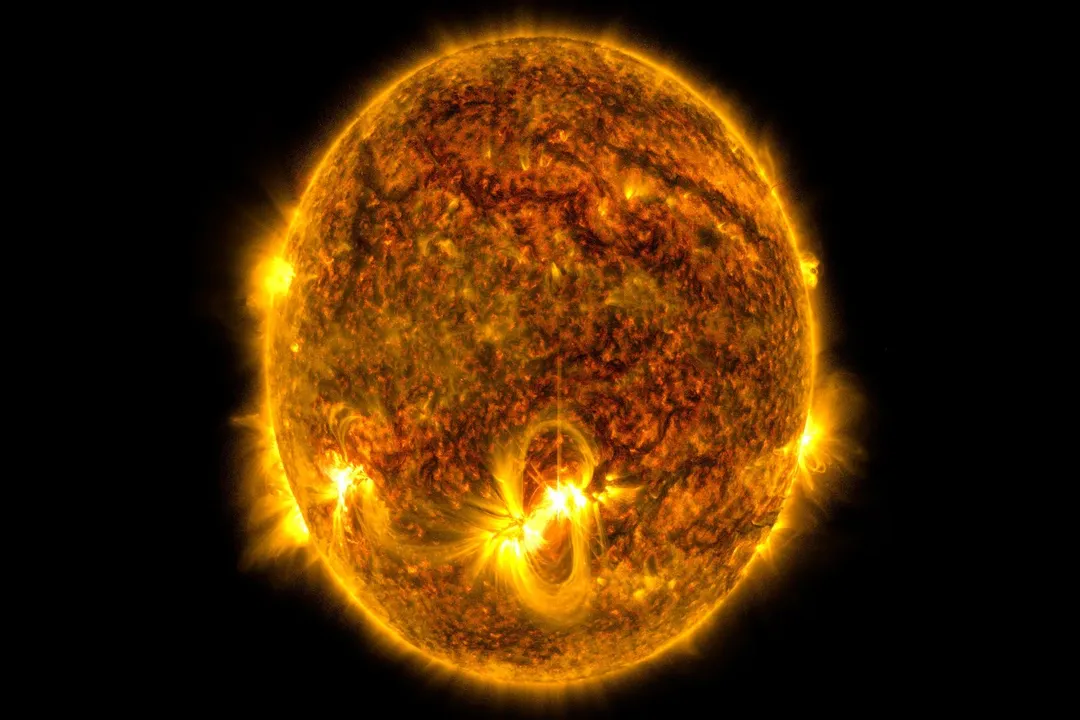
Throughout most of its life, a star maintains stability, known as the main sequence, by fusing hydrogen into helium in its core. The outward pressure generated by this fusion energy perfectly counteracts the crushing inward pull of the star's own gravity. When the core depletes its hydrogen fuel, the outward pressure drops, and gravity forces the core to contract and heat up again, igniting the next element in the fusion chain.
For massive stars, this process is a relentless, escalating series of nuclear reactions happening in nested layers, much like the layers of an onion. After hydrogen fuses to helium, the star burns helium into carbon and oxygen. As the star ages, these burning stages accelerate, progressing to neon, oxygen, and finally silicon. Each subsequent stage provides less energy and lasts for a significantly shorter period than the last. The process culminates in the formation of an iron core.
# Iron Crisis
Iron marks the absolute end of the line for stellar energy generation. Nuclei up to iron have a positive binding energy contribution, meaning that fusing them releases energy that keeps the star stable. Iron, however, is the most stable element; fusing iron nuclei together requires an input of energy rather than releasing it.
Once the core is composed of iron, the star loses its primary energy source instantaneously. At this critical point, the immense gravity is momentarily held in check only by the quantum mechanical pressure exerted by degenerate electrons—a concept related to the Pauli exclusion principle. However, as the iron core grows beyond a certain threshold, called the Chandrasekhar mass limit (about $1.4$ solar masses), the electron degeneracy pressure is no longer sufficient to support the star's colossal weight. The star is doomed, and the collapse begins in earnest, with less than a second remaining before utter transformation.
# Implosion Events
The gravitational collapse is terrifyingly swift. The inner core caves in on itself at velocities that can reach up to , which is a substantial fraction of the speed of light, or about . This rapid implosion triggers two key phenomena that fundamentally change the core's composition: photodisintegration and electron capture.
High-energy gamma rays generated by the skyrocketing core temperature break apart the iron nuclei into lighter components, like helium nuclei (alpha particles), a process called photodisintegration. This process is devastating to the core's pressure because it consumes the very thermal energy that was resisting gravity. Simultaneously, the extreme density forces electrons to combine with protons, effectively squeezing them into neutrons—a process called neutronization or electron capture.
This entire sequence of collapse, photodisintegration, and neutronization releases an overwhelming amount of energy, which is carried away almost entirely by a massive burst of neutrinos. It is estimated that about $99%$ of the total gravitational binding energy released goes out in this neutrino burst—roughly joules, equivalent to about $10%$ of the star’s total rest mass converted to energy.
The core contracts until its density rivals that of an atomic nucleus, reaching nuclear density. At this point, the strong nuclear force between the neutrons and protons becomes powerfully repulsive, halting the inward march of matter. The inner core overshoots this equilibrium point and rebounds explosively.
# Shock Stall
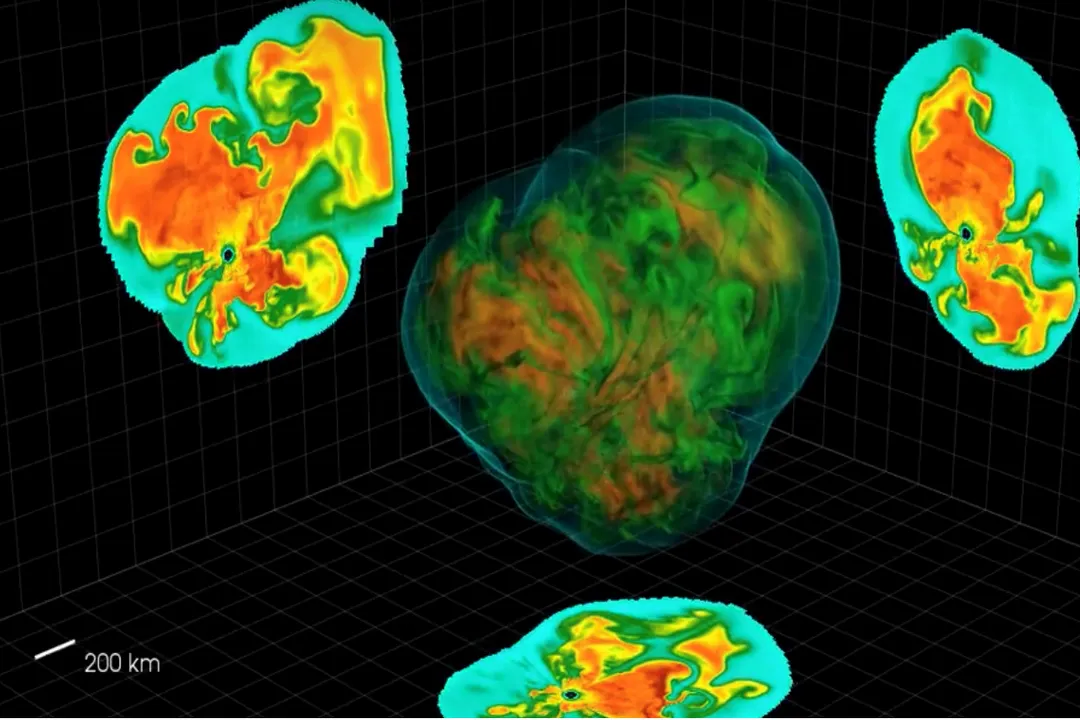
The rebound launches a powerful, outward-propagating shock wave through the stellar material. In simpler models, this shock was thought to race outward and instantly blow the star apart. However, detailed computer simulations show this is rarely the case; the initial shock stalls quickly, often within milliseconds, as it encounters the denser, infalling material in the outer core layers. The energy loss required to reverse the collapse, particularly from re-initiating photodisintegration behind the shock, damps its initial momentum.
It is here that the physics becomes exceptionally complex, requiring conditions that are difficult to model accurately using purely spherical symmetry. The introduction of three-dimensional simulations reveals powerful, turbulent convection in the layers just preceding collapse, with gas speeds reaching hundreds of kilometers per second. This pre-existing turbulence and the asymmetric structure it implies could be the necessary ingredient to help the shock survive and revive, rather than relying on an overly simplified, perfectly symmetric implosion.
The puzzle of revival is largely attributed to the enormous neutrino flux. While most neutrinos escape harmlessly, a small but crucial fraction streaming out from the nascent neutron star deposit their energy behind the stalled shock wave. This neutrino heating reignites the shock, transforming the implosion into a catastrophic outward explosion.
The fact that the mechanism for shock revival is sensitive to the initial conditions—such as the amount of turbulence generated during the final silicon burning phase—explains why core-collapse supernovae are not standard cosmic events; their outcomes are inherently dependent on three-dimensional fluid dynamics that break simple, assumed symmetries.

# Cosmic Chemistry
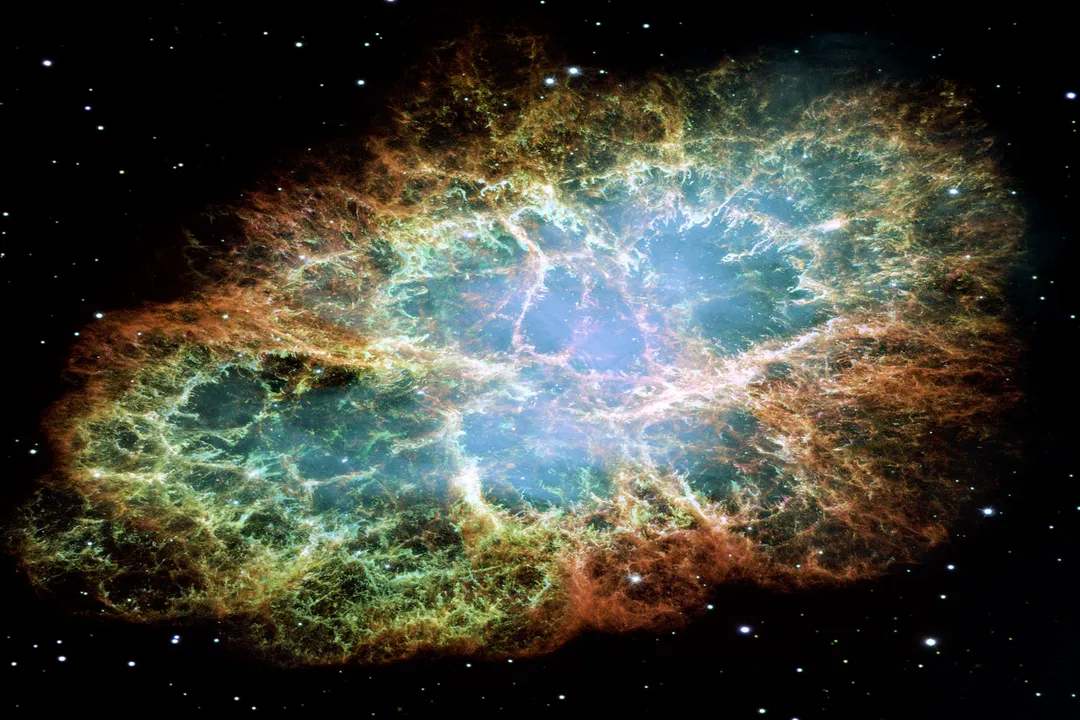
The revived shock wave propagates outward, reaching the outer layers of the star, leading to the brilliant event we observe as a supernova. As this outward-moving wave sweeps through the compressed material, it creates temperatures and densities high enough to facilitate a new round of nucleosynthesis, forming elements heavier than iron—a feat the star could never achieve during its stable life. Elements like gold, uranium, and others that are essential to chemistry and geology are forged in this last, violent second.
In Type II supernovae (where hydrogen is still present in the outer layers), the light curve's brightness over weeks and months is powered by the radioactive decay of freshly synthesized elements, primarily Nickel-56 decaying into Cobalt-56, and then into stable Iron-56.
One must recognize a profound irony in this cosmic drama: the visible explosion—the blinding light that outshines entire galaxies—is a secondary effect. The vast majority of the energy ($99%+$) is carried away by neutrinos, which escape in the first few minutes, essentially constituting an invisible energy release that powers the blast. The material we see illuminating the nebula is the minor fraction of energy that successfully shocked and heated the outer gas envelope.
# Final Remnants
What remains after the stellar envelope is blasted into space depends entirely on the mass of the remaining core material that did not escape.
If the core mass is not too great, the collapse halts at nuclear density, leaving behind an incredibly dense object called a neutron star. These objects pack more than the Sun's mass into a sphere only about the size of a city, roughly in diameter. If the core is massive enough (often cited as exceeding to $2$ solar masses after collapse, depending on the equation of state), even the resistance of neutron degeneracy pressure cannot stop gravity, and the core collapses completely into a black hole.
The formation of these compact remnants is often asymmetric. The complex, non-spherical explosion mechanism can impart a significant "kick" to the newly formed neutron star, sending it hurtling through the galaxy at hundreds of kilometers per second.
# Explosion Variety
Not all core-collapse events look the same. The final spectrum and light curve are heavily influenced by the progenitor star's mass and metallicity, which dictates how much of its outer layers it lost before collapse.
- Type II Supernovae: The star retains its hydrogen envelope until the explosion, typically progenitor stars up to about . The most common outcome is Type II-P, characterized by a plateau in brightness caused by the recombination of hydrogen in the expanding ejecta.
- Type Ib/Ic Supernovae: These result from massive stars that have been stripped of their hydrogen (Type Ib, which may retain helium) or both hydrogen and helium (Type Ic) envelopes, often by powerful stellar winds or interaction with a binary companion (becoming Wolf–Rayet stars).
- Type IIn Supernovae: These show narrow spectral lines because the explosion interacts with a dense shell of material previously expelled by the star shortly before death.
In some less energetic or very massive scenarios, the collapse can be so complete that the star never produces a visible outward shock wave, resulting in a failed supernova where the star simply becomes a black hole in relative silence, though this is difficult to confirm. Conversely, in the most massive cases (over ), the core can trigger a pair-instability supernova where the entire star is disrupted without leaving a compact remnant behind. The sheer variety of outcomes reminds us that while the final iron core is the trigger, the star’s entire life story influences its spectacular demise.
Related Questions
#Citations
Core-collapse | COSMOS
What happens to a massive star's iron core before it collapses?
Supernova - Wikipedia
Collapsing stars, supernovae, and gamma-ray bursts - MPA Garching
Star Basics - NASA Science
DOE Explains...Supernovae - Department of Energy
The 3D Death of a Massive Star - AAS Nova