What physical constraint prevents the core from collapsing indefinitely once it reaches nuclear density?
Answer
The strong nuclear force between neutrons and protons becomes powerfully repulsive.
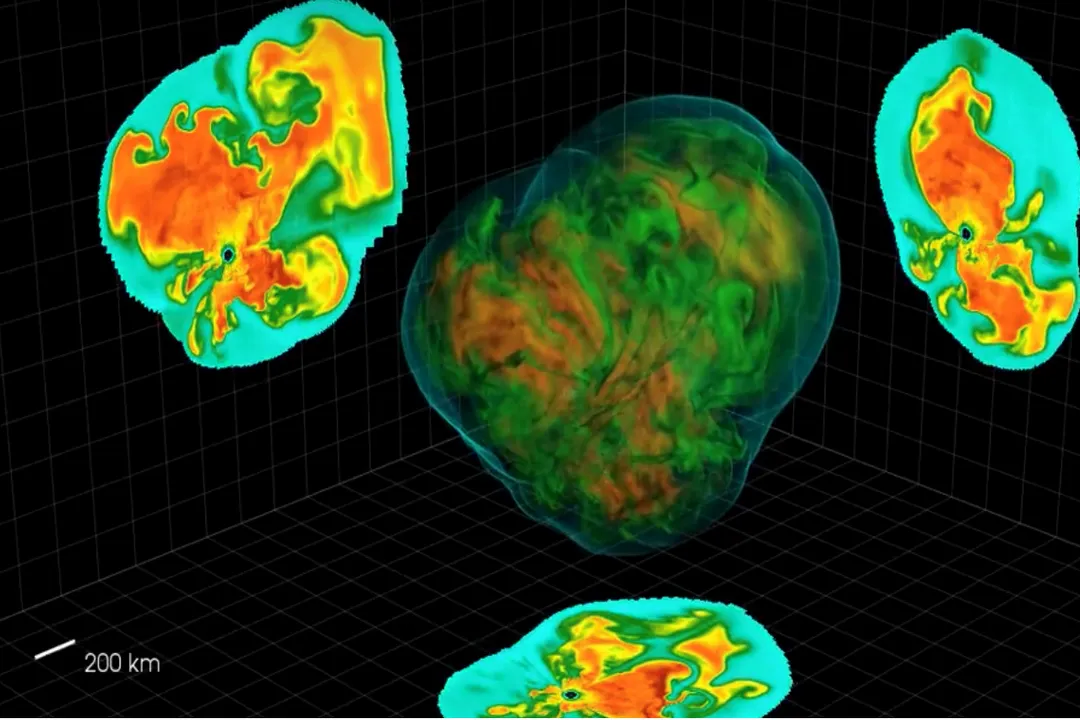
As the stellar core collapses past the point where electron degeneracy pressure fails, it continues compressing until the density rivals that of an atomic nucleus—a state termed nuclear density. At this extreme level of compaction, a fundamental physical interaction takes over: the strong nuclear force. This force, which acts between protons and neutrons, switches from being attractive (binding the nucleus) to being powerfully repulsive when matter is packed this tightly. This repulsive force acts as a hard wall, halting the inward march of matter and causing the inner core to overshoot slightly and rebound explosively.
Related Questions
Why does the formation of an iron core mark the absolute end of stellar energy generation?What phenomenon is described by high-energy gamma rays breaking apart iron nuclei into lighter components during implosion?What is the estimated energy fraction carried away by neutrinos during the core collapse sequence?What physical constraint prevents the core from collapsing indefinitely once it reaches nuclear density?What prerequisite condition, revealed by three-dimensional simulations, is necessary to help the shock wave survive and revive?What mechanism is responsible for reigniting the stalled shock wave into a full catastrophic explosion?What type of supernova results from a massive star stripped of both its hydrogen and helium envelopes, possibly becoming a Wolf–Rayet star?What is the physical criterion that determines if a core collapse leaves behind a neutron star or a black hole?What element's radioactive decay primarily powers the visible light curve of Type II supernovae over subsequent weeks and months?What characteristic defines a 'failed supernova' scenario in massive star collapse?