What happens after a core collapse in a supernova?
The catastrophic event that follows a massive star's core collapse is one of the universe's most dramatic processes, transforming the final moments of a star into a dazzling, violent explosion known as a supernova. [2] This sequence begins when the star, having exhausted its fuel, can no longer support its immense weight against gravity. The true aftermath begins not with the visible explosion, but in the silent, infinitesimal fraction of a second when fusion ceases in the central iron core. [2]
# Iron Core
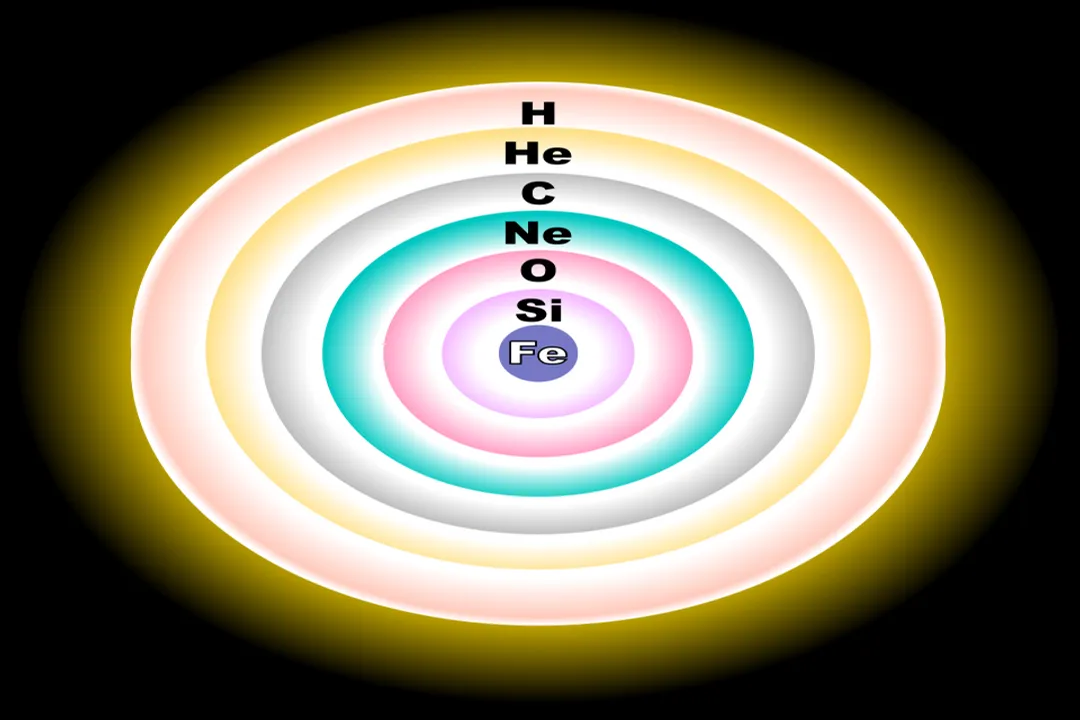
For stars significantly larger than our Sun—generally those starting with masses exceeding about eight times the Sun’s mass—nuclear fusion proceeds through increasingly heavy elements until iron is formed in the center. [2] Iron is the cosmic dead end for energy generation because fusing iron atoms actually consumes energy rather than releasing it. [2] Once the iron core builds up past a critical mass, which is roughly $1.4$ times the mass of the Sun (the Chandrasekhar limit), the outward pressure generated by fusion immediately vanishes. [5] Without this outward force, gravity wins the eternal cosmic tug-of-war instantly, initiating the final collapse. [2][5]
# Rapid Fall
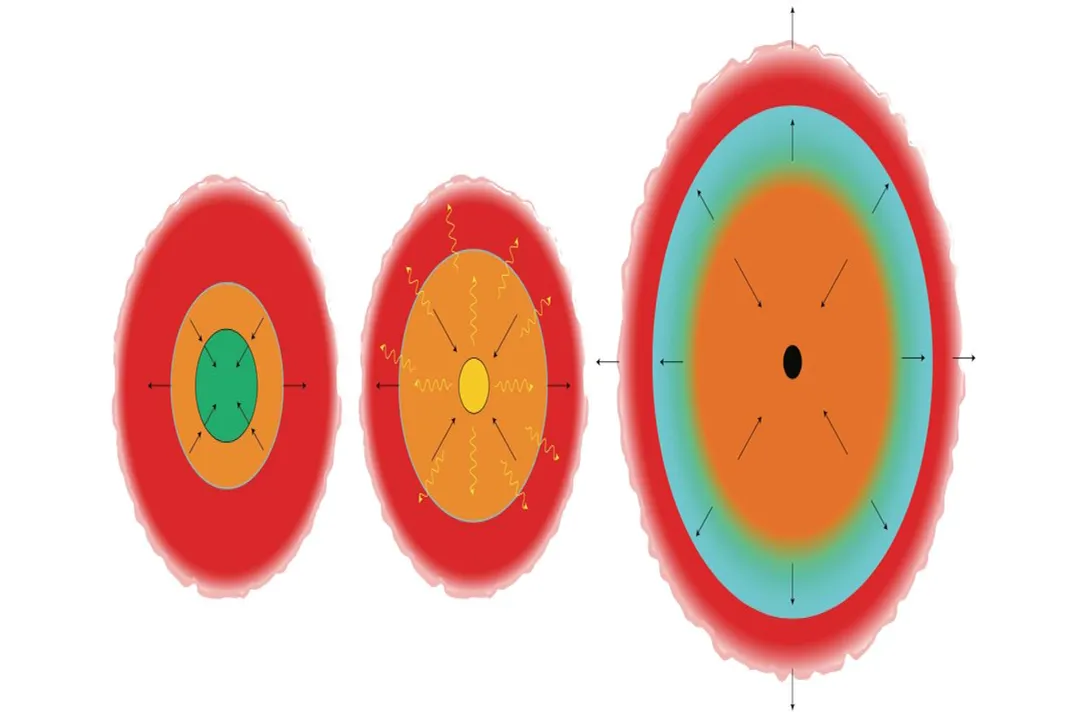
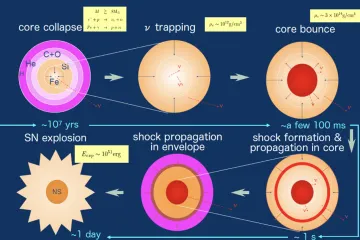
What follows is a free-fall collapse where the stellar material accelerates inward at incredible speeds, sometimes reaching a quarter of the speed of light. [1] The core, initially about the size of the Earth, shrinks down to an object only a few tens of kilometers across in mere milliseconds. [1] To grasp the sheer speed involved, consider that the entire process of the core imploding and forming the dense object happens far faster than a single heartbeat—a timescale utterly alien to human experience, where events are measured in seconds or minutes. [1] The density achieved during this implosion is astounding, reaching values perhaps grams per cubic centimeter, conditions where the atomic structure itself is crushed. [5]
# Shock Wave
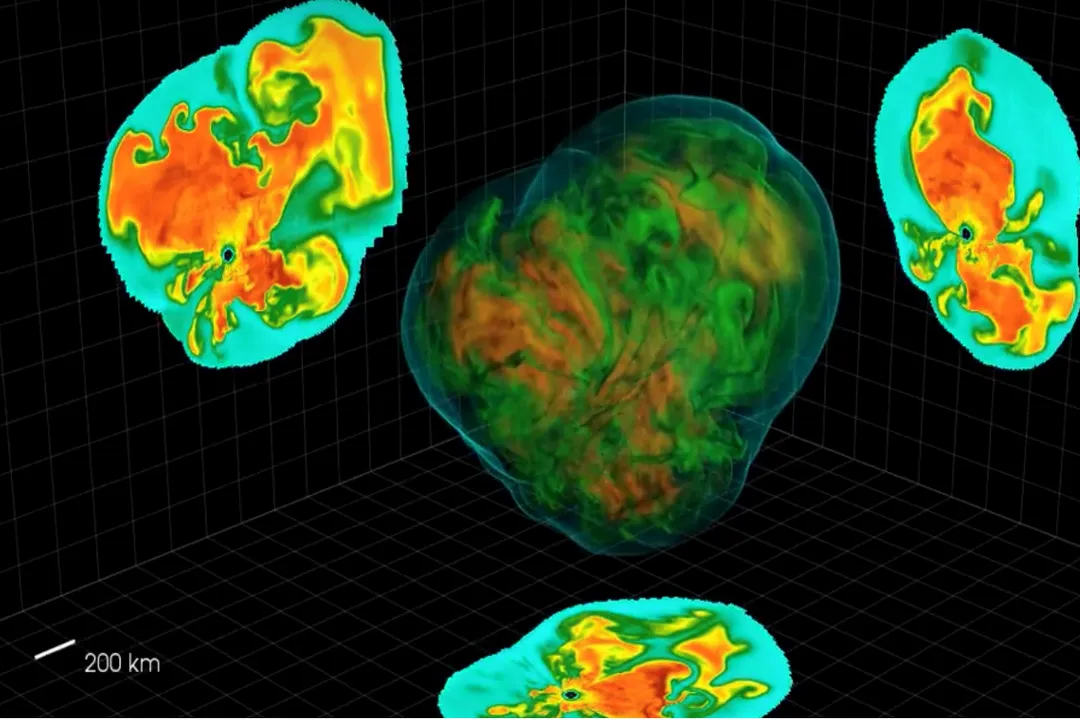
When the infalling outer layers of the star slam into this newly formed, incredibly rigid central object—which is now effectively incompressible—the material cannot simply compress further; it bounces. [2][9] This collision generates a powerful outward-moving pressure wave known as a shock wave. [9] This shock wave rips outward through the star's material, heating it to billions of degrees and driving the spectacular ejection of matter that we observe as a supernova explosion. [2]
However, the initial shock wave often stalls shortly after formation because the infalling stellar material carries too much energy and momentum. [9] The key to successfully driving the explosion lies in the copious amounts of subatomic particles called neutrinos created during the core's collapse and compression. [9] These neutrinos carry away roughly 99% of the gravitational binding energy released by the collapse. [2][9] If enough of these neutrinos stream out and deposit their energy back into the stalled shock wave, they can re-energize it, allowing it to propagate outward and ultimately shatter the star. [9] The successful transmission of this energy dictates whether the explosion is powerful or relatively anemic.
# Stellar Remnants
The ultimate fate of the collapsed core determines what object is left behind, and this depends entirely on the mass of the remnant core after the initial implosion and neutrino burst. [1]
If the remnant mass is below a certain upper limit—often estimated to be around three solar masses, though the exact number is still debated among astrophysicists—the collapse halts at a state of extreme density supported by neutron degeneracy pressure. [5] This object is a neutron star. [1][2] A neutron star is truly exotic; it is so dense that a sugar cube of its material would weigh about a billion tons. [2]
If, however, the initial core mass, after shedding some material via neutrinos or through the explosion itself, still exceeds the maximum limit that neutron degeneracy pressure can support (the Tolman-Oppenheimer-Volkoff limit), gravity proves to be the final victor. [1][5] In this scenario, the core continues to collapse past the point of even neutron star density, crushing down to an infinitely small volume and creating a black hole. [1][2][5]
It is fascinating to consider the difference in the gravitational environment between these two outcomes. A neutron star has a surface you could, hypothetically, land on—though the gravity there is immense, perhaps times stronger than Earth's gravity. [2] A black hole, conversely, has no surface; it is defined only by its event horizon, the boundary from which nothing, not even light, can escape its gravitational pull. [5] The difference in escape velocity between the surface of a maximum-mass neutron star and the event horizon of a black hole represents a final tipping point in physics, where the equation of state breaks down entirely. [3]
# Cosmic Signals
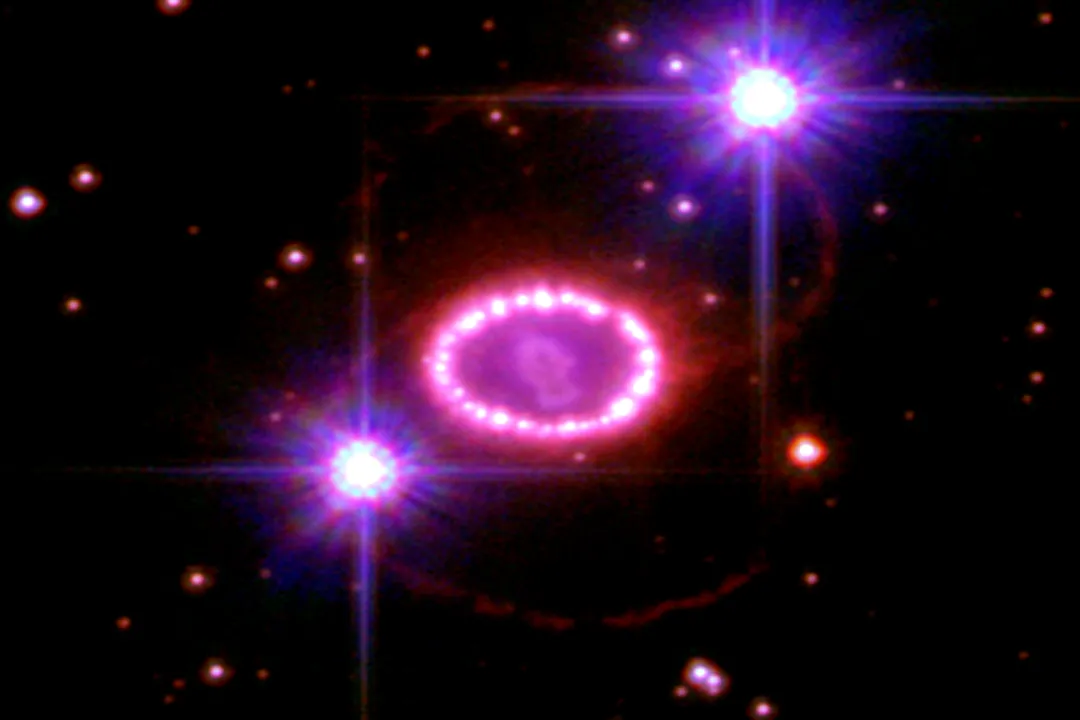
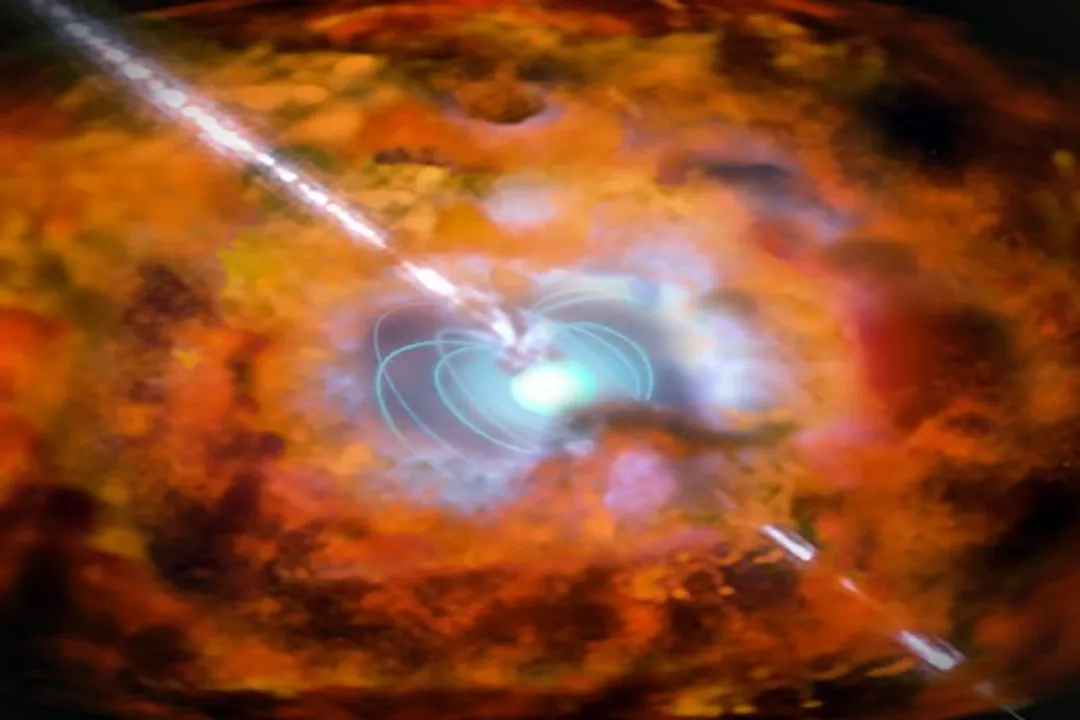
The core-collapse supernova, specifically the Type II variety associated with massive stars, is a spectacular source of light and energy visible across vast cosmic distances. [2] Furthermore, the collapse mechanism itself can sometimes lead to other exotic phenomena. In certain cases, particularly when the collapse is asymmetrical or involves rapid rotation, the explosion can channel energy into tightly focused beams of high-energy radiation called Gamma-Ray Bursts (GRBs). [7] A GRB linked to a supernova is often called a "collapsar" event. [7] These bursts are the most luminous electromagnetic events known in the universe, briefly outshining entire galaxies. [7]
The event also releases gravitational waves, ripples in the fabric of spacetime itself, as the highly dense, non-spherical core collapses and rebounds. [10] While the light from the explosion takes time to reach us, the gravitational waves arrive almost instantaneously, offering a direct probe of the inner workings of the collapse that standard electromagnetic observation cannot provide. [10] Detecting these gravitational signatures allows scientists to measure properties of the explosion immediately, independent of the obscuring layers of dust and gas within the dying star. [10]
# Matter Stability
A common point of curiosity is why the matter remains collapsed after the explosion passes. Why doesn't the newly formed neutron star or black hole immediately spring back to a less dense state?[3]
The answer lies in the sheer power of gravity at these scales. [3] During the star's life, the outward pressure balanced gravity. The core collapse converted gravitational potential energy into kinetic energy (the fall) and thermal/neutrino energy (the heat and particle burst). [5] After the shock wave blasts the outer layers away, the remaining core is held together by forces—neutron degeneracy pressure or the complete dominance of spacetime curvature in the case of a black hole—that are far stronger than any known force that could cause it to expand again under its own immense weight. [3] The matter is locked into a state where the only counter-force strong enough to fight the remaining gravity is either the quantum mechanical resistance of neutrons packed together or nothing at all, as with a black hole singularity. [5] The material ejected moves away, but the core remnant is gravitationally bound to itself, locked in its final, hyper-dense configuration. [3]
Related Questions
#Citations
Core-collapse | COSMOS
Type II supernova
Why does matter stay collapsed in the core, following a ...
What happens to the core of a super massive star after it ...
Core Collapse : r/askastronomy
DOE Explains...Supernovae
The Gamma Ray Burst – Supernova Connection
Supernova
Core Collapse Supernovae - gravitationalwaves