What is the theory of core collapse supernovae?
The violent demise of a massive star, known as a core collapse supernova (CCSN), is one of the universe’s most spectacular and consequential events. [4] These explosions mark the end of life for stars substantially more massive than our Sun, typically those beginning their lives with masses exceeding about eight times the Sun's mass (). [7] Unlike the gentler death of Sun-like stars, which puff off their outer layers as planetary nebulae, the core of a massive star succumbs to its own immense gravity in a fraction of a second, leading to an explosion that can briefly outshine an entire galaxy. [9]
# Stellar Deaths
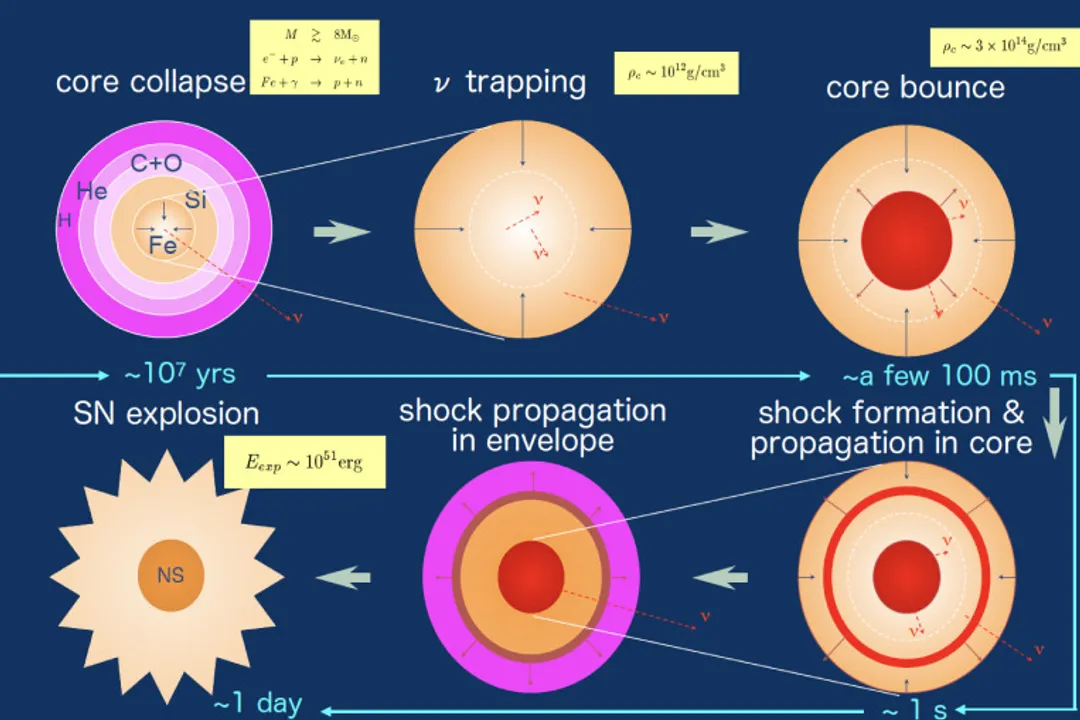
A massive star spends its life in a delicate state of equilibrium, balancing the inward pull of gravity with the outward pressure generated by thermonuclear fusion in its core. [4] This fusion process builds up heavier and heavier elements in concentric shells, moving from hydrogen to helium, then carbon, neon, oxygen, and silicon. [7] The final stage of this burning process, which creates iron (), is the critical turning point. [4] Iron cannot release energy through fusion; instead, fusing iron consumes energy. [7] Once the core is predominantly iron, the primary energy source sustaining the star vanishes almost instantaneously. [4]
This loss of thermal support allows gravity to gain the upper hand decisively. The iron core, which can be roughly the size of Earth, begins a catastrophic free-fall collapse. [9]
# Core Implosion
When the core's mass exceeds the Chandrasekhar limit—the maximum mass a white dwarf can support against gravity—the collapse accelerates dramatically. [3] The crushing gravity forces protons and electrons to combine into neutrons and neutrinos in a process called electron capture: . [4] This process is incredibly rapid, removing the primary source of outward pressure (electrons) just as the star needs it most. [4]
The core contracts until its density reaches that of an atomic nucleus, approximately grams per cubic centimeter. [9] At this point, the strong nuclear force creates an outward repulsive pressure, halting the infall of matter. [4] The core, now a proto-neutron star (PNS), is incredibly compact, often only tens of kilometers across. [9] The infalling outer layers, moving inward at speeds reaching up to 70,000 kilometers per second, suddenly strike this incompressible, rigid PNS surface. [4]
While the silicon-burning stage of the star lasts for about a day, the final collapse phase, from the iron core forming to the PNS stiffening, takes only milliseconds. [9] This immense compression, squeezing multiple solar masses into a radius smaller than a city, highlights the unparalleled physical extremes involved in this stellar mechanism. [9]
# Shock Formation
The violent collision between the infalling stellar material and the newly formed, ultra-dense neutron star generates a powerful shock wave that initially propagates outward through the star's interior. [4][9] In the simplest theoretical models, this shock wave is strong enough to plow through the remaining overlying stellar layers, causing the star to explode. [4]
However, detailed simulations have shown that this initial shock often stalls rapidly, perhaps just a few hundred kilometers from the center of the nascent neutron star. [4] This stalling occurs because the dense, hot material immediately behind the shock begins to cool rapidly by emitting neutrinos, transferring energy away from the shock front and causing it to lose momentum. [4] If the shock remains stalled, the enormous mass of the star's outer layers will simply fall back onto the proto-neutron star, leading to immediate collapse into a black hole without a visible supernova explosion. [9]
# Neutrino Physics
The resuscitation of the stalled shock wave—the true engine of the explosion—is widely believed to be driven by the torrent of neutrinos released during the core's formation. [4][5] The gravitational energy liberated during the core collapse is staggering, converting about joules of binding energy into kinetic energy, with over 99% of that energy carried away by these nearly massless, weakly interacting particles. [4]
In the "neutrino-driven explosion" mechanism, a fraction of these neutrinos stream outward into the neutrino-heated material just behind the stalled shock front. [4] These neutrinos deposit a small but critical amount of energy into this layer, effectively re-energizing the shock and allowing it to accelerate outward, overcoming the gravitational pull of the infalling envelope. [4] The exact efficiency of this energy transfer and the conditions required for explosion are highly sensitive to the equations of state (how matter behaves under extreme density) and the nuances of neutrino flavor oscillations, where neutrinos change between different types (). [4][3]
The challenge in simulating these events effectively means that while the basic sequence is understood, the precise nature of the transition from a stalled shock to a successful explosion still relies heavily on numerical approximations of turbulent fluid dynamics and weak-interaction physics. [9] Getting the precise neutrino transport right remains the main computational hurdle that separates successful explosion simulations from those that incorrectly predict prompt black hole formation. [9]
# Observational Types
Core collapse supernovae are generally categorized based on the spectral features observed in their light curves, particularly the presence or absence of hydrogen lines. [7] The most common manifestation of a CCSN is a Type II supernova. [7] A Type II supernova is defined by the presence of hydrogen Balmer lines in its spectrum. [7] This indicates that the progenitor star still retained a substantial hydrogen envelope when the explosion occurred. [7] The vast majority of core collapse events fall into this category. [7]
Other classifications exist, such as Type Ib and Type Ic, which lack hydrogen and helium lines, respectively, in their spectra. [7] These often suggest that the progenitor star somehow lost its outer layers before the explosion—perhaps through strong stellar winds or interaction with a binary companion—exposing the inner, helium- or carbon-oxygen-rich layers to view. [7]
# Element Creation
The explosion is not merely a destructive force; it is a fundamental mechanism for cosmic enrichment. [5] While elements up to iron are synthesized before the collapse, the extreme temperatures and neutron densities created during the explosion and subsequent shock propagation are necessary to forge heavier elements via rapid neutron capture, known as the r-process. [5] Elements such as gold, platinum, and uranium are thought to be primarily synthesized in these explosive environments, or perhaps in the merger of neutron stars, and then scattered into the interstellar medium. [5]
The material ejected by a CCSN enriches the next generation of stars and planets with these heavy elements. [5] For instance, the iron that makes up the blood in our veins and the nickel in our technology originated in the cores of long-dead, massive stars. [7] The study of the specific element abundances observed in different supernova remnants provides astrophysicists with critical constraints on the physics occurring deep within the collapsing core, as different explosion mechanisms—a prompt shock revival versus a late-time neutrino-driven explosion—would yield distinct nucleosynthetic signatures. [5] A comparison between the theoretical yields of neutrino-driven models versus those that result in a prompt black hole formation helps astronomers refine their understanding of which explosion channel is dominant in nature. [6]
The outcome of the core collapse dictates the nature of the remnant left behind. If the surviving neutron star can retain enough of the infalling material, or if the initial progenitor was sufficiently massive (perhaps over ), the remnant core may continue to collapse beyond the theoretical limit for a neutron star, forming a black hole. [7][9] Conversely, if the explosion successfully ejects the outer layers, a stable neutron star is left as the stellar cinder, a highly magnetized, incredibly dense object whose physics continues to be a subject of intense research. [9]
#Videos
A Detailed Breakdown of Core Collapse Supernovae - YouTube
Related Questions
#Citations
Core-collapse supernova explosion theory | Nature
Theory of core-collapse supernovae - ScienceDirect.com
[astro-ph/0612072] Theory of Core-Collapse Supernovae - arXiv
The mechanism(s) of core-collapse supernovae - The Royal Society
Physical mechanism of core-collapse supernovae that neutrinos drive
Core-collapse supernova explosion theory - NASA ADS
Type II supernova - Wikipedia
A Detailed Breakdown of Core Collapse Supernovae - YouTube
Core-Collapse Supernova Theory | FSU Digital Repository