How is a Type II supernova spectrally defined in terms of observed lines?
Presence of hydrogen Balmer lines in its spectrum.
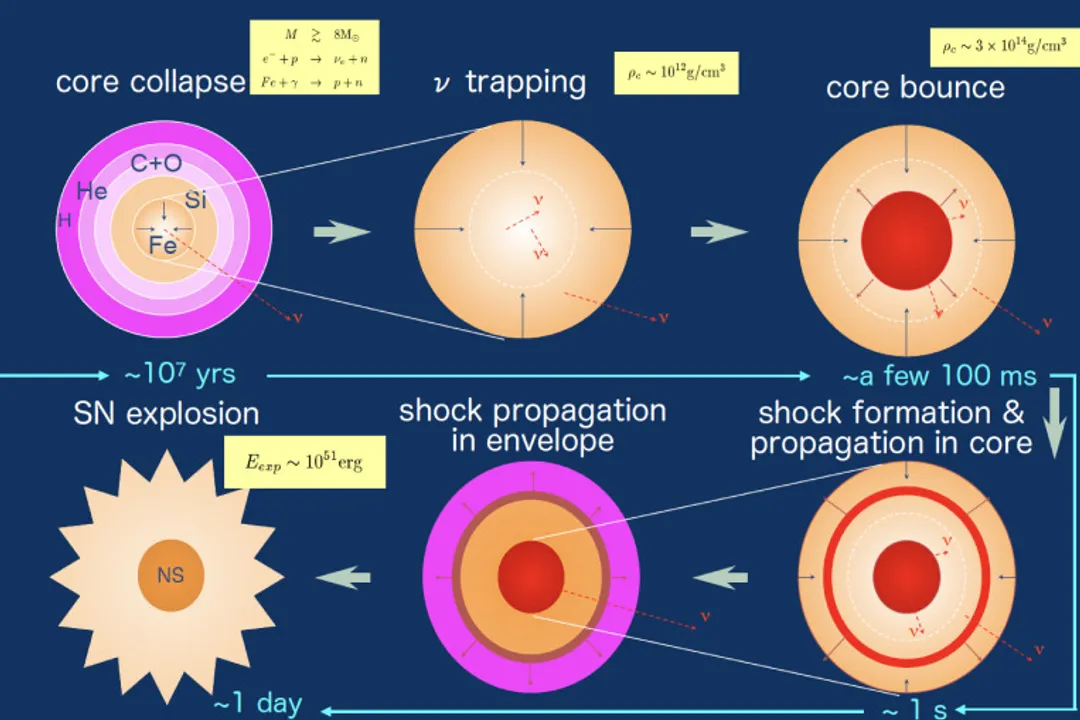
Core collapse supernovae are classified based on spectral characteristics observed in their light curves, particularly concerning the presence or absence of specific elemental lines, namely hydrogen and helium. A Type II supernova is the most common manifestation observed for CCSNe. This classification is strictly defined by the distinct detection of hydrogen Balmer lines within its spectrum during observation. The presence of these hydrogen lines signifies a crucial detail about the progenitor star: it retained a substantial hydrogen envelope when the catastrophic explosion occurred. Conversely, supernovae lacking hydrogen (Type Ib) or both hydrogen and helium (Type Ic) imply that the progenitor star shed its outer layers before collapsing, often due to intense stellar winds or interaction within a binary system.
#Videos
A Detailed Breakdown of Core Collapse Supernovae - YouTube