What condition might lead the remnant core to collapse further into a black hole instead of stabilizing as a neutron star?
The initial progenitor was sufficiently massive (perhaps over $25 M_{\odot}$) or retained too much infalling material.
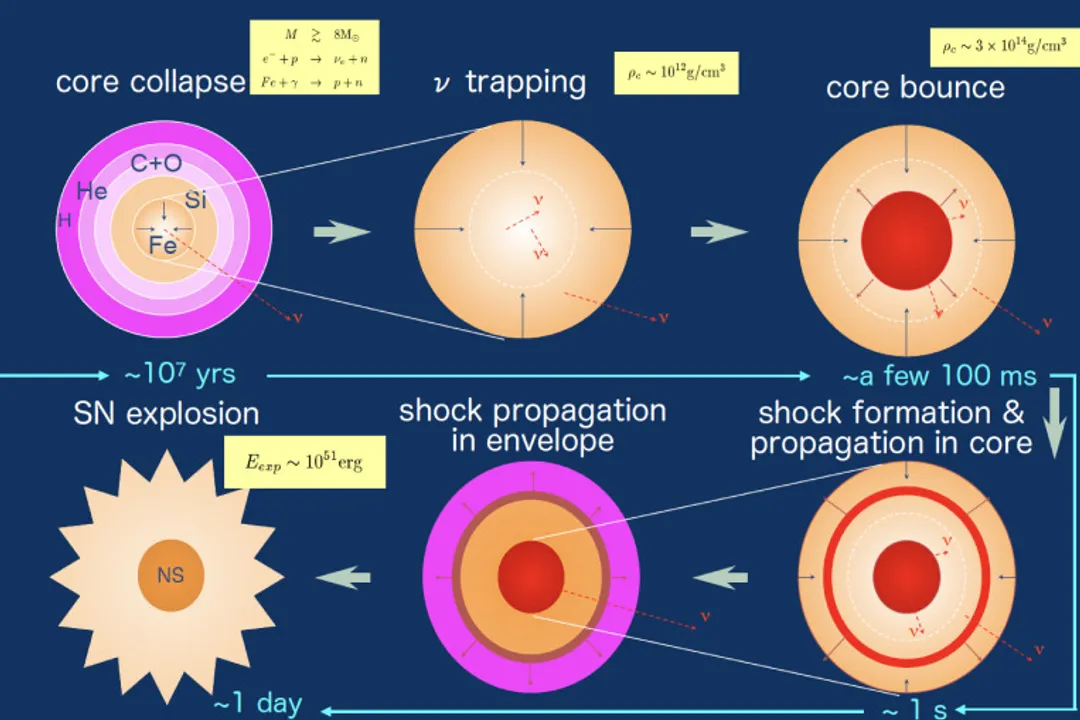
The final state of the stellar remnant following core collapse is determined by whether the core mass, after the explosion or collapse dynamics have played out, exceeds the theoretical maximum mass limit for a stable neutron star. If the explosion successfully ejects the outer layers, a stable neutron star is left behind. However, if the progenitor star was initially very massive, perhaps exceeding $25 M_{\odot}$, or if the explosion mechanism fails and a large fraction of the infalling outer layers lands back onto the proto-neutron star, the resulting object's mass may surpass this critical limit. When the mass exceeds what the strong nuclear force resistance can support, the core undergoes a final, inevitable collapse, leading directly to the formation of a black hole, leaving no visible stellar cinder behind.
#Videos
A Detailed Breakdown of Core Collapse Supernovae - YouTube