What is widely believed to drive the resuscitation of the stalled shock wave in a CCSN explosion?
A torrent of neutrinos released during the core's formation.
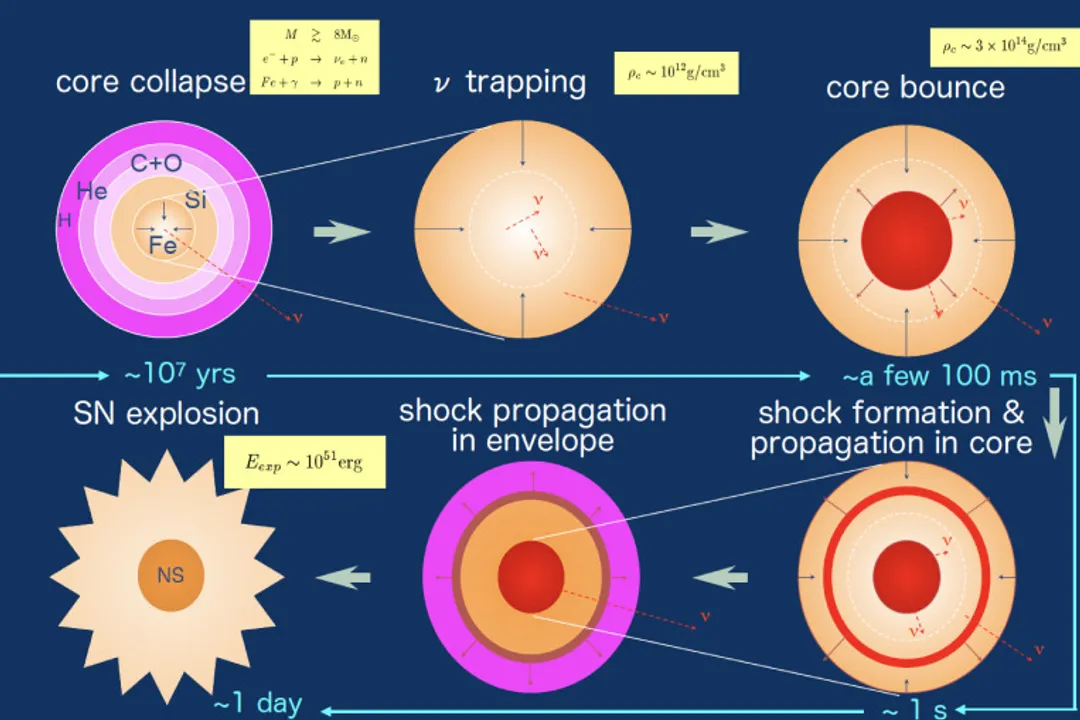
The survival and ultimate success of a core collapse supernova explosion hinges on re-energizing the stalled shock wave, a process widely attributed to the physics of neutrinos. During the initial core collapse and the formation of the proto-neutron star, an immense amount of gravitational potential energy, roughly $10^{46}$ joules, is liberated. The vast majority—over 99%—of this energy is carried away by the immense flux of neutrinos produced during the electron capture process. In the neutrino-driven explosion mechanism, a fraction of these streaming neutrinos deposit energy into the hot, shocked region just behind the stalled front. This small but critical addition of energy effectively re-heats the material, reignites the shock, and provides the necessary outward pressure boost to overcome the crushing gravity of the infalling stellar envelope, driving the visible supernova.
#Videos
A Detailed Breakdown of Core Collapse Supernovae - YouTube