Why does the synthesis of iron isotope $^{56} ext{Fe}$ cause the immediate cessation of energy generation support in a massive star's core?
Fusing iron consumes energy rather than releasing it
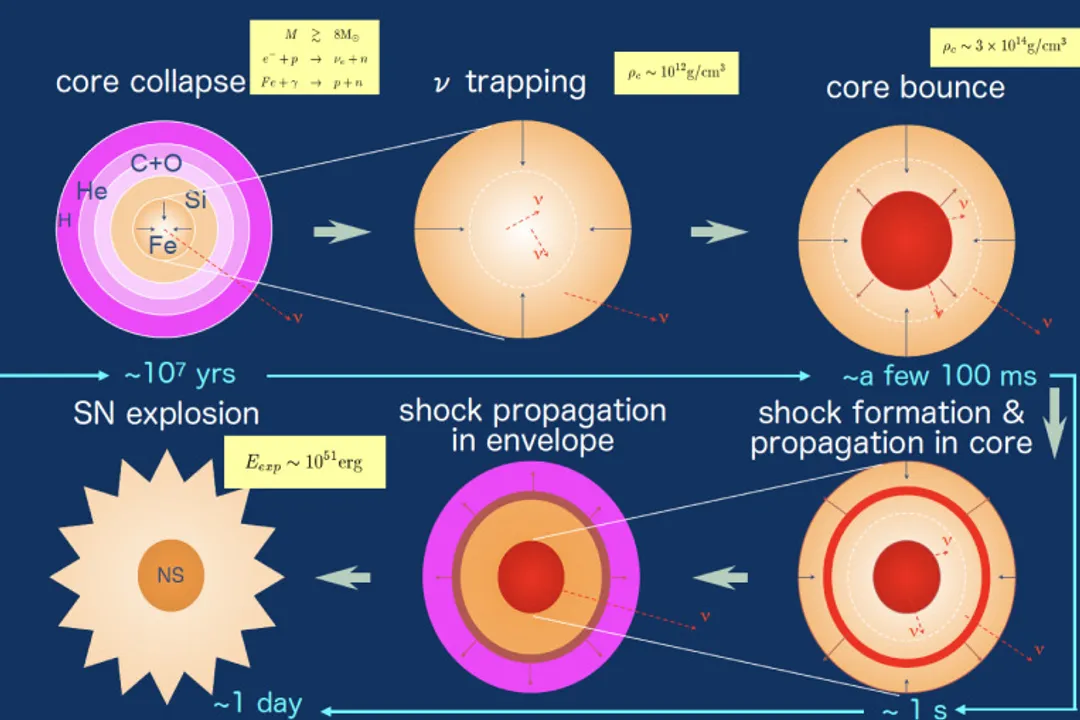
The stability of a massive star throughout its life is maintained by thermonuclear fusion, where lighter elements fuse into heavier ones, releasing energy that generates outward thermal pressure to oppose crushing gravity. This sequence progresses through hydrogen, helium, carbon, neon, oxygen, and silicon. However, iron ($^{56} ext{Fe}$) represents a unique, energetically unfavorable endpoint in this chain. Unlike all preceding reactions, the fusion of iron nuclei requires an input of energy rather than releasing a net surplus. Once the core becomes iron, the star's primary energy source switches off instantaneously, meaning there is no longer any thermal pressure being generated to resist the overwhelming inward force of gravity, thus initiating collapse.
#Videos
A Detailed Breakdown of Core Collapse Supernovae