What causes the gravitational contraction of a protostar to stop?
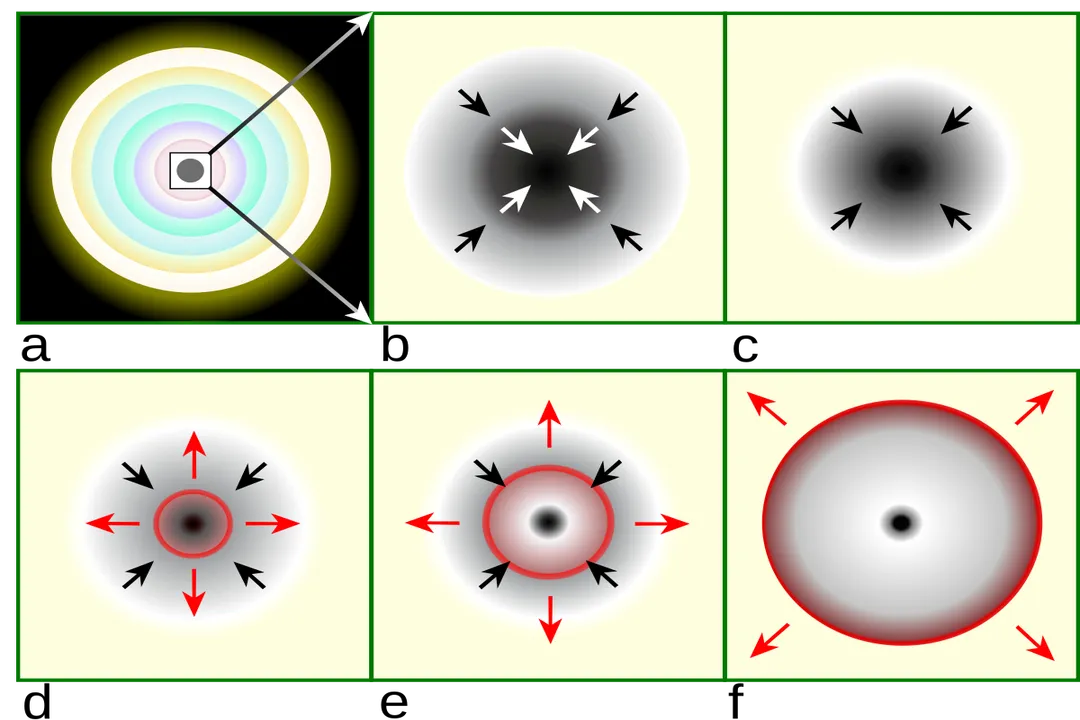
The deep mystery of how a star ceases its frantic inward squeeze and settles into a long, stable life is rooted in a fundamental battle between two cosmic forces: gravity, which always pulls inward, and internal pressure, which pushes outward. This struggle is never truly won or lost in a simple sense; rather, the contraction phase, which defines a protostar, ends when one force is precisely balanced by the other, allowing the object to graduate to true stellar status. This transition marks the definitive end of the gravitational contraction driven by the initial collapse of the stellar nursery.
# Initial Collapse
Star birth begins within the cold, dense pockets of the interstellar medium, specifically in what are known as Giant Molecular Clouds (GMCs). These colossal clouds, composed primarily of molecular hydrogen, are incredibly spread out—millions of times less dense than the air we breathe. A GMC is initially held up against its own immense gravity by internal pressure, which comes from the gas's thermal motion and any embedded magnetic fields. For a star to form, this balance must be broken.
The initiation of collapse requires that gravity overcomes the existing internal pressure. This imbalance can be triggered by external events, such as shockwaves from nearby supernova explosions, the cloud colliding with another cloud, or even the passage of the cloud through a spiral arm of the galaxy. Once triggered, the cloud fragments into smaller, denser cores, some of which possess masses comparable to future stars—a few times the mass of the Sun.
The very first phase of this core collapse is deceptively easy. Initially, the core is low in density and transparent, meaning any energy generated by compression can easily escape as photons leak out. Since the energy escapes freely, pressure cannot build up quickly, allowing gravity to relentlessly pull the material inward. This free-fall continues until the core density rises significantly, reaching a critical point where the gas becomes opaque to its own radiation. At this opacity threshold, photons become trapped, causing the interior gas temperature to spike and pressure to finally begin accumulating against gravity's pull.
# Energy Source
Before the ultimate stopping mechanism takes hold, the object is classified as a protostar. A protostar is not yet a true star because its core is too cool to sustain nuclear fusion, with temperatures significantly below the required ignition point (around 15 million Kelvins).
So, what makes the protostar shine? Its initial energy source is purely mechanical: the Kelvin-Helmholtz Mechanism. This process is driven by gravitational contraction itself. As the gas sphere shrinks, gravitational potential energy is converted into heat and light. The energy budget is split; roughly 50% of the released gravitational energy is radiated away as starlight, while the other 50% goes into further heating the protostar's interior.
This gravitational energy reservoir is not infinite. The total time a protostar can shine purely by contraction is estimated by the Kelvin-Helmholtz timescale, which is the ratio of the gravitational binding energy to its current luminosity. For a Sun-like mass, this timescale is significant, perhaps around 30 million years, but for lower-mass objects, it stretches out to perhaps a billion years, reflecting a slower collapse. Conversely, high-mass protostars, such as those 30 times the Sun's mass, experience a much faster gravitational collapse, potentially taking less than 10,000 years to reach the next critical stage.
# Core Heating
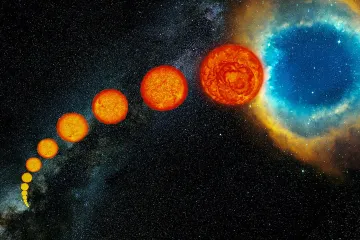
As the protostar continues to shrink, the trapped heat causes the internal temperature and density to soar continuously. This compression is the engine driving the core toward the necessary conditions for self-sustaining power generation. The pressure resisting gravity is initially thermal pressure arising from this heat. According to the Virial Theorem, for a system in equilibrium, the average kinetic energy—which relates directly to temperature and pressure—must be balanced by half the gravitational potential energy. As gravity compresses the system, potential energy decreases, and kinetic energy (temperature) must increase to keep up, until a new, hotter state of balance is approached.
The entire evolutionary track from a cool clump to a zero-age main sequence star is essentially a race to achieve the required core temperature. This required temperature is the ignition point for the most fundamental energy generation process in the universe: the fusion of hydrogen into helium.
# Fusion Ignition
The moment the gravitational contraction stops is directly tied to the core reaching the critical threshold for thermonuclear reactions. For stars like our Sun, this means achieving a core temperature around 10 million Kelvin. At this point, the proton-proton (P-P) chain reaction ignites, or for more massive stars, the CNO cycle begins to dominate.
This ignition is the fundamental change agent. The energy released by fusion—which occurs in the core—creates a powerful, outward-directed thermal pressure that is strong enough to finally counteract the inward crushing force of the star's own mass.
It is helpful to consider the different masses in play here. For any object less massive than about $0.08$ times the mass of the Sun, the core never gets hot enough to begin sustainable hydrogen fusion; these objects become Brown Dwarfs, shining only via residual gravitational contraction and cooling off slowly. The contraction stops partially when electron degeneracy pressure becomes dominant, but they never achieve the power source of a true star. For the successful stars, however, the onset of fusion dramatically changes the pressure dynamics.
The gravitational contraction slows down significantly as the energy produced by the newly ignited fusion reactions begins to balance the energy the star is radiating away as luminosity.
# Stable State
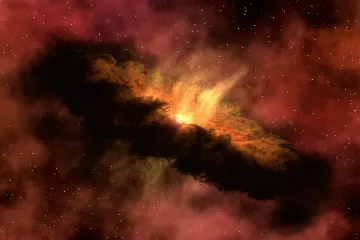
When the outward thermal pressure generated by core hydrogen fusion exactly balances the inward gravitational force, the star has achieved Hydrostatic Equilibrium. This signifies the cessation of the large-scale, slow gravitational shrinking that defined the protostar phase.
But stabilization requires more than just mechanical balance; it also requires Thermal Equilibrium. This means the energy generated internally by fusion now perfectly matches the energy escaping from the surface as starlight. Once both hydrostatic and thermal equilibrium are established, the object officially lands on the Zero-Age Main Sequence (ZAMS) as a full-fledged, self-regulating star. The gravitational contraction that began in the cold molecular cloud has been arrested by the creation of its own internal, sustained nuclear furnace.
It’s interesting to pause here and reflect on the nature of this "stop." The transition is not instantaneous like flipping a switch. For a star like the Sun, the Kelvin-Helmholz contraction phase is long enough (tens of millions of years) that the star slowly settles onto the main sequence track on an H-R diagram, gradually reducing its contraction rate as fusion ramps up. However, for a very massive star (say, ), the entire collapse, from cloud fragment to ZAMS, is extremely rapid, perhaps taking only a few tens of thousands of years. The higher gravity creates an immensely faster rate of heating, causing the star to skip quickly to fusion ignition and stabilize almost immediately relative to its lifespan. This difference in timescale suggests that the process of halting contraction is far smoother and protracted for low-mass stars than it is for their short-lived, massive cousins.
A deeper look at the equilibrium reveals a subtle ongoing process. While the overall radius of the star stabilizes, the star is not static. Fusion converts mass into energy, meaning the star slowly consumes its core hydrogen over billions of years. As the hydrogen fuel is depleted and converted to helium ash in the center, the core contracts slightly again, increasing temperature and luminosity, which causes the outer layers to expand—this is why stars like our Sun will swell into a red giant later in life. The main sequence stability, the state that stops the initial gravitational squeeze, is therefore a dynamic state of balance, constantly being maintained against the inexorable change of fuel consumption. This constant, low-level adjustment, driven by the changing composition of the core, is an essential feature of stellar life that keeps the catastrophic gravitational collapse at bay for eons.
Related Questions
#Citations
Gravitational collapse - Wikipedia
Lecture 14: Star Formation
Gravitational Contraction and Star Formation - HyperPhysics Concepts