What force causes the nebula to contract?
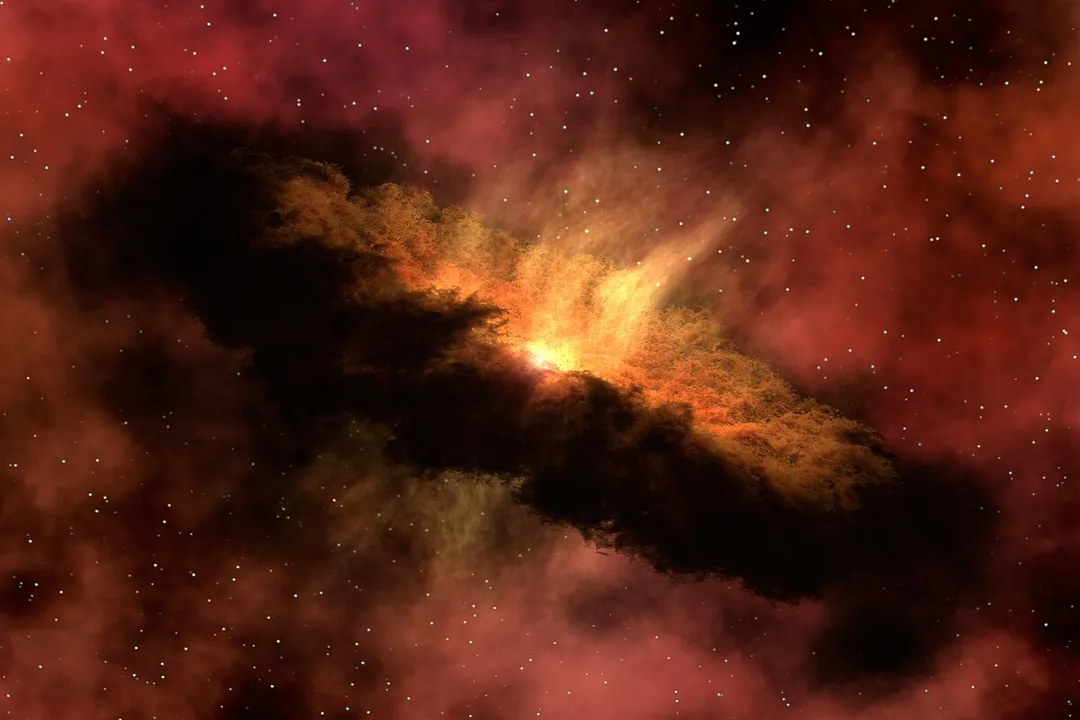
The vast, luminous clouds scattered across the cosmos, known as nebulae, represent the stellar nurseries of the universe. These immense reservoirs of gas and dust are the raw material from which stars, planets, and entire solar systems eventually form. [1][7] When observing these structures, one naturally wonders about the engine driving their transformation—what immense, invisible power compels these sprawling masses to shrink and concentrate their material into dense, blazing objects? The fundamental answer lies with gravity, the inescapable force of attraction that dictates the structure and evolution of the cosmos on the grandest scales. [4][8][9]
# Cosmic Attraction
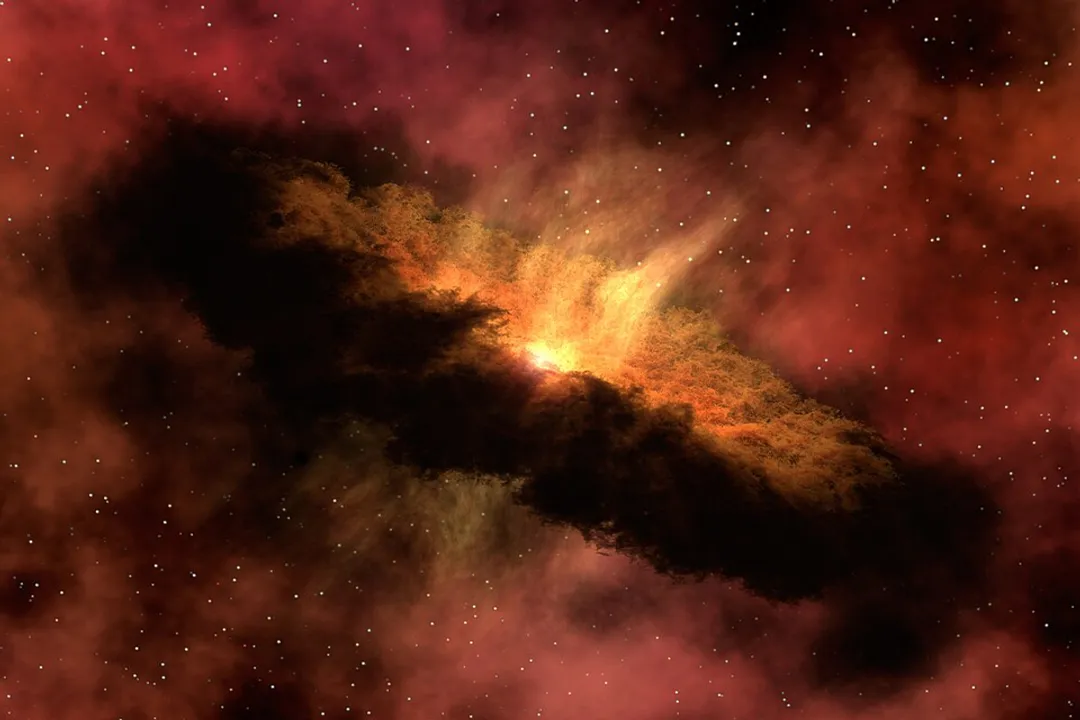
A nebula, in its initial diffuse state, is essentially a giant molecular cloud, composed mostly of hydrogen and helium, along with trace amounts of heavier elements locked up in microscopic dust grains. [7] While this cloud may span many light-years, the material within it is spread incredibly thin—far less dense than the best vacuum we can achieve in terrestrial laboratories. [7] For contraction to occur, the pervasive force of gravity must overcome the internal forces that are constantly pushing outward, primarily thermal pressure generated by the kinetic energy of the gas particles, and, increasingly, rotational inertia. [8]
Gravity acts on all the mass within the cloud, pulling every particle toward every other particle. [5] In a perfectly uniform, isolated cloud, these forces might cancel out, leading to a static, albeit cold, existence. However, real nebulae are not perfectly uniform; they are turbulent, often containing slight clumps or denser pockets of material. [5] These slight density variations are the seeds of collapse. Where matter is slightly more concentrated, the gravitational pull is marginally stronger, drawing in neighboring atoms and dust grains at a faster rate than the surrounding regions. [8] This initiates a runaway process where increased mass leads to increased gravitational attraction, thereby pulling in even more mass, leading to further contraction.
# Triggering Collapse
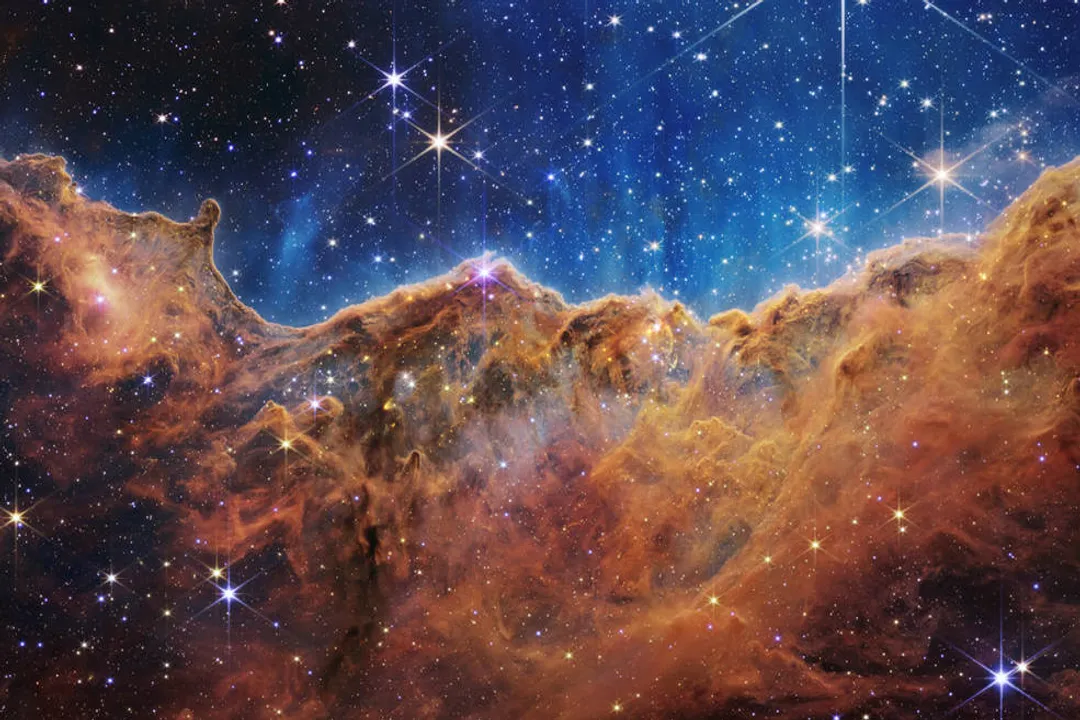
While gravity is the force responsible for the act of contraction, it often needs an external catalyst to begin overcoming the initial balancing forces, especially in very cold, stable clouds. [5][8] Think of a perfectly balanced stack of blocks; a gentle nudge is required to start the tumble. In the interstellar medium, these necessary nudges often come from violent cosmic events occurring nearby. [5][8]
One of the most effective triggers is the shockwave generated by a supernova explosion. [5][8] When a massive star dies, it blasts its outer layers into space at incredible speeds. This expanding shell of superheated gas slams into a quiescent molecular cloud, compressing sections of it suddenly and dramatically. [5] This compression instantly creates the localized high-density regions where gravity can seize control. [8] Alternatively, the sheer density of a large cloud can, over long timescales, simply reach a critical threshold where the internal gravitational binding energy exceeds the internal kinetic energy, setting off the collapse known naturally, often referred to in physics as exceeding the Jeans mass or experiencing Jeans instability. [8] If this critical mass threshold is reached internally, no external explosion is necessary for the gravitational engine to start its work. [8]
# Contraction Dynamics
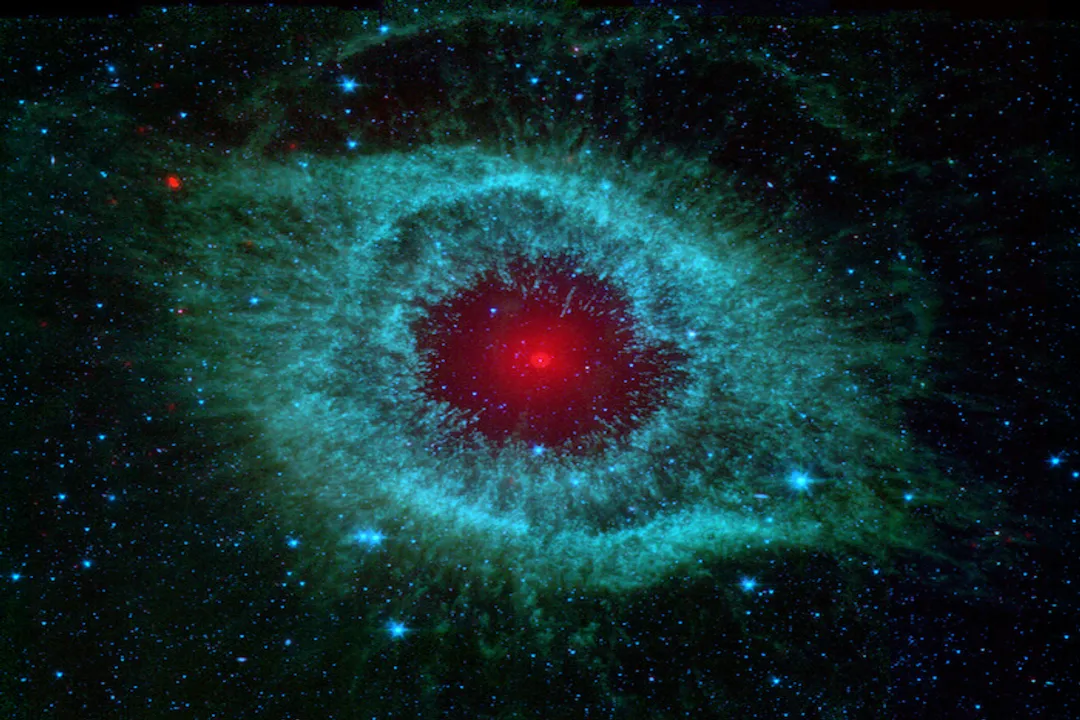
Once the gravitational collapse begins in earnest, the process becomes dynamic and governed by fundamental laws of physics, most notably the conservation of angular momentum. [1] Imagine a spinning ice skater pulling their arms in; they spin faster to conserve their rotational energy as their mass moves closer to the axis of rotation. The same principle applies to the contracting nebula. As the cloud shrinks under gravity, its rotation rate must increase proportionally. [1]
This increase in rotational speed has a profound effect on the cloud's geometry. Gravity pulls material inward equally in all directions initially, but the centrifugal force generated by the spin resists this inward pull most effectively along the plane of rotation. [8] Consequently, the material falls inward most easily along the rotational axis, while the material spinning around the middle piles up, flattening the structure. [8] The result is the transformation of a roughly spherical cloud into a thin, rotating, pancake-like structure known as a protoplanetary disk or solar nebula. [1] This disk is where the formation of planets will eventually occur. [1]
The entire process is messy and hierarchical. The large initial cloud doesn't contract smoothly into one object; instead, it tends to fragment into smaller, denser clumps as the collapse proceeds. [8] Each of these smaller clumps can then proceed independently to form a star or a binary system. [8]
To better visualize this fundamental shift in structure driven by the interplay between gravity and rotation, consider the state change illustrated below:
| Characteristic | Initial Diffuse Cloud State | Mid-Collapse Protoplanetary Disk State |
|---|---|---|
| Shape | Irregular, roughly spherical | Flattened disk shape |
| Density | Extremely low, near vacuum | Significantly higher, especially in the center |
| Rotation Speed | Very slow | Rapidly increasing due to conservation of momentum |
| Temperature | Extremely cold (near absolute zero) | Increasing due to compression |
| Fate | Fragmenting into smaller cores | Cores condensing into protostars |
# Heating Up
The continuous, relentless pull of gravity does more than just change the shape of the nebula; it also dramatically increases its internal energy. As gas and dust particles fall toward the center of the condensing mass, their gravitational potential energy is converted into kinetic energy, which then manifests as heat when particles collide. [5] This heating effect is intense near the center, where the pressure is highest and the infall is most rapid. [5][9]
This process creates a dense, hot core known as a protostar. [5] The protostar continues to accrete material from the surrounding disk. The gravitational contraction is the only mechanism capable of generating this kind of sustained, massive heat in the absence of nuclear fusion. [5][9] Only when the core temperature and pressure become high enough—millions of degrees Celsius—will hydrogen fusion ignite, marking the true birth of a main-sequence star. [9] Until that fusion threshold is met, the object’s existence, its heat, and its continued growth are entirely dependent on the ongoing, powerful influence of gravitational contraction stemming from the initial nebula. [5]
The very nature of a nebula as a stellar building block necessitates this gravitational collapse. If the force of gravity were somehow neutralized, the cloud would simply remain a cold, diffuse mist forever, never achieving the density required to power a star or coalesce its remaining material into planets orbiting that star. [8] Therefore, the contraction is not merely a step in the process; it is the prerequisite for stellar creation, driven solely by the mutual attraction inherent to all matter in the universe.
Related Questions
#Citations
Formation of Galaxy - Solar Nebulas and Solar System - Turito
What causes a nebula - a very diffuse cloud of Hydrogen to ... - Reddit
The Outer Planets: A Star is Born
What are the two forces that are responsible for the creation ... - Quora
Learning Target 2 Flashcards - Quizlet
Formation and evolution of the Solar System - Wikipedia
What Is a Nebula? | NASA Space Place – NASA Science for Kids
The Origin of the Solar System
What two forces caused the solar nebula to develop into the sun?
Nebula Definition, Types & Examples - Study.com