Is the Veil Nebula in the Milky Way?
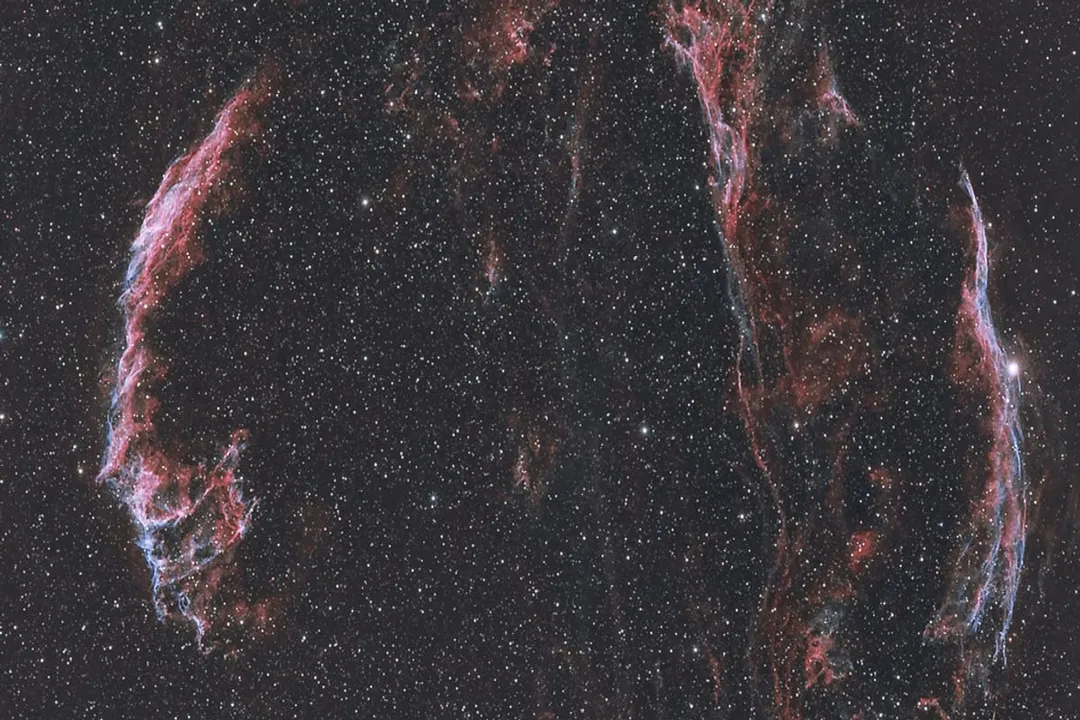
The delicate, ethereal structures we observe as the Veil Nebula reside squarely within the boundaries of our own galaxy, the Milky Way. [1] This famous celestial object is not a distant island universe but rather a remnant of a cataclysmic event that occurred relatively recently in cosmic terms, deep within one of the Milky Way's spiral arms. [2] Its presence serves as a spectacular, ongoing illustration of stellar evolution and death occurring right here in our galactic neighborhood. [5] Spanning an immense area of the sky in the constellation Cygnus, the Veil Nebula represents the expanding debris from a colossal star that met its end in a supernova explosion estimated to have happened between ten and twenty thousand years ago. [2]
# Galactic Address
Confirming its cosmic address immediately places the Veil Nebula as an intrinsic feature of our galaxy. At a distance of approximately $2,400$ light-years from Earth, it is one of the closer supernova remnants we can study in detail. [1][2] To put this into a broader galactic perspective, the entire Milky Way disk is estimated to be about $100,000$ light-years across, meaning the Veil Nebula is not located near the galactic center or the far outer rim, but rather occupies space within the Orion Arm, one of the major spiral structures of our galaxy. [2]
The physical extent of this remnant is staggering, stretching across more than $100$ light-years in diameter. [2] Considering the vastness of space, $100$ light-years is a huge volume. If we try to visualize this locally, it's helpful to note that the nearest star system to us, Alpha Centauri, is only about $4.37$ light-years away. Therefore, the Veil Nebula's structure covers a region in space equivalent to roughly twenty-three times the distance to our closest stellar neighbors. This sheer scale emphasizes that even events happening within our galaxy can produce structures too large for the naked eye to appreciate as a whole. [8]
# Supernova Aftermath
The entire nebula is the visible aftermath of a massive star—perhaps twenty to forty times the mass of our Sun—outliving its fuel supply and collapsing under its own gravity. [2] When such a star explodes as a Type II supernova, it blasts material outward at incredible speeds. The shockwave from this explosion slams into the calmer, pre-existing interstellar medium—the gas and dust already floating between the stars in the Milky Way—causing it to glow brightly across various wavelengths of light. [2][5]
The intense energies involved heat the gas to millions of degrees initially, but as the material expands and cools over millennia, it forms the intricate filaments we now see. [2] The light we capture, particularly in images from instruments like the Hubble Space Telescope, reveals this shock front glowing brightly. [5][6] This process is continuous; the nebula is still expanding today, gradually dissipating its material back into the interstellar medium from which it was originally formed, enriching it with heavier elements synthesized during the star's life and the explosion itself. [2]
# Observable Components
When observing or imaging the Veil Nebula, astronomers recognize several distinct features, which were cataloged separately before their connection as parts of a single remnant was understood. [2] These sub-sections give the Veil its evocative, complex structure. [8]
The primary, most visually striking components include:
- The Western Veil Nebula: Officially designated NGC 6960, this is often called the "Witch's Broom" because of its delicate, sweeping appearance. [7] It typically appears along the line of sight with the star 52 Cygni. [2]
- The Eastern Veil Nebula: This section encompasses NGC 6992 and NGC 6995, sometimes grouped as Caldwell 34. [2][6] It generally appears as a brighter, more expansive arc on the opposite side of the main structure. [6]
- Pickering's Triangle: This structure, officially cataloged as NGC 6979, lies between the Eastern and Western parts and is characterized by more tightly packed knots of glowing gas. [2]
It is fascinating to note how these designations came about. When early observers cataloged these objects, they often mapped only the brightest, most easily distinguishable parts. It took subsequent, more powerful telescopes and integrated observations to confirm that these seemingly separate nebulae were, in fact, fragments of the same expanding shell, all originating from that single supernova event within our galaxy. [2][8]
# Imaging and Filters
The visual appearance of the Veil Nebula is vastly different depending on the method of observation, which speaks to the varying conditions inside the remnant. Visually, through a typical amateur telescope, the nebula is extremely faint, appearing as a pale, grayish smudge even under dark skies, due to the low surface brightness of the diffuse gas. [8] The human eye, relying on rod cells in low light, is not sensitive enough to register the faint colors produced by the glowing gases.
This is where the expertise of astrophotographers comes into play, transforming the faint structure into the vibrant objects seen in public galleries. They rely heavily on narrow-band imaging to tease out the structure. [4] Since the gas primarily emits light at specific wavelengths corresponding to ionized hydrogen (H-alpha), doubly ionized oxygen (), and ionized sulfur (), specialized filters are used to block out nearly all other light pollution and starlight. [5][6] For instance, the emission, often rendered as blue or cyan in composite images, shows the shock-heated gas structures beautifully, while the emission, typically red, reveals the overall glowing hydrogen content. [5][4] The striking, sometimes electric-looking colors in deep-sky photographs are thus not what the eye sees directly but are a mapping of specific elemental emissions captured over long exposures. [4]
For an observer hoping to see any hint of structure visually, the required viewing conditions are harsh. One practical tip for locating the fainter portions is to use averted vision—looking slightly to the side of the object—as this engages the more light-sensitive parts of the retina. Even so, to see the intricate detail captured by Hubble, specialized setups involving long exposures and filters like the or filters are essential to differentiate the glowing gas from the background star field. [8]
# Comparison of Structures
When comparing the Eastern and Western components, one can infer differences in the density of the interstellar medium the original shockwave encountered. The Eastern Veil (NGC 6992/6995) often appears as a broad, relatively smoother sheet of emission. [6] This might suggest the initial expansion moved into a region of more uniform, perhaps slightly less dense, interstellar cloud material.
In contrast, the Western Veil (NGC 6960) and Pickering's Triangle often display sharper, curvier, and more knotted filaments. [7] This intricate, almost fibrous appearance suggests the shock front is interacting with denser clumps or knots of gas and dust that were already present in the nebula's path. The energy is being funneled and compressed more dramatically in these localized areas, resulting in brighter, more defined knots of light where the shock interaction is strongest. [2] Analyzing the brightness and morphology across these different regions offers astronomers a three-dimensional map of the interstellar material that existed twenty millennia ago in that section of Cygnus. [5]
This internal variation across a $100$-light-year structure gives us a unique, frozen-in-time cross-section of the interstellar medium in our local galactic arm. Think of it less like a static sculpture and more like a cosmic ripple tank where the initial splash created waves that reveal the structure of the water itself—in this case, the gas clouds of the Milky Way. [1]
# Observing from Earth
Because the Veil Nebula is a large, diffuse object, its brightness is spread out over many square degrees of the sky, making it a challenging target for casual observation. [8] Its designation as a prominent feature in the constellation Cygnus means it is best observed during the Northern Hemisphere's summer and early autumn months when Cygnus is high overhead. [1]
While its distance is significant for a supernova remnant, it is still very much an interior object of the Milky Way. Stars in the foreground that are much closer or much farther away can sometimes appear superimposed over the nebula, creating complex line-of-sight confusion. [7] However, because the nebula itself is so large and relatively close compared to the galactic core, it doesn't suffer from the dust obscuration that plagues observations of more distant Milky Way features located near the galactic plane's center. It sits in a comparatively clearer window, allowing us to see its structure with relative ease, provided we have a dark sky and a large enough aperture to gather sufficient light. [8] Observing this local galactic ruin offers a profound connection to the processes that shape our galactic home.
Related Questions
#Citations
The Veil in the Milky Way - CNMOC
Veil Nebula - Wikipedia
Milky-Way towards the constellation of Cygnus (ground-based image)
The Eastern Veil Nebula in SHO from DSW : r/astrophotography
Uncovering the Veil Nebula - NASA Science
ESA - Hubble uncovers the Veil Nebula - European Space Agency
The Western Veil Nebula (NGC 6960) - Department of Astrophysics
The Veil Nebula - by Brian Ventrudo - Seeking Starlight