How does NASA know what the Milky Way looks like?

When we look up at a clear, dark night sky far from city lights, we see the Milky Way as a faint, glowing band of light stretching across the heavens. [4][7] This ethereal glow isn't a single object but the combined light of billions of stars packed densely into the plane of our galaxy, viewed edge-on from our vantage point within it. [4][5] This perspective immediately presents a fundamental problem for astronomers: how can we possibly know the overall shape—the grand spiral arms, the central bar, and the size—of a structure we inhabit? We are essentially trying to draw a map of a forest while standing in the middle of it, with dense foliage blocking our view of the outline. [1][8]
# Inside View
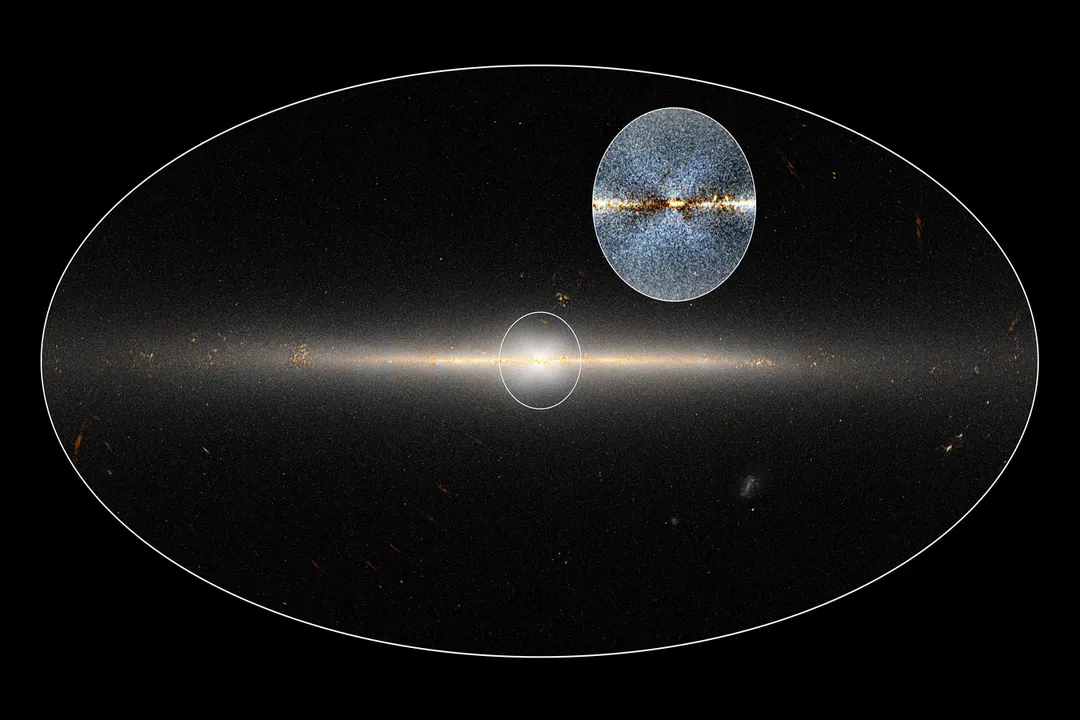
The immediate visual experience is limited. What we see as that hazy strip is the disk of the galaxy seen from the side. [5] Our own solar system resides within this disk, about two-thirds of the way from the galactic center, tucked into a smaller feature known as the Orion Spur or Arm. [4][7] Because we are embedded within the thickest part of the disk, massive amounts of intervening gas and dust obscure our view of what lies beyond, especially toward the center. [1][4] If we tried to observe the Milky Way using only visible light, much like observing a distant galaxy, we would be completely blind to its true structure beyond a few thousand light-years. [1][8] The dust clouds act like thick fog, absorbing and scattering the visible starlight coming from farther within the galactic plane. [4]
# Piercing the Veil
To overcome this galactic obstruction, scientists, including those at NASA, must employ tools that can pass through this dust barrier. Visible light has too short a wavelength to penetrate effectively, but longer wavelengths can. [1][4] This necessity dictates the primary observational techniques used to map the galaxy: radio astronomy and infrared astronomy. [1][8]
Radio waves, which have much longer wavelengths than visible light, are scattered far less by interstellar dust, allowing them to travel across the galaxy relatively unimpeded. [4][8] Astronomers can target gas clouds, particularly hydrogen gas, which is abundant throughout the galaxy. [1] By detecting the specific radio signature emitted by neutral hydrogen—the 21-centimeter line—they can locate these clouds. [4] Similarly, infrared light is better at cutting through dust than optical light, revealing regions of star formation and the central bulge that are otherwise hidden. [4][5]

# Measuring Motion
Locating a gas cloud in the sky only gives us two dimensions—its position on the celestial sphere. To build a three-dimensional map of the spiral arms, we need the third dimension: distance. [1] This is where the Doppler effect, specifically redshift and blueshift, becomes indispensable. [1][4]
As the gas clouds orbit the galactic center, their motion relative to our Sun creates a measurable change in the frequency of the radio waves they emit. [1] If a cloud is moving away from us, its signal is shifted toward longer, redder wavelengths (redshift); if it is moving toward us, the signal is shifted toward shorter, bluer wavelengths (blueshift). [4] By precisely measuring this Doppler shift, astronomers calculate the cloud's radial velocity—how fast it is moving toward or away from Earth. [1]
The process isn't simple triangulation; it relies on kinematic modeling. Astronomers assume that the galaxy is in some state of rotation and use the measured velocity, combined with assumptions about the gravitational forces at play, to infer the actual distance to the cloud. [4] This is an incredibly complex calculation, as the galaxy is not a simple, uniform spinning disk; it has warpings, density waves, and non-circular motions that must be accounted for. [1]
An interesting implication of this technique is the sheer scale of the required precision. Consider the Sun orbits the galactic center at roughly 220 kilometers per second. [7] For a gas cloud only slightly farther out to have a significantly different radial velocity, astronomers need instruments capable of measuring speed differences in the range of a few kilometers per second across distances spanning tens of thousands of light-years. Any small error in measuring the cloud’s velocity translates into a substantial error in its calculated distance, meaning the map is constantly being refined as observational techniques improve.
# Constructing the Shape
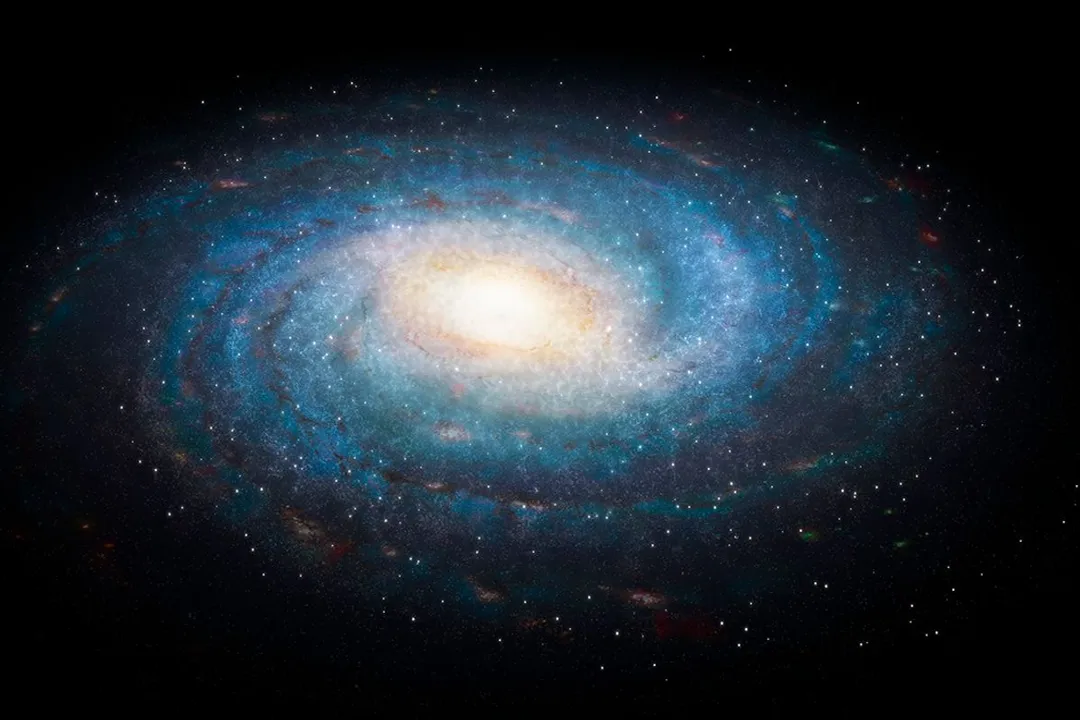
Once enough of these three-dimensional points—the locations of gas and star-forming regions—are gathered, a picture begins to emerge. [1][4] The data consistently show that the Milky Way is not a simple spiral galaxy, but rather a barred spiral galaxy. [7] This means that instead of the spiral arms starting directly from the central bulge, they emerge from the ends of a vast, elongated structure of stars called the central bar. [5][7]
The mapping of the disk reveals several major spiral arms, such as the Perseus Arm and the Scutum-Centaurus Arm, along with smaller features like the Orion Spur where we reside. [4] The identification of the bar itself was a significant finding, often requiring infrared observations that could penetrate the central dust to resolve the elongated structure of older stars in the core. [5] Further refinement, utilizing X-ray data from orbiting observatories, has helped detail the bulge, revealing structures like an X-shape composed of X-ray binaries, which offers clues about the turbulent formation history of that central region. [5]
# External Analogy
While the internal mapping provides the raw data points, a crucial step in confirming our model comes from looking outward. We cannot take a photograph of the Milky Way from the outside, so scientists compare our galaxy to the billions of other galaxies we can observe completely. [1][4]
Astronomers classify galaxies based on their appearance, mass, and star formation rates. When they find external spiral galaxies that match the rotational speed, mass estimates, and general properties derived from our internal mapping data, they use those external galaxies as templates. [1] If an external galaxy is classified as a barred spiral, and our internal kinematic data strongly suggests we possess a bar and spiral arms, the conclusion that the Milky Way is a barred spiral becomes highly certain. [4] This comparative anatomy is what allows NASA and other agencies to confidently render artistic visualizations—they are educated, data-driven extrapolations based on physics and observation of our galactic neighbors. [1]
It is important to recognize the difference between direct observation and modeling in this context. When a famous artist's rendition of the Milky Way is published, it represents the current scientific consensus model—a "best fit" curve derived from thousands of discrete measurements of hydrogen clouds and star clusters. The exact definition of where one arm ends and another begins is often fuzzy, representing regions where the density wave is strongest, not hard physical edges. This contrasts sharply with our view of Andromeda, where we see a static image captured at a single moment in time, albeit one millions of years in the past.
# Mapping Techniques Summary
The process is a triangulation between internal measurements and external comparisons. Below is a summary of the key methods NASA relies upon to piece together our galaxy's portrait:
| Component Mapped | Observational Technique | Key Information Gained |
|---|---|---|
| Gas Clouds (Hydrogen) | Radio Astronomy (21-cm line) | Location and velocity for mapping arms and disk structure [4][8] |
| Dust & Young Stars | Infrared Astronomy | Penetrating dust to see obscured central regions and star nurseries [4][5] |
| Structure/Motion | Doppler Shift Analysis | Radial velocity used to calculate distance and rotational curve [1][4] |
| Bulge Features | X-ray Astronomy | Pinpointing dense, energetic structures within the galactic center [5] |
| Overall Structure | Extragalactic Comparison | Confirmation of the barred spiral classification by analogy to exterior galaxies [1] |
The entire effort is a testament to patience and technological development. Decades of accumulating radio data, refining infrared sensor technology, and improving the computer models used to process the Doppler shifts have allowed us to transform a simple, hazy band of light into a complex, rotating, barred spiral system. [1][4] This detailed map is continually updated, demonstrating our growing expertise in galactic cartography, even from the most challenging vantage point imaginable. [4][5]
Related Questions
#Citations
How do we know what the Milky Way looks like if we are within it?
The Milky Way Galaxy - NASA Science
how do we know what our galaxy, the milky way, looks like? #space ...
How we know what the Milky Way Galaxy looks like
X Marks the Spot for Milky Way Formation - Jet Propulsion Laboratory
How we learned the shape of the Milky Way - Astronomy Magazine
Milky Way - Imagine the Universe! - NASA
How Do We Know What the Milky Way Looks Like When We Are ...
how do we know what our galaxy, the milky way, looks like - #space