Which arm of the Milky Way is the sun in?
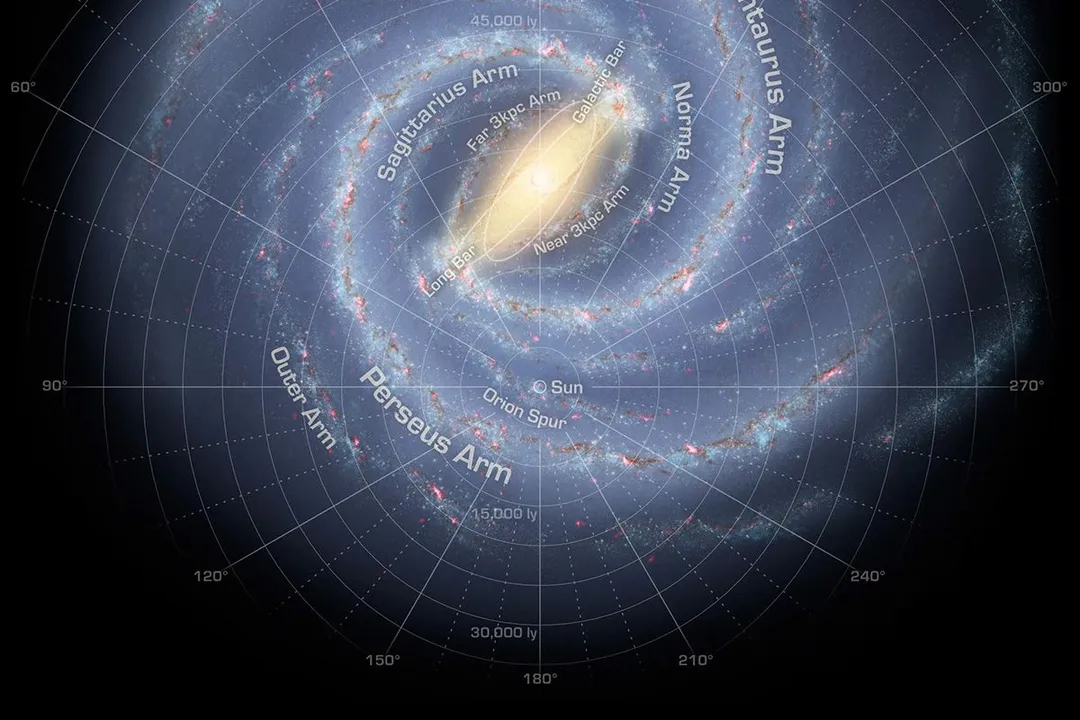
Our star, the Sun, and our entire planetary system are nestled within the vast structure of the Milky Way galaxy, and the specific address we occupy is one of its spiral features, commonly referred to as the Orion Arm. [1][3][7] This identification marks a significant shift in astronomical understanding, moving past older, geocentric views where Earth was thought to be central to everything. [1] Knowing exactly where we sit within this galactic disk is surprisingly complicated because, unlike observing distant galaxies, we cannot step outside the Milky Way to get a clear, face-on view. [1]
# Galactic Home
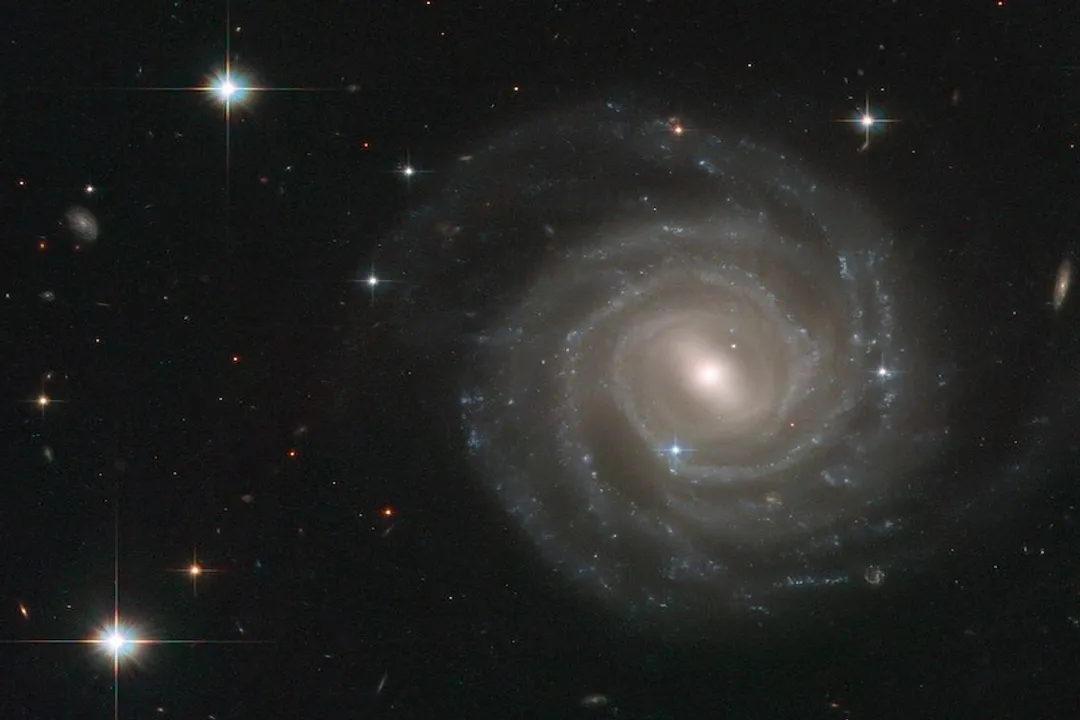
The Milky Way is classified as a barred spiral galaxy. [3] This means it has a central bulge packed with billions of stars, from which a bar-shaped structure extends, and the spiral arms wind outward from the ends of that bar. [3] While the exact count of major arms is debated—with models suggesting both two and four main arms—it is generally agreed that the structure includes numerous smaller arms and spurs. [3][7] Our Solar System is not floating in the major concentrations of stellar matter; instead, we reside on the edge of a relatively minor feature. [1][3]
This specific location is known by several names: the Orion-Cygnus Arm, the Local Arm, or the Orion Spur. [4][7] It is situated between two of the more prominent, larger structures: the Perseus Arm and the Scutum-Centaurus Arm (or Carina-Sagittarius Arm, depending on the map projection). [3][7]
The Sun's distance from the galactic center is estimated to be around 26,000 light-years. [1][3][7] Given that the entire galaxy is estimated to span about 100,000 to 120,000 light-years across, this places our Solar System roughly halfway from the core out toward the visible edge. [3][4] To traverse the distance to the center or the outer rim, one would need to travel approximately 25,000 light-years. [1]
# Naming and Local Context

The designation Orion Arm comes from its convenient alignment with one of the most recognizable constellations in our night sky: Orion the Hunter. [3][7] When we look toward Orion, we are essentially looking inward along our own local arm. [3] This direction allows us to see many of the constellation's brightest stars, like Betelgeuse and Rigel, and famous nebulae, such as the Orion Nebula (M42), because these objects are neighbors within our immediate galactic neighborhood. [3][7]
It is worth noting that the terminology used for our local structure has evolved. While once often dismissed as merely a "spur"—a smaller offshoot—newer research suggests the Orion Arm is a much more substantial feature, potentially a significant segment of an arm itself, perhaps branching between the Sagittarius and Perseus arms. [2][7] Some recent studies even suggest its characteristics, like its pitch angle and star formation rate, compare favorably to those of the galaxy's major arms, leading some to consider it the fifth significant feature in the Milky Way's structure. [6][7]
If you picture the Milky Way as a giant cosmic clock face, our Solar System is located in a region where the density of matter is slightly lower than in the main arms, a relative void sometimes called the Local Bubble. [7][8] This placement seems to have profound implications for the potential for life throughout the galaxy.
# The Habitable Niche
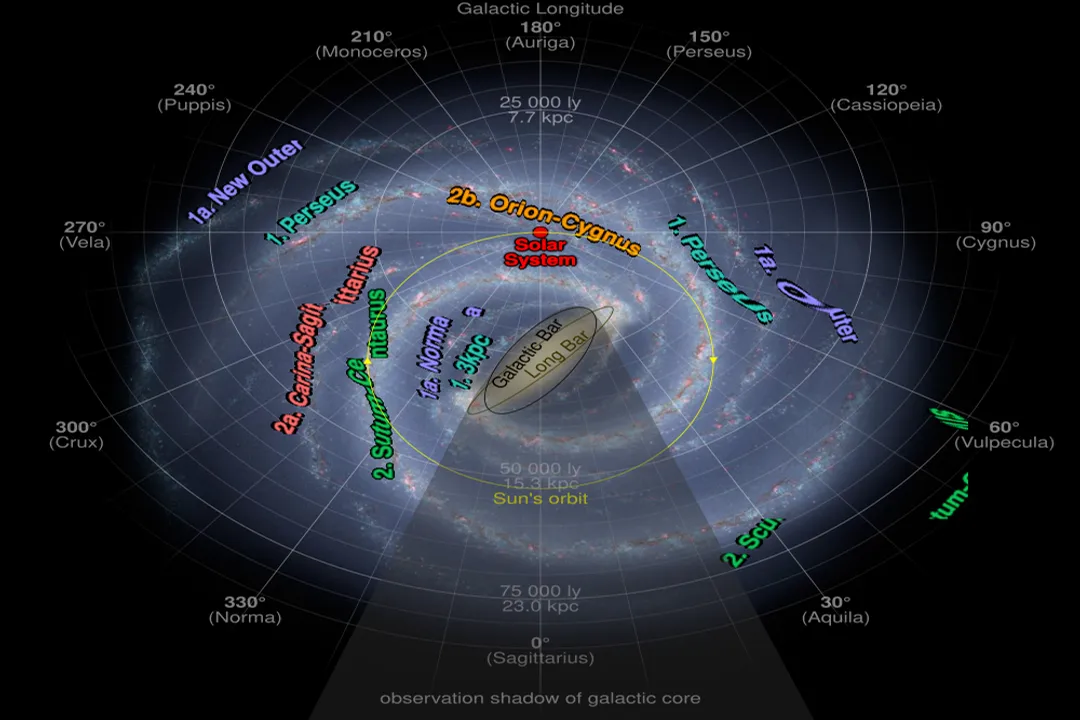
The very position of the Solar System within the Orion Arm—situated between major arms and far enough from the crowded galactic center—is considered by some to be a factor in Earth’s habitability. [3] Stars that orbit too close to the galactic center or travel frequently through the dense star swarms of the major spiral arms are subject to higher levels of deadly radiation. [3]
Our solar system's orbit around the galactic core seems to be well-synchronized with the overall rotation of the galaxy, allowing it to spend more time in the quieter, resource-rich areas between the major stellar concentrations. [3] This quieter niche provides a less hazardous environment compared to the higher energy zones within the densely packed arms. When comparing the structure of the galaxy to a terrestrial setting, our location isn't in the main, heavily populated metropolis of the central bulge, nor is it out in the sparsely populated, dark suburbs near the galactic edge. We reside in a comfortable, well-established ring road, offering safety and proximity to necessary materials for long-term planetary evolution. [3]
To put our cosmic speed into perspective, the Sun is currently traveling around the galactic center at an immense velocity, completing one full circuit—a galactic year—in approximately 230 million years. [4] Considering the immense distances involved, understanding our location requires methods beyond standard visible-light astronomy.
# Mapping the Unseen Structure
Determining the structure of the Milky Way from the inside presents a unique cartographical challenge. [6] We cannot simply take a photograph of the whole thing. Instead, astronomers rely on sophisticated techniques to piece together the galactic map, primarily by observing objects that can penetrate the thick layers of gas and dust that obscure visible light.
The key to mapping the spiral arms involves studying the distribution of hydrogen, the most abundant element in the universe. While cold hydrogen gas doesn't emit visible light, it does emit radio waves (specifically at a wavelength of , or H I hydrogen) that easily pass through interstellar dust. By using radio telescopes, scientists track these radio signals, and by analyzing the Doppler shift—the change in wavelength caused by motion toward or away from us—they can calculate the distance and velocity of these gas clouds.
A more precise, contemporary method involves locating high-mass star-forming regions (HMSFRs) and observing masers—naturally occurring microwave emitters, often involving water or methyl alcohol molecules within these gas clouds. [7] Recent surveys, like the BeSSeL Survey, have used the parallax of these masers, measured by arrays like the Very Long Baseline Array (VLBA), to gain highly accurate distances to segments of the arms. [6][7] These high-precision measurements have been crucial in refining the understanding that the Orion Arm is a substantial, independent segment, rather than just a minor connection between larger features. [6][7]
This mapping process also reveals that star formation tends to lag behind the compression of gas in the density waves that form the arms. When researchers compared the locations of the gas (traced by masers) with the locations of slightly older stars (about 1 billion years old), they found slight offsets and differences in the calculated "pitch angle" of the arm, which supports the idea that the arm structure is a propagating density wave phenomenon. [7]
To fully map the galaxy, however, a blind spot remains: Earth is located in the Northern Hemisphere, and our current array of high-precision instruments like the VLBA is also primarily based there, limiting our ability to map the entire sky, especially the southern portions of the galaxy, without more Southern Hemisphere observations. [6]
# Objects in the Local Neighborhood
Our residence in the Orion Arm means that many objects we admire with amateur telescopes are, in fact, just down the road in cosmic terms. [3] The arm is populated by numerous well-known deep-sky objects that are easily visible to observers. [7]
For example, when you train a telescope on the famed Orion Nebula (M42), you are looking at a stellar nursery located within your own local arm. [7] Other famous celestial landmarks found in this spur include:
- The Pleiades (M45) [7]
- The Beehive Cluster (M44) [7]
- The Ring Nebula (M57) [7]
- The Butterfly Cluster (M6) [7]
The abundance of these bright, relatively young objects in the direction of Orion helps confirm that this region is an active area of star formation, even if it is considered a minor arm or spur compared to the galaxy's main structures. [3] It illustrates a fundamental concept: the spiral arms are where the newest, hottest, and brightest stars are currently being born from the dense clouds of gas and dust.
When considering our place in the universe, it is easy to feel insignificant, being just one star in one arm of one galaxy among billions. [1] Yet, this precise location offers a unique vantage point. We are close enough to the galactic center to observe the overall dynamics of the Milky Way, but far enough out to reside in a relatively stable zone, away from the extreme gravitational and radiation environments of the core or the major arm crossings. [3] This steady cosmic address has likely provided the necessary calm for complex life to develop over billions of years on our planet. Understanding the Orion Arm is, quite literally, understanding our cosmic home address and the conditions that allow it to exist.
#Videos
Where Is The Sun Located In Our Galaxy? - Physics Frontier
Related Questions
#Citations
Which Milky Way spiral arm is ours? - EarthSky
Is it still widely accepted that the Sol system resides in the Orion Arm ...
Our position in the Milky Way - Sun.org
Orion Arm - Wikipedia
Where are Earth and the Sun located in the Milky Way?
Our Galactic Arm May Have a Longer Reach Than We Thought
Milky Way Galaxy | Type & Spiral Arms - Lesson - Study.com
Where Is The Sun Located In Our Galaxy? - Physics Frontier