Do astronauts see the Milky Way in space?
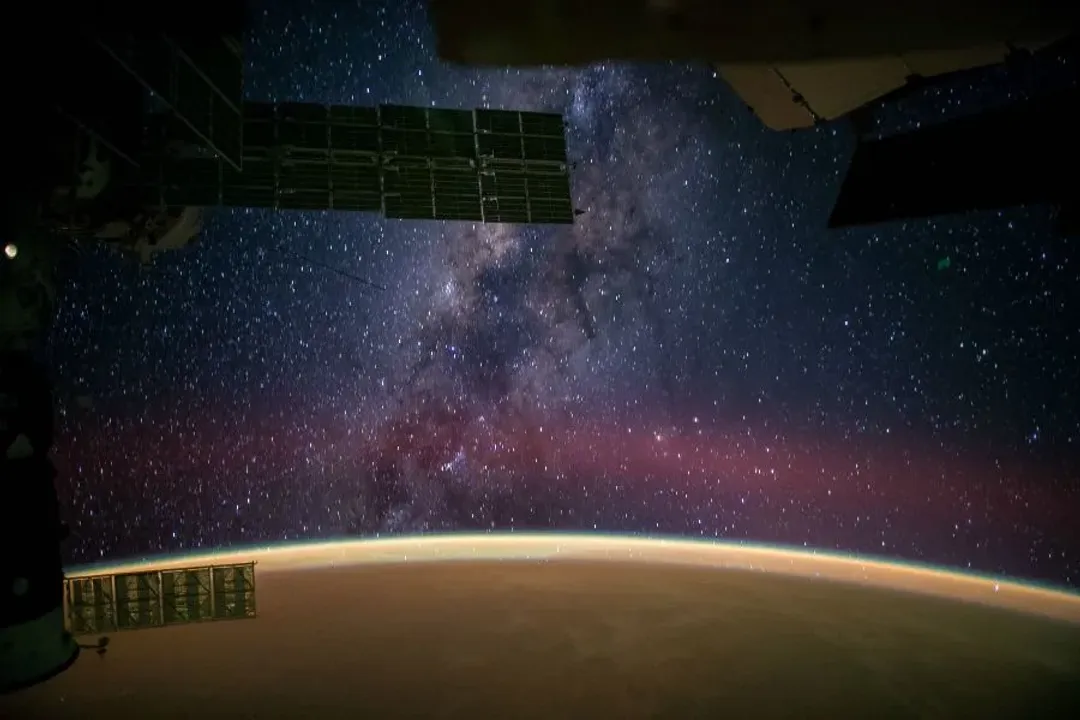
Astronauts absolutely see the Milky Way, and when they do, the experience is often described as far surpassing what is visible from Earth, even from the darkest locations on our planet. The fundamental reason for this stark difference lies in what we leave behind when we reach orbit: the atmosphere. On Earth, our atmosphere scatters sunlight, causing the sky to appear blue during the day and creating a light glow at night, even far from city lights. This scattering dims the faint light from distant stars and the diffuse glow of our galaxy's core.
# Atmosphere Blockade
From the vantage point of the International Space Station (ISS), there is no atmospheric interference to diffuse or block the light traveling from the stars and nebulae that make up the Milky Way. This absence means the view of the galaxy is significantly clearer and more intense. While ground-based astronomers use specialized equipment to capture long-exposure photographs that reveal stunning detail, astronauts are witnessing that celestial structure with the naked eye, albeit through a window. The view is not just clearer; it is fundamentally brighter because the light hasn't been attenuated by kilometers of air.
# Brilliant Appearance
When the ISS is on the night side of Earth, the Milky Way reveals itself as a brilliant band of light stretching across the black void. Astronauts report that the central core of our galaxy, the brightest part, appears especially spectacular. It is not merely a faint smudge; it is a vivid, magnificent structure. One astronaut captured an image showing the galaxy's light starkly set against the absolute blackness encountered beyond the Earth's illuminated horizon. The consensus among those who have seen it is that it is a truly amazing sight, far exceeding expectations based on terrestrial viewing conditions. It's important to note that the stars themselves appear phenomenal, much better than on the surface.
# Orbital Timing
However, seeing this grand spectacle isn't as simple as just looking out the window all the time. Orbit imposes its own set of viewing challenges that earthly stargazers never face. The ISS orbits the Earth roughly every 90 minutes, meaning astronauts experience about 16 sunrises and sunsets every 24 hours. This rapid cycle means that long periods of true, deep night are punctuated by extended periods of daylight or twilight conditions.
If the station is passing through the sunlit side of the planet, the glare reflecting off the Earth itself—the bright limb—is overwhelming, washing out the view of the fainter stars and the Milky Way. Therefore, the best opportunity to view the galaxy is during those brief orbital night passes, and even then, the astronaut must orient themselves to look away from the Earth's glowing edge. This environmental constraint shapes the experience; it's not continuous immersion in galactic darkness, but rather fleeting, perfect moments of clarity dictated by orbital mechanics.
# Light vs. Shadow
It might seem counterintuitive, but the biggest competitor to seeing the Milky Way from the ISS isn't the sun, but the Earth itself. On the ground, even the darkest desert site has some ambient light pollution or natural airglow to contend with, however minimal. In orbit, the Earth acts as a massive, illuminated object, scattering sunlight across its surface and atmosphere, creating a bright arc that dominates half the visual field. For an astronaut, the perfect viewing spot isn't merely a dark time, but a specific direction—away from that glowing sphere. Consider this: if an astronaut were to hold a hand up to block the Earth's glow, the difference in visual contrast for the surrounding stars would be immediate and dramatic. This illustrates how proximity to a large, sunlit body fundamentally alters the perception of faint deep-sky objects, even in the vacuum of space.
# Clarity Comparison
The view from orbit offers a unique comparison point that ground-based observers can only approximate. While a photographer on Earth can capture the faint dust lanes and subtle colors of the galactic center using hours of light collection, the astronaut sees a high-contrast, immediate projection of that same structure. For instance, professional observatories use specialized filters and long exposures to achieve clarity; the astronaut bypasses that entire technological step for the basic structure, gaining intensity but trading off duration of observation time. Where a seasoned astronomer might spend a week tracking a section of the Cygnus Rift from a high-altitude observatory, an astronaut might see a segment of it in high definition for a mere minute or two before the orbital path carries them into daylight again. This makes the astronaut's visual experience perhaps the purest, albeit highly transient, naked-eye view of our galaxy available to a human being.
#Videos
Milky Way Galaxy as seen from SPACE (4K) - YouTube
Related Questions
#Citations
If we can see the milky way from earth, how come we cant ... - Reddit
See What The Milky Way Looks Like From The International Space ...
Milky Way Viewed From the International Space Station - NASA
I got asked this week if you can see the Milky Way from ... - Instagram
Milky Way Galaxy as seen from SPACE (4K) - YouTube
Can astronauts see the Milky Way from space? - Quora
What Does the Milky Way Look Like from the ISS? - Futurism
Stargazing from the ISS - NASA Science
Astronaut's Remarkable Image Captures Milky Way Beyond Earth's ...