How did we figure out where the center of the Milky Way is?
The challenge of pinpointing the precise location of the Milky Way's center seems almost paradoxical. We are inside the structure, much like trying to determine the center of a massive city while standing on a busy street in the middle of it; the immediate surroundings obstruct the view of the whole layout. [1][3] Our own galaxy is a gigantic, disk-shaped collection of stars, gas, and dust, and the dense plane of the disk, where most of the visible material lies, acts like a thick fog when we try to look toward the galaxy's heart. [3][7] If we could view the Milky Way from the outside, it would be simple, but looking from our vantage point near one of the spiral arms means that much of the light from the central region is absorbed or scattered by intervening interstellar dust. [1][3]
# Early Limitations
For a long time, astronomers struggled with this fundamental question. Early attempts at mapping the galaxy relied on visible light observations, which quickly ran into the limitations imposed by that dust. [3] Before the advent of newer technologies, astronomers had to make educated guesses based on the distribution of visible objects they could see. [8] One of the most significant early steps came from the work of astronomer Harlow Shapley in the early 20th century. [2][4] He recognized that the distribution of visible objects was not uniform when looking across the sky. [2]
# Globular Clues
Shapley's key insight came from studying globular star clusters. [4] These are dense, spherical collections of hundreds of thousands of old stars that orbit the galactic center in a halo far above and below the main disk. [4][7] Because these clusters reside outside the densest parts of the dusty disk, they offer a clearer line of sight toward the galactic nucleus than the disk stars do. [4] Shapley reasoned that if the galaxy had a center, these clusters would orbit around it, meaning they should appear to be clumped in one specific direction in the sky relative to us. [2][8]
When he charted the positions of these clusters, he found a distinct concentration in the direction of the constellation Sagittarius. [2][4] This provided the first strong evidence that the Sun was not at the center of the Milky Way, but rather located somewhere in the suburbs, about two-thirds of the way out from the core. [2][8] Shapley estimated the distance to the center based on these cluster measurements to be around 30,000 light-years. [2] While the direction was largely correct—Sagittarius is still where we point to find the center—the actual distance estimate has been refined considerably since his initial work. [2][3]
If you were to try replicating a simplified version of this method for a science project, you would look up the coordinates of known globular clusters. You would notice that while they are scattered across the celestial sphere, the vast majority appear clustered toward one side of the sky, indicating that direction is toward the main mass of the galaxy. [4] The core idea hinges on the fact that the clusters are distributed spherically around the center, whereas we are stuck inside the disk. [4]
# Seeing Through Dust
Shapley's method was groundbreaking but limited by the visibility of stars and clusters. [3] To get a much more accurate fix on the exact location and to study the immediate vicinity of the center, astronomers needed ways to bypass the thick curtain of dust that blocks visible light. [1][3] This is where the magic of different wavelengths of light comes into play. [3]
# Radio and Infrared
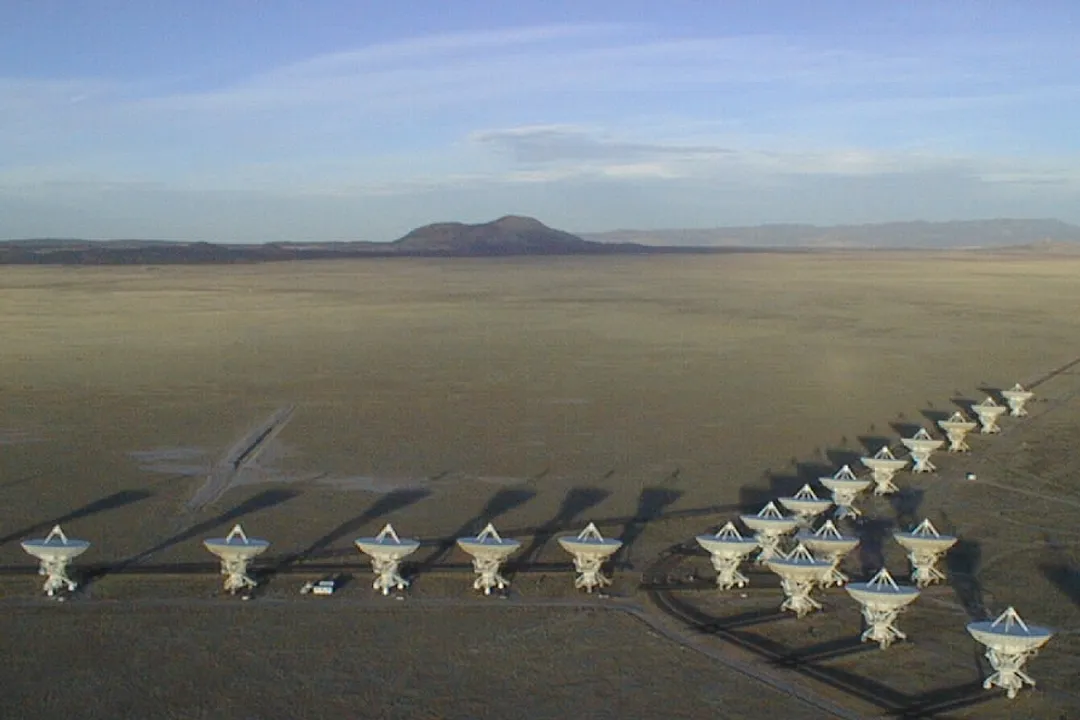
Visible light, which is what our eyes and most optical telescopes use, has wavelengths too short to penetrate the dust clouds effectively. [1] Longer wavelengths, however, can pass right through, much like how radio waves easily go through walls that visible light cannot. [1][3] This realization drove the development of radio astronomy and infrared astronomy as essential tools for galactic cartography. [3]
Radio waves, specifically those emitted by cold hydrogen gas, travel unimpeded from the galaxy's interior. [1] By observing the 21-centimeter line from hydrogen gas—a specific radio frequency emitted when the electron in a hydrogen atom flips its spin—astronomers can map the motion and location of vast clouds of gas near the core. [1][5] Doppler shifts applied to these radio signals allow scientists to calculate how fast these clouds are moving toward or away from us, which in turn maps out the structure of the arms and the rotation around the center. [1]
Simultaneously, infrared light, which is essentially heat radiation, can also penetrate the obscuring dust much better than visible light. [3] Infrared observations allow telescopes to peer into the dense star-forming regions right near the galactic nucleus, revealing structures that were completely hidden from optical telescopes. [3] This multi-wavelength approach provides a layered understanding: visible light for the outer structure (limited), globular clusters for the general direction, and radio/infrared for the inner structure. [3][5]
It is fascinating to consider the technological gap that needed bridging. Shapley relied on photographic plates and stellar magnitudes; modern astronomers rely on highly sensitive radio dishes and space-based infrared instruments that can detect signals millions of times fainter than the background noise. [1][5] This comparison highlights a key point in astronomical discovery: the breakthrough often comes not from a better theory, but from a better tool to see what was already there. [1]
# The Final Marker
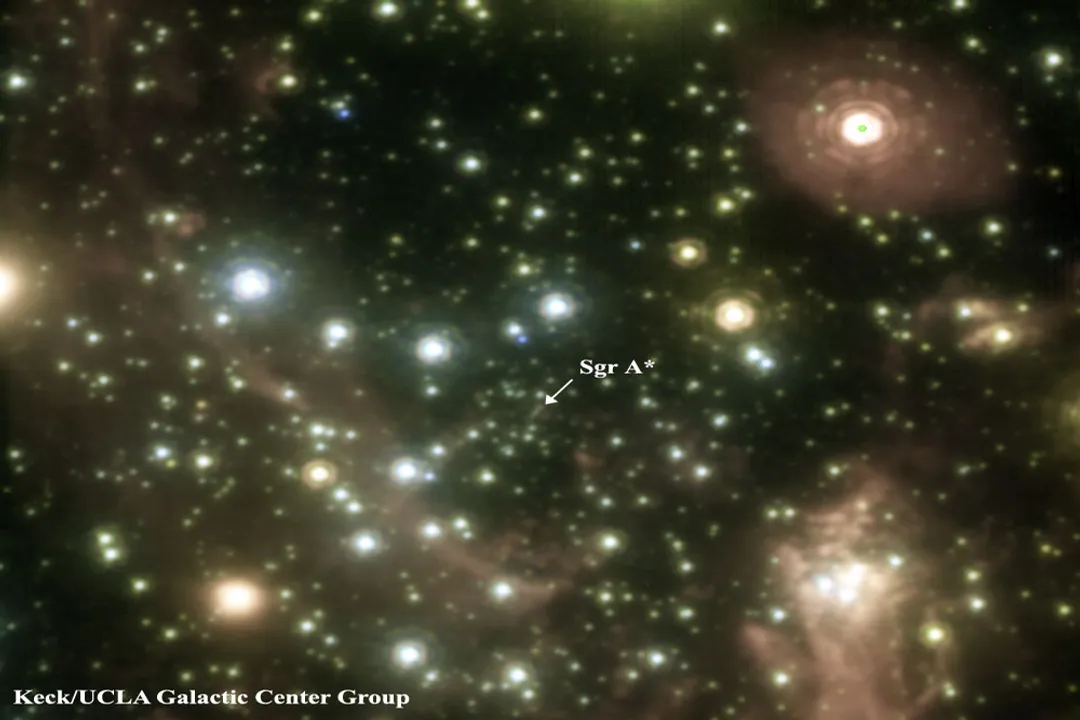
The search eventually narrowed down to a very specific, tiny area within the Sagittarius constellation: a region known as the Galactic Center, or . [7] While gas clouds and stars provided the structure, the definitive marker for the exact geometric center turned out to be the supermassive black hole residing there. [7]
# Sgr A* Orbiters
Today, the most precise confirmation of the Milky Way's center comes from observing the orbits of individual stars extremely close to the radiant source known as Sagittarius A* (Sgr A*). [5][7] These stars are whipping around an unseen, massive object at incredible speeds. [5] By meticulously tracking these star paths over many years—decades, in some cases—astronomers can use Kepler's laws of planetary motion, adapted for general relativity, to calculate the mass and location of the central object they are orbiting. [5]
The star known as S2 is one of the most famous examples of this tracking. [5] It completes an orbit in just about 16 years, coming incredibly close to the central point before swinging back out. [5] The collective data from monitoring dozens of these "S-stars" confirms that they are all circling a single, extremely compact object with a mass equivalent to about four million times that of our Sun. [7] This object is , the supermassive black hole at the heart of our galaxy. [7][5]
The center of the Milky Way is, therefore, defined as the location of . [7] The high-precision astrometry—the measurement of the precise positions and motions of these stars—has allowed scientists to pinpoint the center to an accuracy of within a fraction of a light-year, a precision unimaginable in Shapley's time. [5] The distance to this central point is now generally accepted to be around 26,000 light-years away from Earth. [2][7]
To appreciate the difference in precision, consider this: Shapley’s initial estimate of 30,000 light-years was off by about 15% in distance. [2] Modern measurements place the center at light-years away, a level of certainty achieved only by tracking the gravitational influence on nearby stellar objects. [7] This difference in scale—moving from general direction determined by fuzzy clusters to an exact point determined by orbital mechanics—represents the evolution of observational astronomy. [5]
# Galactic Structure Summary
Our current understanding paints a detailed picture of our cosmic home, where the center is a distinct, gravitationally dominant region. [6][7]
The Milky Way is classified as a barred spiral galaxy. [6] This means that instead of a simple circular bulge at the center, there is a central bar-shaped structure composed of stars, gas, and dust. [6] Surrounding this bar is the central bulge, followed by the disk where our Sun resides, and finally, the vast, spherical halo containing globular clusters and dark matter. [6][7]
Here is a simplified breakdown of the key components that helped build this map:
| Component Used | Primary Observation Wavelength | What it Revealed | Citation Example |
|---|---|---|---|
| Globular Clusters | Visible Light | General direction of the core; proved Sun is off-center | [2][4] |
| Hydrogen Gas | Radio Waves (21cm) | Mapping the rotational structure and gas distribution | [1][5] |
| S-Stars (e.g., S2) | Infrared Light | Precise location and mass of the central black hole | [5][7] |
The fact that the initial determination relied on looking out at external objects (globular clusters) to find an internal location, and the final, most accurate determination relied on looking in at objects orbiting the center using non-visible light, shows a clear pattern in astronomical progress: when nature puts up a barrier, you must find a way to observe at a different energy level. [3] The development of infrared and radio telescopes was not just an incremental improvement; it was a completely different avenue for gathering data that bypassed the fundamental obstacle of interstellar extinction. [3]
Our Solar System sits approximately 26,000 light-years away from the Galactic Center. [7] If the Milky Way's entire diameter is estimated to be about 100,000 light-years across, this places us firmly within the disk, about halfway between the bar’s edge and the outer spiral arms. [6] Knowing this central coordinate is essential because it provides the reference point for measuring the scale, structure, and rotational dynamics of the entire galactic system. [6] Without that anchor point defined by , all our distance measurements across the rest of the galaxy would lack a common, firm basis. [5]
#Videos
How We Found Earth's Location in the Milky Way - YouTube
Related Questions
#Citations
ELI5: How did we map out the exact shape of the Milky Way ... - Reddit
How did scientists determine our location within the Milky Way galaxy
How we learned the shape of the Milky Way - Astronomy Magazine
Finding the Center of the Milky Way Galaxy Using Globular Star ...
How We Found Earth's Location in the Milky Way - YouTube
Milky Way - Imagine the Universe! - NASA
Learn about our galaxy - UCLA Galactic Center Group
How did we determine the centre of the Milky Way Galaxy? - Quora