Is Carina Nebula in the Milky Way?
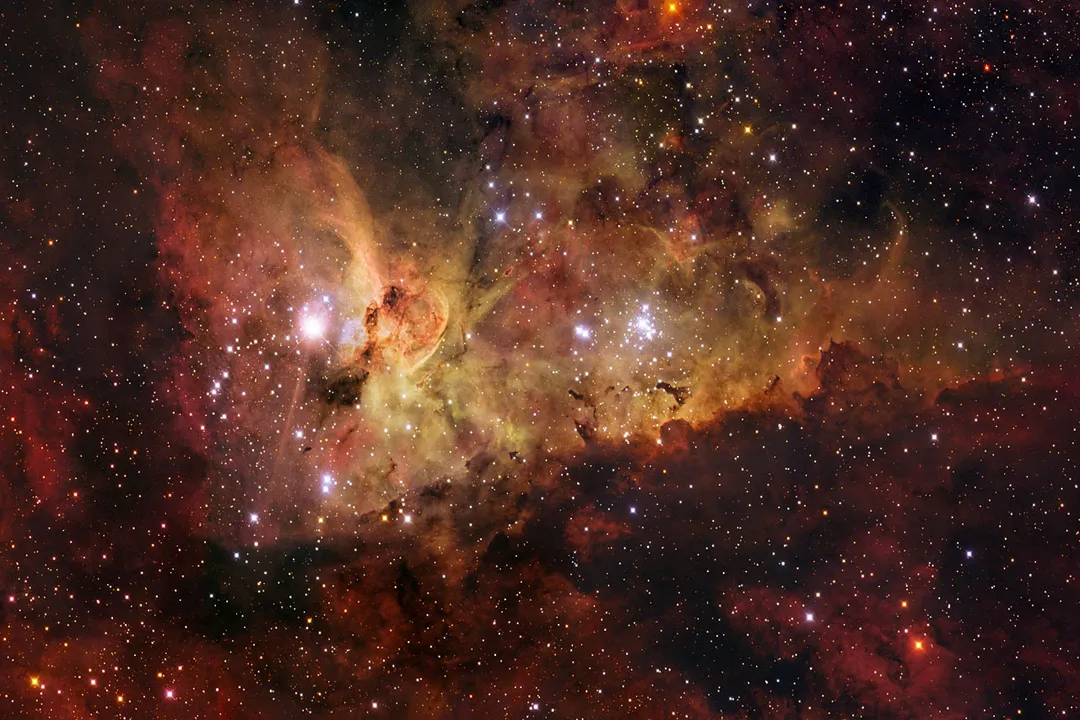
The stunning expanse of gas and dust known as the Carina Nebula resides firmly within the boundaries of our own galaxy, the Milky Way. [1][7] This colossal stellar nursery, often captured in breathtaking detail by instruments like the Hubble Space Telescope, is not a distant island universe but a relatively close neighbor in the grand architecture of our spiral home. [3][8] Its official designation, NGC 3372, barely hints at the violent and beautiful processes occurring within its vast clouds of material, located in the southern sky constellation Carina. [1]
# Galactic Placement
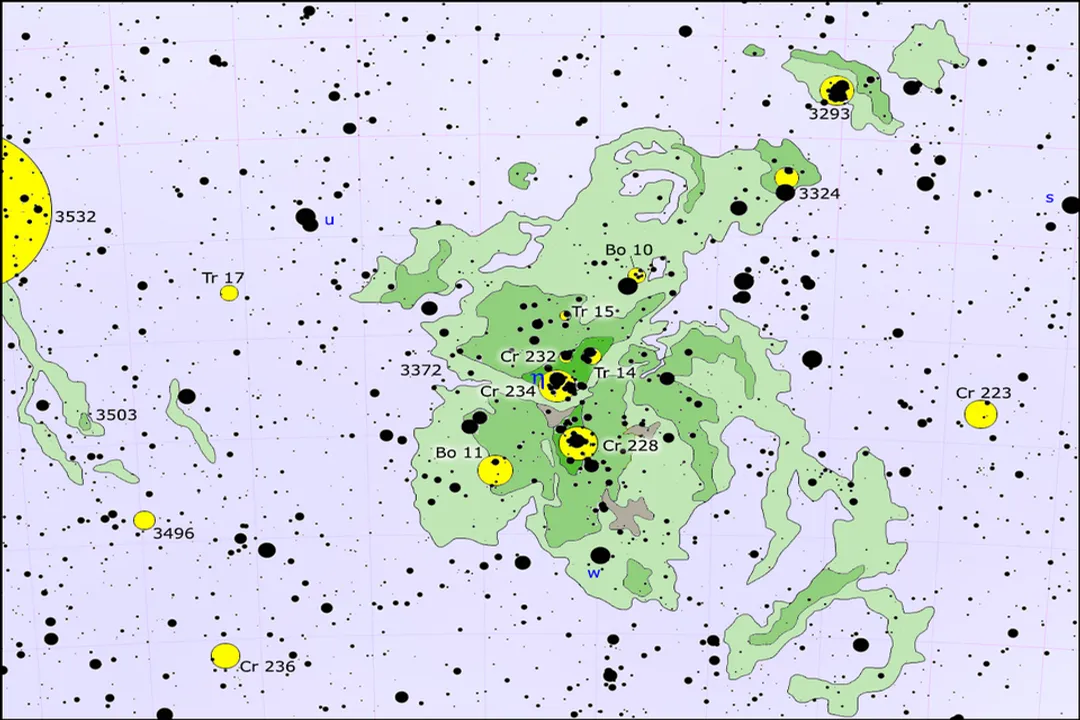
Confirming its membership in the Milky Way places the Carina Nebula roughly away from Earth. [1] This measurement is significant because it establishes the nebula as a prominent feature within the local neighborhood of our galactic disk, specifically situated within the Perseus Arm or the Sagittarius Arm, depending on the observational model used for mapping the galaxy's structure. [1] To put this distance into perspective, imagine the entire Milky Way is a dinner plate nearly a hundred thousand light-years across; the Carina Nebula is located on that plate, not orbiting a neighboring star system or residing in a separate galaxy entirely. [7]
The nebula's position means that while it is a star-forming region, it is significantly closer than the Milky Way's central supermassive black hole, Sagittarius A*, which lies about away from us. [1] This relative proximity is precisely why astronomical imaging projects dedicate so much time to capturing its features; the closer an object is, the larger and more detailed it appears through our telescopes. [5][6] For observers in the Southern Hemisphere, it is a magnificent, conspicuous sight in the night sky, sometimes mistaken for the much closer and brighter Orion Nebula by novice stargazers, though it far outshines it in sheer scale. [2]
# Stellar Nursery Size
The sheer physical dimensions of the Carina Nebula are staggering. It spans approximately across. [1] To visualize this scope, consider that the entire Orion Nebula, perhaps the most famous star-forming region visible to Northern Hemisphere observers, is only about wide. [1] This means the Carina Nebula is nearly twelve times wider than Orion. When viewing images captured by instruments like the ESO's VLT or Hubble, the apparent density of the gas and dust is misleading; the structures are separated by immense, almost empty voids of space within that span. [5]
The gas within the nebula is predominantly ionized hydrogen, causing it to glow brightly, classifying it as an . [1] This glow is often photographed in striking false color by space telescopes to highlight different elements and temperatures present in the region, revealing structures far more complex than the eye can perceive directly. [3][8]
When one looks at mosaics taken by instruments like the Hubble Space Telescope, the combined image captures a vast sweep of the Southern Milky Way, with the nebula being one of the brightest components in that stellar stream. [7]
# Eta Carinae Star
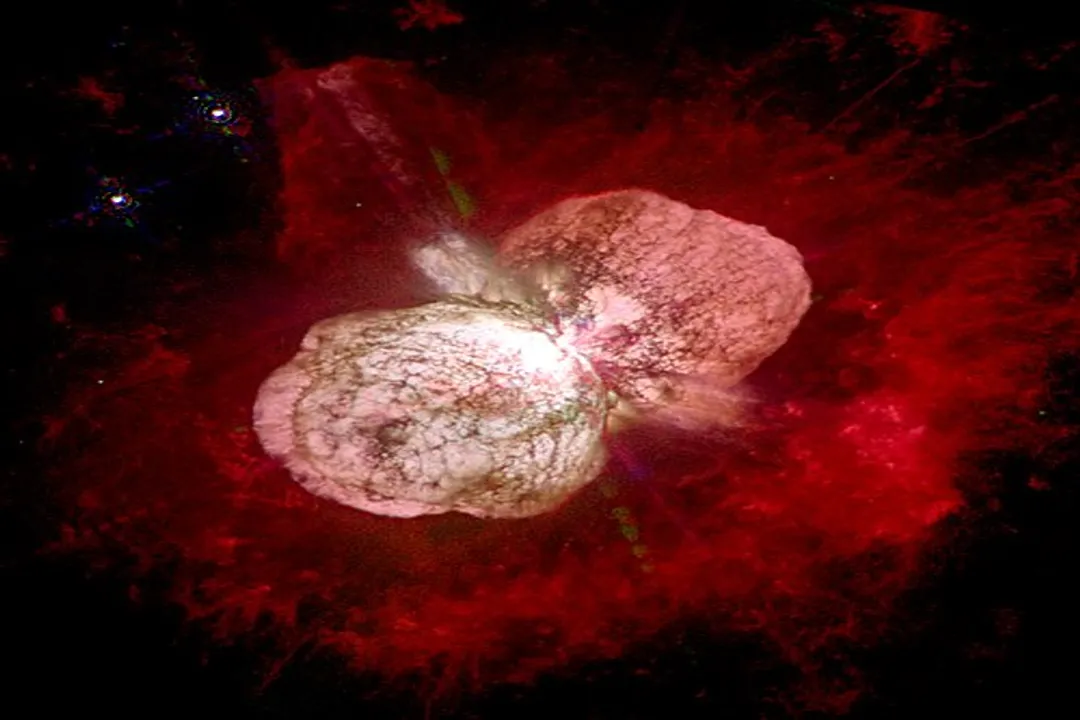
At the heart of the nebula lies its most dynamic and historically significant feature: the massive, highly unstable star system known as Eta Carinae. [1] This is not a single star, but a binary system dominated by a star that is incredibly luminous, radiating millions of times the power of our Sun. [1]
Eta Carinae's history is one of dramatic outbursts. In the , it underwent a Great Eruption, briefly becoming the second-brightest star in the sky, despite being thousands of light-years away. [1] This eruption ejected a massive shell of material, which now forms the spectacular Homunculus Nebula, visible as a bright, hourglass-shaped structure often seen obscuring the brightest parts of the larger Carina Nebula. [1] The energy released by this event dramatically carved out the surrounding clouds, demonstrating the profound impact a single star can have on its immediate galactic neighborhood. [4]
Analyzing the light from Eta Carinae is challenging because the star system is frequently shrouded by intervening dust, requiring infrared observations to penetrate the obscuring layers and study its true nature and luminosity. [3] The star is considered one of the most massive known in our galaxy, and its eventual fate—likely a hypernova or a pair-instability supernova—will dramatically reshape the immediate environment of the nebula. [1]
# Pillars and Dust
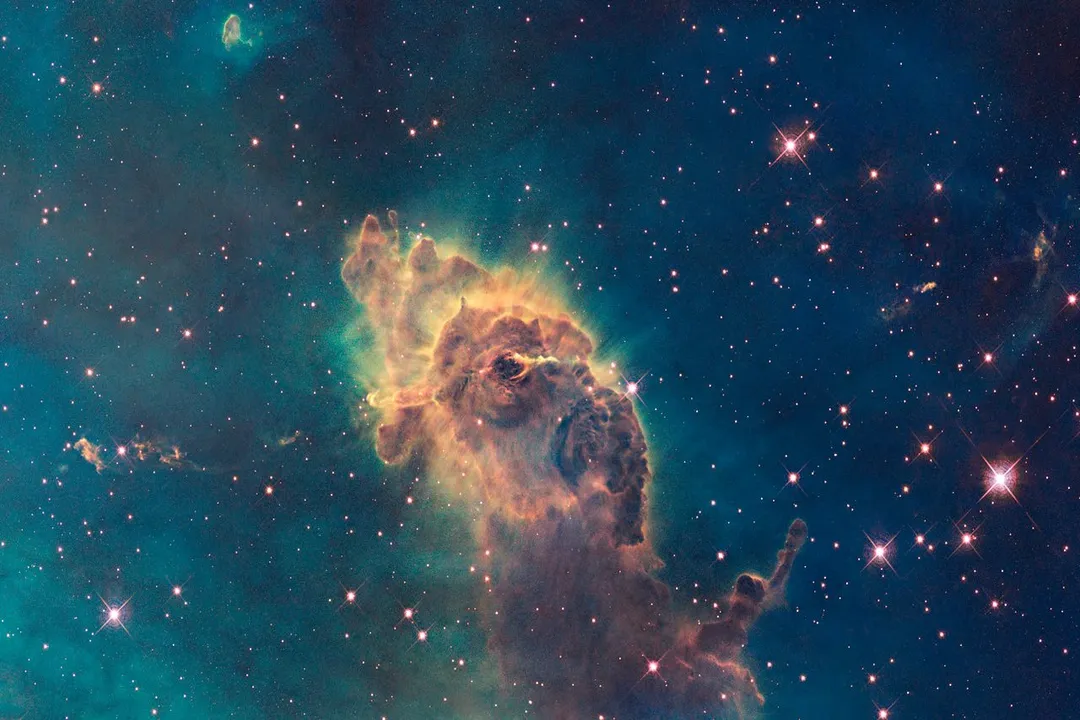
The darkness and bright, sculpted shapes within the Carina Nebula are the result of intense ultraviolet radiation from hot, young stars interacting with cooler, denser pockets of gas and dust. [3] One of the most recognizable features in many Hubble images is the "Keyhole," a dark lane cutting through the nebula's glowing interior. [1] This dark patch is actually a dense, opaque cloud of dust and gas that blocks the visible light emanating from behind it. [8]
Telescope images frequently show towering structures, sometimes likened to colossal pillars or fingers pointing outward from the brighter regions. [3][8] These structures are dynamic, constantly being eroded by the stellar winds and radiation pressure from the massive stars nearby. [3] Observing these structures across different points in time offers an invaluable glimpse into the cycle of star formation, where dense knots collapse to form new stars while the surrounding material is simultaneously blasted away by existing ones. [5]
For those imaging the nebula from amateur observatories, the challenge lies in capturing enough light to resolve these fine details. The integration time required for a single, clear image can run into many hours, even when using professional-grade equipment pointed at the nebula, as seen in deep-sky gallery submissions. [6]
A fascinating aspect of the nebula’s structure, often highlighted in wide-field views of the Southern Milky Way, is how the dust lanes interact with the stellar population. [7] The dark molecular clouds—the very birthplace of stars—are being actively illuminated and dispersed by the stars that have already formed, creating a feedback loop that dictates the nebula's evolution over millions of years. [1]

# Observational Context
The appearance of the Carina Nebula changes dramatically depending on the instrument used to observe it. The Hubble Space Telescope often captures crisp, detailed views focusing on specific regions, like the aftermath of Eta Carinae's eruption or the walls of the Keyhole. [3][8] In contrast, ground-based telescopes, such as those operated by the European Southern Observatory (ESO), can capture much wider fields of view, contextualizing the nebula within the larger background of the Milky Way's star fields. [5][7]
This difference in perspective is important for understanding the nebula's scale. When viewed in a wide-field mosaic, the nebula appears as a vast, slightly nebulous patch among countless other distant stars. [7] However, when magnified, the detailed structures emerge, showing textures that look almost sculpted, betraying the violent stellar winds shaping the gas. [5][9]
For astrophotographers working with specialized equipment, capturing the Carina Nebula requires patience and clear skies from southern latitudes. [6] The deep integration necessary to bring out the faint outer wisps of gas, while simultaneously managing the extreme brightness of the core region dominated by Eta Carinae, presents a distinct technical hurdle compared to imaging more diffuse nebulae. [2]
If we consider the density of star formation, the Carina Nebula represents a major ongoing event in the Milky Way. While the Orion Nebula is known for producing many Sun-like stars, the Carina complex is dominated by the production of the galactic heavyweights—stars exceeding ten or twenty solar masses. [1] This massive stellar output means the nebula is not just a passive cloud but an active engine of stellar evolution, fundamentally altering the chemical and energetic balance of its local galactic spiral arm. [4] Observing the faint, scattered light around the edges of the main nebula body allows researchers to trace the extent of the recent energetic expulsion from Eta Carinae, mapping the material that has already traveled several light-years away from the central eruption site. [9]
The fact that this entire, colossal structure is located within the Milky Way, rather than outside it, underscores the immense diversity and activity present throughout our own galactic disk. It is a tangible example of the complex, dynamic processes that govern stellar life cycles, playing out relatively close to our own solar system in cosmic terms. [1][7]
# Color Interpretation
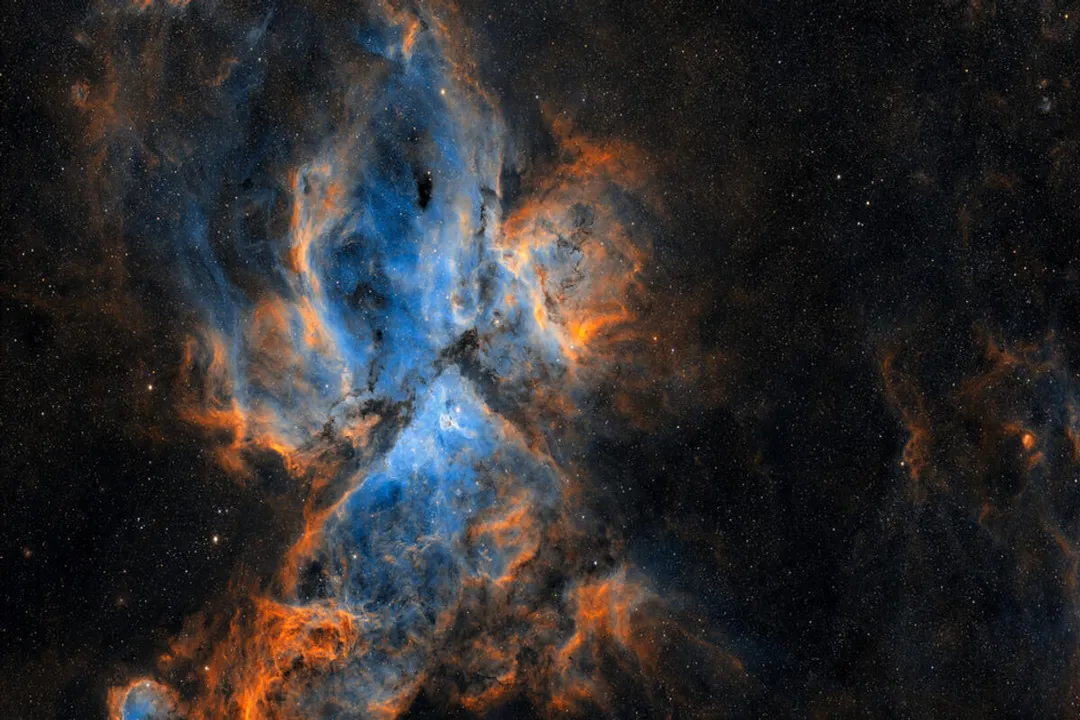
When reviewing the incredible imagery of the Carina Nebula, it is helpful to remember the role of color in scientific visualization. While the nebula glows faintly to the unaided eye as a ghostly patch, the deep-field images are almost always composites designed to highlight specific atomic emissions. [3][8] For instance, hydrogen, oxygen, and sulfur emissions are frequently mapped to red, green, and blue channels, respectively, to reveal temperature differences and chemical composition that would otherwise be blended together in visible light. [3]
This technique allows astronomers to create a map of the physical conditions within the nebula. A region appearing intensely red in a Hubble image, for example, signifies a dominance of ionized hydrogen, the classic signature of an active star-forming region still blazing hot from the UV radiation of its newest inhabitants. [8] Comparing these false-color renderings with broadband, more "natural" color images, like some taken by ground-based platforms, provides a complete picture—one that shows the sheer aesthetic beauty alongside the underlying astrophysical data. [5] It is a striking difference that reminds the viewer that while the structure is real, its most vivid colors are a translator's tool, making the invisible chemistry visible to human eyes. [7]
Related Questions
#Citations
Carina Nebula - Wikipedia
Carina nebula in the milky way galaxy - Facebook
Carina Nebula - NASA Science
The Carina Nebula[7] or Eta Carinae Nebula[8] (catalogued as NGC ...
The Carina Nebula - ESO.org
Carina Nebula | Telescope Live
Wide-field Image of the Southern Milky Way
WFC3 visible image of the Carina Nebula - ESA/Hubble
The Carina Nebula (also known as NGC 3372) is massive — one of ...