What spectacular, hourglass-shaped structure formed from material ejected during Eta Carinae's 1840s outburst?
Answer
The Homunculus Nebula
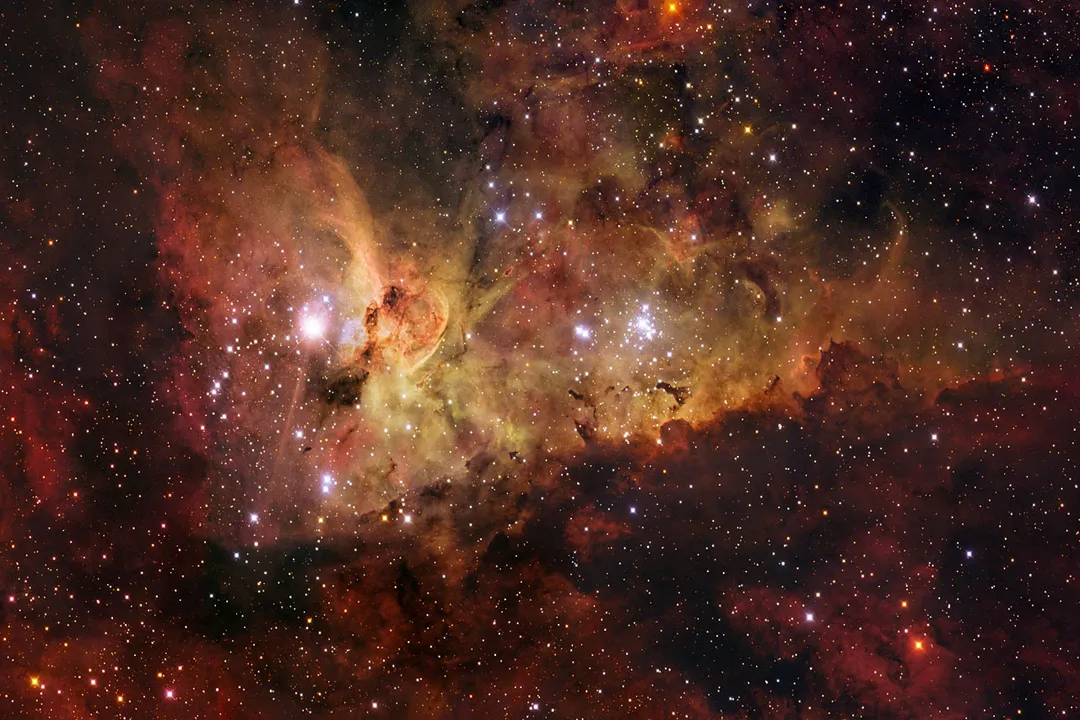
The Great Eruption experienced by Eta Carinae in the 1840s resulted in the ejection of a substantial shell of material into space surrounding the star system. This ejected material subsequently formed a distinct and visually striking structure known as the Homunculus Nebula. This nebula is characterized by its bright, hourglass-shaped appearance and often seems to obscure the central, brightest parts of the greater Carina Nebula. The presence of the Homunculus Nebula serves as tangible evidence of the profound energetic impact a single massive star system can have on its immediate cosmic surroundings.
Related Questions
Approximately how far from Earth is the Carina Nebula located within the Milky Way?How much wider is the Carina Nebula in physical dimensions compared to the Orion Nebula?What type of stellar system is the highly luminous Eta Carinae star?What historical event did the Eta Carinae system undergo in the 1840s that ejected a massive shell of material?What classification is used for the Carina Nebula due to its gas being predominantly ionized hydrogen?What is the name of the dark lane structure visible cutting through the glowing interior of the Carina Nebula?What spectacular, hourglass-shaped structure formed from material ejected during Eta Carinae's 1840s outburst?In terms of stellar output, what type of stars does the Carina complex primarily produce compared to the Orion Nebula?In false-color imagery created by telescopes like Hubble, which emission is typically mapped to the color red?Within which spiral arm of the Milky Way is the Carina Nebula situated, according to observational models?