Are we in the Orion Arm of the Milky Way?
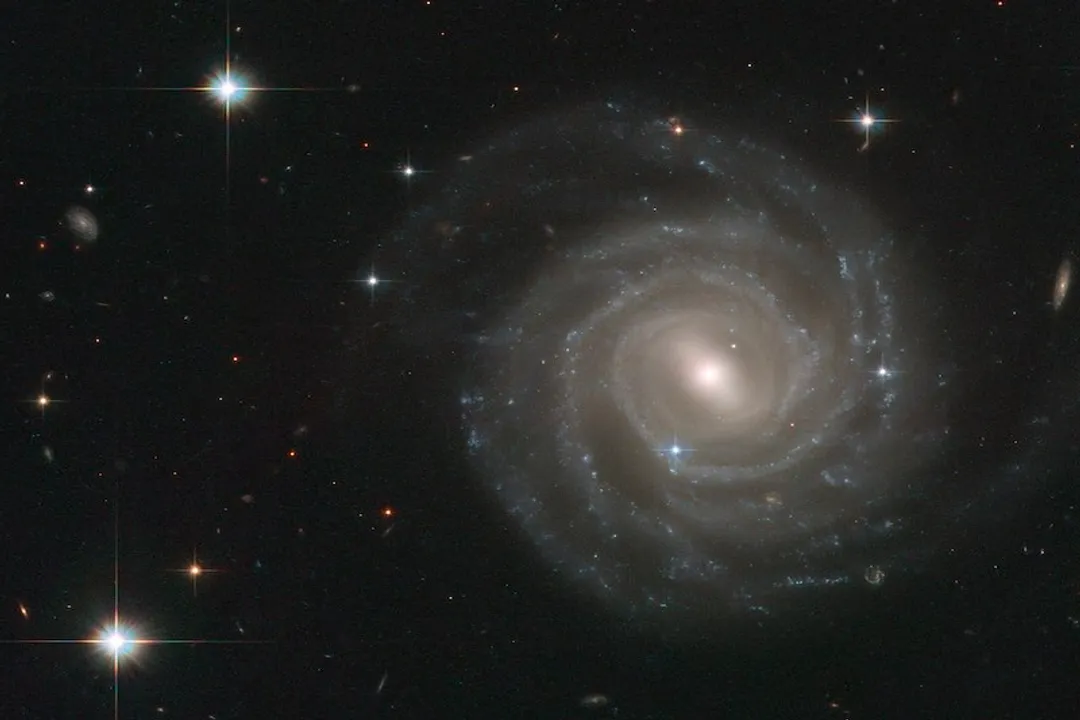
The island of stars we inhabit, the Milky Way galaxy, is a grand, barred spiral structure, and yes, our local neighborhood, the Solar System, is indeed situated within a distinctive structure known as the Orion Arm. [1][4] This designation, sometimes expanded to the Orion-Cygnus Arm or referred to simply as the Local Arm, settles a long-standing piece of astronomical context for Earthlings. [4][8] We are not floating in a desolate void between major structures, but rather embedded within this specific, if somewhat less prominent, galactic feature. [6]
# Galactic Cartography
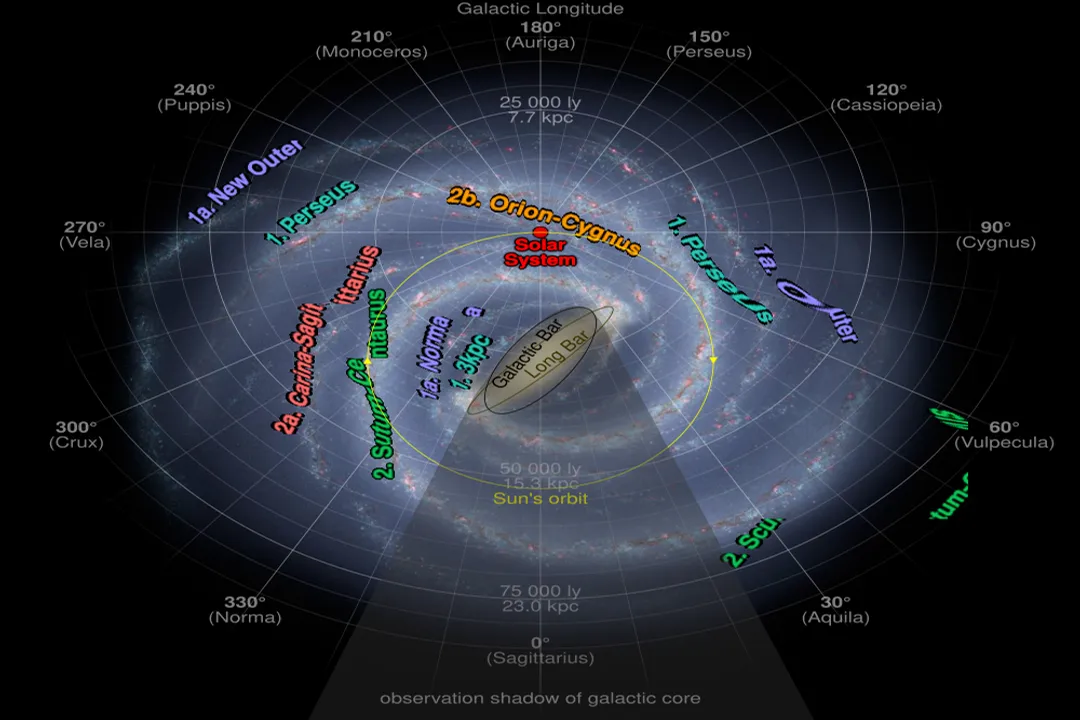
To grasp our cosmic address, one must first visualize the Milky Way in its entirety. It is a vast entity, estimated to span between 100,000 and 120,000 light-years across, containing an estimated 100 to 400 billion stars, all revolving around a brilliant, dense central bulge. [1][8] This immense swirl is not uniform; its structure is defined by several spiral arms, which are regions where gas, dust, and newborn stars are concentrated. [7]
For decades, astronomers envisioned the Milky Way as possessing four primary arms. Under that older model, our position was less clear or sometimes relegated to an area between the main structures. [7] However, modern, high-precision mapping, significantly aided by missions like the European Space Agency’s Gaia spacecraft and radio astronomy techniques, has refined this view. [4][7]
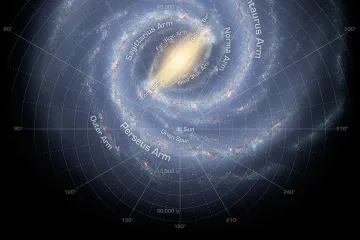
The consensus today places the Sun in the Orion Arm, which is considered a minor spiral arm or a spur extending from a larger feature. [1][4] Specifically, our local structure nestles between two of the galaxy's main components: the Sagittarius Arm (or Carina–Sagittarius Arm), which lies nearer to the Galactic Center, and the Perseus Arm, which sweeps farther outward. [1][4] The Sun's location is situated relatively close to the inner edge of this arm. [4]
# Size Ambiguity

The term "spur" versus "arm" reflects the ongoing process of galactic measurement. Early observations hinted at the Orion Arm's existence, but its significance was debated. [7] Some models demoted it to a mere offshoot, leaving our solar system in the comparatively empty region separating the major arms. [7]
More recent, detailed work, however, suggests the Orion Arm is far more substantial than previously believed, potentially justifying its classification as a genuine, albeit smaller, arm. [7] Data gathered from maser parallaxes—measuring the slight apparent shift of microwave-emitting regions as Earth orbits the Sun—and Gaia’s high-precision visible light measurements point toward a considerable structure. [4][7] The estimated length has been revised upward; where it was once thought to be perhaps 10,000 light-years long, current assessments place it at least 25,000 to 26,000 light-years in extent. [4][6][7] This makes its length comparable to the distance between our Sun and the Galactic Center, which is approximately 26,000 light-years. [1][4] Its width is generally cited as around 3,500 light-years. [4] These findings suggest the Local Arm is a "much longer structure" than earlier models suggested and may even be similar in scale to the galaxy’s major features. [7]
# Naming Origin
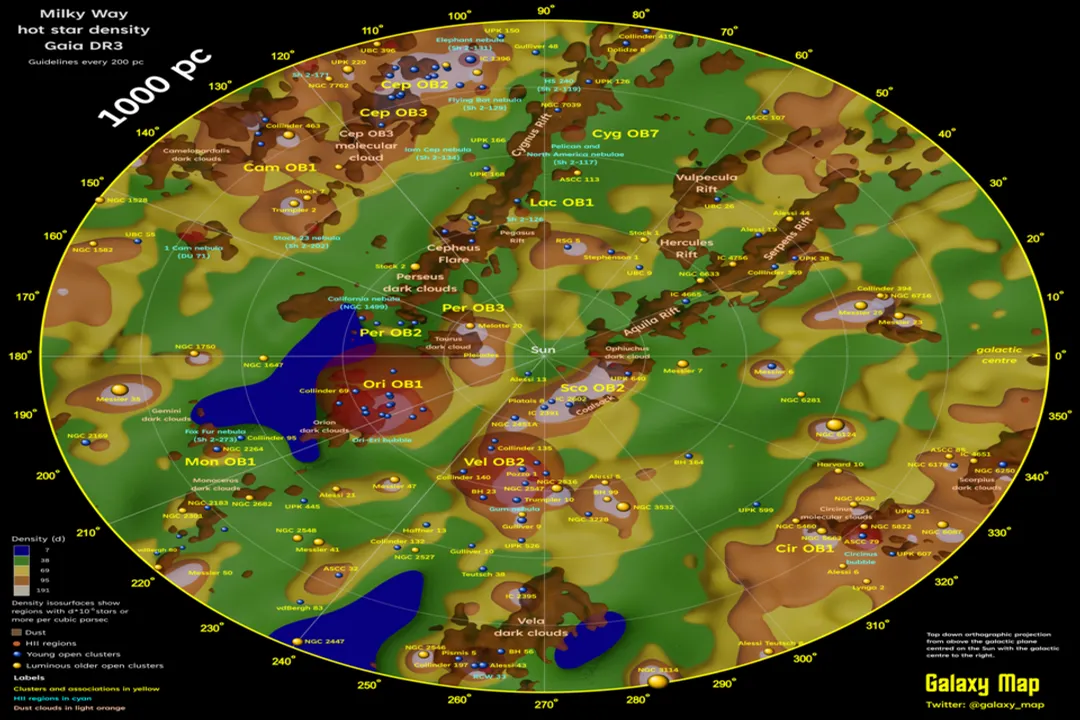
The nomenclature itself is tied directly to our terrestrial view of the night sky. The Orion Arm is named after the constellation Orion the Hunter. [4] When we look toward Orion—easily visible in the Northern Hemisphere winter sky—we are essentially looking along the length of our local stellar neighborhood. [4] This region hosts several of the most luminous and recognizable stars visible to the naked eye, such as Betelgeuse and Rigel, as well as massive star-forming complexes like the Orion Nebula (M42). [3][4] Seeing these bright objects confirms we are looking toward a relatively rich local stream of stars. [3]
# Contextualizing Location
Our solar system is not merely in the Orion Arm; our precise location within it has interesting implications when considering the structure of the galaxy as a whole. We reside about halfway along the arm's length, positioned within what is known as the Local Bubble, a relative cavity in the interstellar medium. [4]
This location within a minor arm, rather than in the densest part of a major arm or near the central bar, has been speculated to be beneficial for the development of complex life. [6][8] The galactic core, for instance, is fraught with intense radiation from the supermassive black hole, Sagittarius A*, and experiences frequent gravitational disruptions from close stellar encounters. [7] Conversely, the far outer edges of the galaxy often lack the necessary "metals"—elements heavier than helium, produced by older generations of stars—needed to form rocky planets like Earth. [7]
The Orion Arm, therefore, seems to occupy a habitable zone within the galaxy. [8] It is dense enough to have recycled the heavy elements necessary for planetary and biological formation, yet tranquil enough to allow complex evolutionary processes to proceed over billions of years without frequent catastrophic resets from supernova explosions or gravitational shear found in the main arms. [7][8] Being situated in a spur or a less dense local arm might represent a kind of cosmic buffer zone, offering stability. [4]
| Galactic Feature | Primary Classification | Approximate Distance from Center (ly) | Key Feature Mentioned |
|---|---|---|---|
| Galactic Center | Bar/Bulge | 0 | Sagittarius A* (SMBH) |
| Sagittarius Arm | Major Arm | Nearer than Orion Arm | Lagoon and Trifid Nebulae [3] |
| Orion Arm | Minor Arm/Spur | ~26,000 | Orion Nebula (M42) [4] |
| Perseus Arm | Major Arm | Farther out than Orion Arm | Heart and Soul Nebulae [3] |
The observational history of our location, including past mentions by prominent figures that cited the Sagittarius Arm, highlights the difficulty of mapping the galaxy from within. [5] As mapping techniques improve, particularly those that can penetrate interstellar dust using radio waves (masers) or highly precise parallax measurements (Gaia), the established model shifts. [4][7] What was once taught in older textbooks as the Sagittarius Arm has, due to better resolution, been identified as the Orion Spur, a sign of the ever-evolving nature of astronomical science. [5] It underscores that galactic cartography is not static; our map gets redrawn as measurement precision increases. [7]
# Tracing Star Birth
Spiral arms are not static collections of stars; they are density waves propagating through the galactic disk, squeezing interstellar gas and dust, which triggers star formation. [7] This process means the arms are traced most effectively by the youngest, hottest stars—the O-type stars—because they are massive, burn brightly, and die quickly, thus remaining close to their birthplaces. [4]
The recent studies using data from the Gaia spacecraft focused heavily on these O-type stars, as well as interstellar masers, to trace the Orion Arm’s path. [4][7] One significant finding involves the constellation Cygnus. Astronomers previously placed many young stars in Cygnus within the Perseus Arm, located further out. However, parallax measurements moved many of these young stellar nurseries back toward the Sun, placing them firmly in the Orion Arm instead. [4] This discovery suddenly revealed that our local arm was "a much longer structure" with significant ongoing star formation, perhaps rivaling that of the major arms in terms of activity in our sector. [4][7]
One point of minor divergence in current mapping concerns the southern extent of the arm. Some research suggests the Local Arm spirals toward the constellation Puppis, while other analyses assign those distant stars to the Perseus Arm instead. [4] This highlights that even with powerful tools like Gaia, delineating the exact boundaries where one structure blends into the next remains a challenge, particularly where dust obscures our view. [4]
# The Local Viewpoint
Consider the perspective from Earth. Because we are located within the Orion Arm, the band of the Milky Way we see stretching across the night sky—that faint, dusty river of light—is dominated by objects in this local feature. [8] When we observe familiar constellations like Orion, we are looking into the densest part of our immediate spiral structure. [4]
It is a fascinating exercise to consider that the Orion Nebula (M42), one of the most famous star-forming regions visible from Earth, is literally a neighbor, lying within the same stellar tendril as our Sun. [3][4] It serves as a dramatic, visible manifestation of the very process—compression of gas leading to stellar birth—that defines the structure we are a part of. [7]
If we imagine the larger spiral arms as the main highways of the galaxy, the Orion Arm is a significant, well-populated side road. Its relative thinness and position between the two massive arms give it a unique profile. For any potential extraterrestrial civilization in another part of the galaxy, our address might be less impressive on a galactic scale, but for the purposes of terrestrial life's long-term development, this specific, quieter corner of the disk appears to be an ideal berth. [6][8] It is a zone rich in the necessary elemental components, yet distant enough from the turbulent, high-impact zones of the central bar and the dense spiral fronts where supernovae rates might be higher. [7][8]
The fact that we can observe and study the structure of the galaxy—measuring the parallaxes of stars tens of thousands of light-years away—is only possible because we possess the stability and the required stellar metallicity found here in the galactic disk, particularly in these intermediate features like the Orion Arm. [7] Our local environment, though perhaps a minor arm, is significant for being the location that has allowed for the development of the very beings capable of mapping it. [6] The ongoing mapping efforts, combining radio astronomy's dust-piercing views with Gaia's vast stellar surveys, promise to keep redrawing this map, making our corner of the Milky Way progressively clearer with every new data release. [4]
#Videos
Which Spiral Arm Of The Galaxy Is Ours? - YouTube
Related Questions
#Citations
Orion Arm - Wikipedia
"We live in the Orion Arm of the Milky Way" : r/MandelaEffect - Reddit
The Universe within 5000 Light Years - The Orion Arm
Which Milky Way spiral arm is ours? - EarthSky
Which Spiral Arm Of The Galaxy Is Ours? - YouTube
Astronomers are redrawing our corner of the Milky Way - PNAS
Orion Arm Facts for Kids
Milky Way - Encyclopedia Galactica - Orion's Arm