Why do planets look like they are flickering?
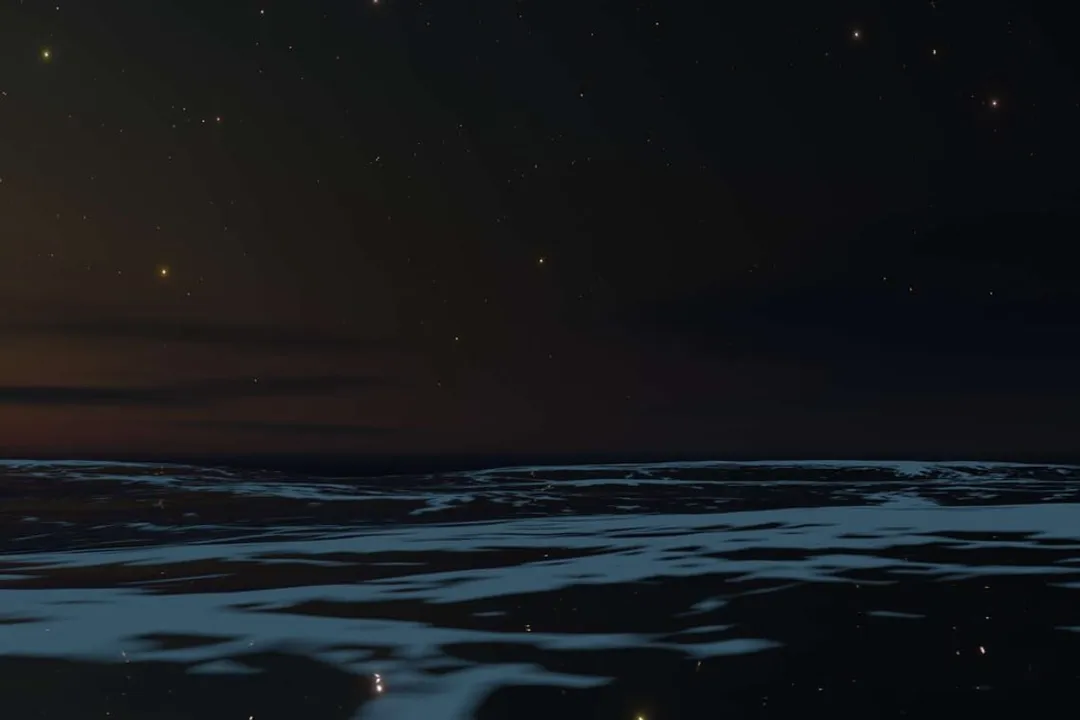
The visual phenomenon of celestial objects appearing to flicker, or twinkle, is a common sight for anyone who spends time looking up at the night sky, yet the stars and the planets behave differently. Most observers quickly notice that the steady pinpricks of light—the planets—rarely exhibit the shimmering effect that stars so consistently display. When a planet does seem to flicker, it’s often a fleeting moment or only occurs when the object is positioned very low above the horizon, leading to questions about why this distinction exists between our near neighbors and the distant suns. [3][4][7]
# Stellar Points
The reason stars twinkle is fundamentally tied to their immense distance from Earth. [3][4] Because stars are so far away, their light reaches us as effectively point sources. [3][4] Imagine a laser pointer beam coming from millions of miles away; it remains incredibly narrow. This narrow beam of light must pass through Earth’s atmosphere before it reaches our eyes. [3][5]
The Earth's atmosphere is not a uniform, still blanket of air. It is constantly churning, characterized by layers of air with varying temperatures and densities. [3][5][6] These atmospheric irregularities act like tiny, rapidly moving lenses. As the star's pinpoint beam travels through these turbulent layers, the light is slightly refracted, or bent, in random directions many times per second. [3][5] This continuous, minuscule shifting of the light path is what we perceive as twinkling or flickering. [3][4][5][6] Think of it like trying to view a distant streetlamp through the heat rising off hot asphalt—the light source seems to dance wildly. [3]
# Planetary Disks
Planets, conversely, are far closer to Earth than stars are. [3][4] While they are still vastly distant, their relative proximity means they appear to us not as singular points of light, but as small, discernible disks. [3][4] Although you might not see the disk shape with the naked eye, the light arriving at Earth comes from a wider area rather than a single point. [3][5]
When light from this extended planetary disk enters the atmosphere, the light rays from one edge of the disk might be bent slightly upward by an atmospheric pocket, while rays from the opposite edge might be bent slightly downward. [3][5] Because the light is coming from a slightly wider source, these atmospheric disturbances tend to average out across the entire visible disk. [3][5] One part of the disk might momentarily dim while another brightens, but the overall effect on the planet’s total perceived brightness and position is minimal, resulting in a steady, non-flickering appearance. [3][5]
To better grasp this critical difference in visual behavior based on apparent size, here is a quick comparison:
| Celestial Body | Approximate Angular Size (Naked Eye) | Light Appearance | Twinkling Tendency |
|---|---|---|---|
| Distant Star | Point Source (Zero angular width) | Single beam | High [3][4] |
| Nearby Planet | Small Disk | Extended source | Low (unless near horizon) [3][5] |
# Low Horizon Effect
The primary condition under which a planet will appear to flicker is when it is positioned very low on the horizon. [3][4] This is not because the planet itself has changed its nature; rather, it’s because of the increased path length the light must travel through our atmosphere. [3][4]
When an object is directly overhead (at the zenith), its light passes through the thinnest possible layer of air. When an object is near the horizon, its light skims across the Earth tangentially, meaning it traverses a much longer, thicker column of atmosphere filled with more turbulence, dust, and temperature variation. [3][4] This dramatically increased atmospheric interference is powerful enough to overcome the averaging effect that usually stabilizes the planet’s light. [3][4] In these low-lying situations, the planet’s disk appears to shift, dim, and brighten rapidly, mimicking the twinkling of a star, sometimes even more intensely because of the density of the air layers near the ground. [3]
A fascinating implication arises from observing a bright planet like Venus or Jupiter flicker strongly when low in the sky. If you see an object displaying strong, rapid twinkling—even a planet—you can be absolutely certain that the light you are seeing has been heavily distorted by Earth’s lower atmosphere. This twinkling is never an inherent property of the distant celestial body itself, but rather a signature of the air mass directly above your local observing spot. [3][5] It’s an immediate, real-time gauge of atmospheric "seeing" conditions, with conditions being worst near the horizon. [3]
# Color Distortions
When both stars and planets are viewed close to the horizon, the atmospheric effect can become so pronounced that it causes more than just brightness variations; it can also induce noticeable color shifts. [7] The atmosphere acts somewhat like a prism, separating white light into its constituent colors—a process called dispersion. [7]
If you observe a planet that is flickering intensely while close to the horizon, you might sometimes see the light momentarily separate into brief flashes of red and blue. [7] This color separation happens because the light of different wavelengths (colors) is refracted by slightly different amounts as it passes through the turbulent air layers near the ground. [7] Blue light bends more than red light, causing the light to split temporarily. While stars exhibit this chromatic aberration alongside their intensity flickering, a planet displaying these colors is an unambiguous sign of very turbulent, low-altitude viewing conditions.
When you are observing higher in the sky, planets will retain their steady, silvery, or pale yellowish glow, depending on their composition and position, showing their stability against the atmospheric chaos that is constantly causing their stellar neighbors to dance around them. [4]
Related Questions
#Citations
Why do some astronomers say that stars twinkle but planets do not?
Why does Venus flicker? - Astronomy Stack Exchange
Twinkling - Wikipedia
Why Do Stars Flicker | What Causes Stars to Twinkle - Star Walk
Why do stars twinkle but the sun and planets don't ... - YouTube
Why do planets and stars flicker? - Physics Forums
Why do some stars look like they're flickering red and blue in the sky?
Have you ever wondered why #stars twinkle in the night sky, but ...
Why Do Stars Twinkle? Exploring Stellar Scintillation and ... - TikTok