What does a star actually look like up close?
The familiar sight of a star—a steady, distant point of light against the blackness—offers almost no clue to its actual, terrifyingly massive reality up close. From our vantage point, planets like Mars or Venus appear as disks, allowing us to imagine them as worlds. Stars, however, remain stubbornly unresolved. To truly see what a star looks like nearby requires either a journey only a probe can make or the aid of the world's most powerful telescopes focused on our own solar neighborhood.[1][2]
# Sun Surface
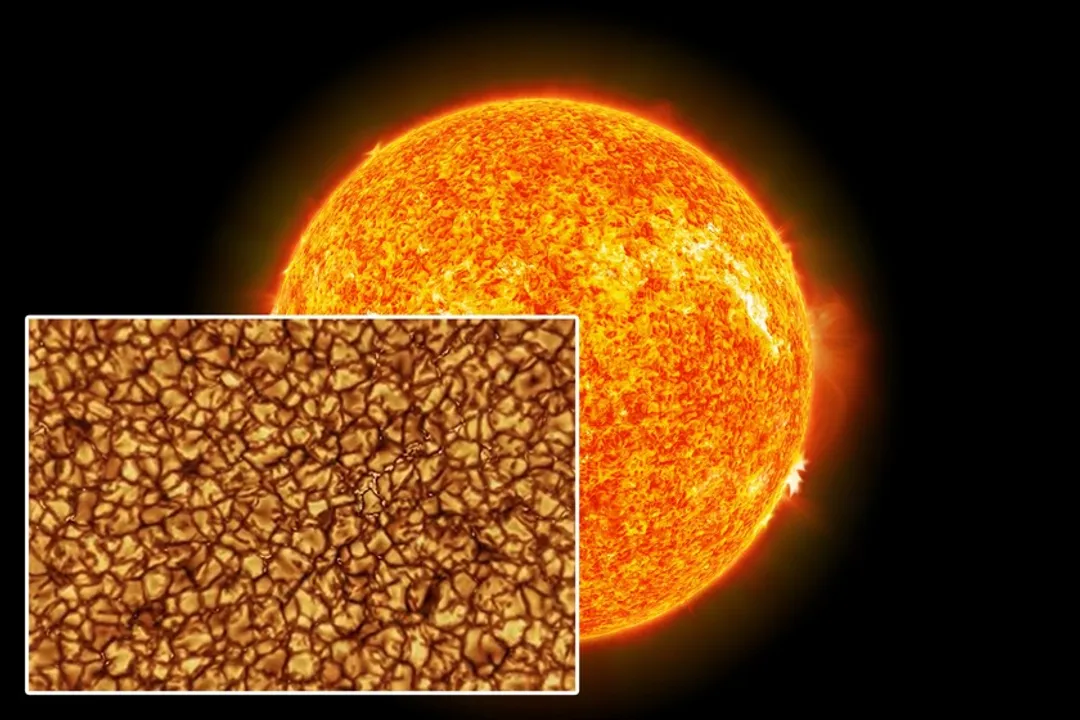
The closest star, the Sun, provides our only empirical "close-up." When we approach it via spacecraft, like the Parker Solar Probe, or through detailed imaging, the surface is not the smooth, featureless ball we see with filtered-down eyes. Instead, it’s a turbulent, boiling environment of incandescent gas known as plasma.[1][5]
The Sun’s visible surface is called the photosphere, and it exhibits a granular texture. [1][5] Imagine a vast ocean of boiling oatmeal, but instead of water, it's superheated gas at about 5,500 degrees Celsius. [1] Each bright, irregularly shaped patch in this texture is a convection cell, where hot material wells up from below, spreads out, cools slightly, and then sinks back down along the darker lanes between the granules. [1][5] The size of these features is immense; a single one of these granules can span hundreds of miles across. [1]
When observing our star, we also see magnetic activity manifesting in dramatic ways. Dark patches known as sunspots appear, which are cooler regions where intense magnetic fields have suppressed the convective flow of heat from the interior. [1] These spots are often surrounded by brighter areas called faculae, which are regions of intense magnetic activity. [1] For a short time, these images captured by probes have shown us the violent, churning reality hiding behind the placid twinkle we observe from Earth. [7]
# Distant Giants
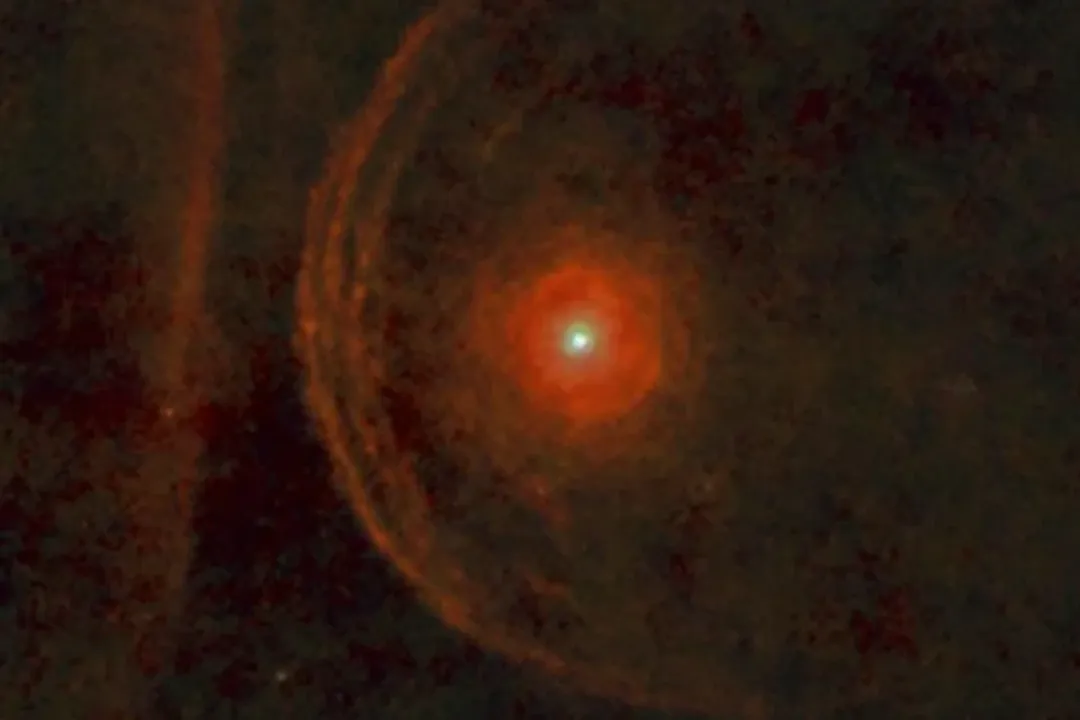
What about stars other than the Sun? Since even the nearest star system, Alpha Centauri, is over four light-years away, getting a true probe-based close-up is impossible with current technology. However, astronomers have managed to resolve the surfaces of certain very large, nearby, evolved stars, such as red supergiants, using ground-based interferometry and specialized instruments. [1][4]
One star that has yielded remarkable surface detail is Betelgeuse. [4] When astronomers managed to capture its first close-up image—a feat of incredible technical precision—it didn't look like a uniform sphere. Instead, it resembled a mottled, uneven orange disk. [4] The image resolved vast, distinct patches on its surface, which scientists determined were gigantic convection cells, like the granules on the Sun but scaled up to an incomprehensible degree. [4][6]
In the case of Betelgeuse, which is predicted to be millions of times the volume of our Sun, a single one of these convective features can be larger than the entire orbit of Jupiter. [1][6] This means that when you look at that "close-up," you are seeing areas where gas is rising and cooling, forming immense, turbulent bubbles hundreds of millions of miles wide. [6] It truly looks less like a static ball and more like a monstrous, unevenly glowing sphere of ceaseless cosmic boiling. [4] This level of resolution, achieved by instruments like those at the European Southern Observatory (ESO), allows scientists to study the internal dynamics of these massive stars from light-years away. [6]
# Stellar Structure
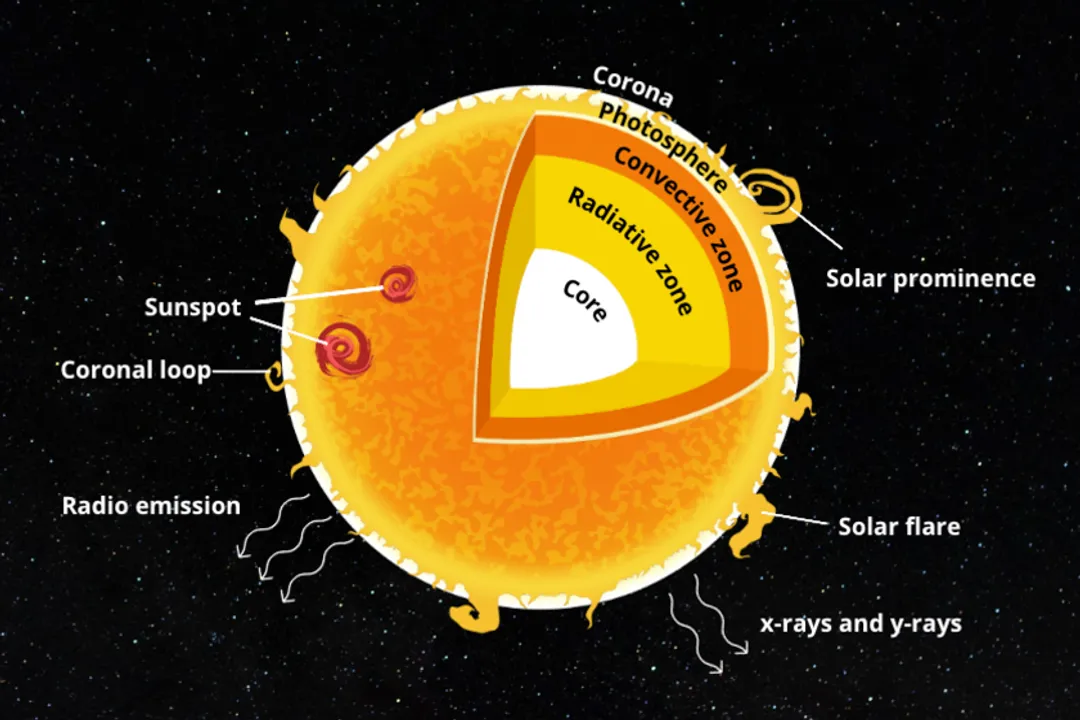
It is essential to remember that a star's "surface" is not solid; it is the point where the gas becomes thin enough for light to escape relatively freely. [5] If you could somehow stand on the photosphere of any star, you would immediately fall through the wispy, ever-thinning layers of gas. [5] There is no ground to stand on, only a gradient of heat and pressure.[5]
Stars are fundamentally composed of plasma, a superheated state of matter where electrons are stripped from atomic nuclei. [5] The light we see is emitted from this plasma. [5] Comparing the Sun to a much larger, cooler star like a red giant, the visual difference in the surface plasma is stark, even when resolved. The Sun’s surface appears relatively fine-grained (on the scale of hundreds of miles), while the surface of a red supergiant resolves into features the size of entire solar systems. [1]
To illustrate the dramatic visual differences based on the star's evolutionary state and size, consider this comparison:
| Feature | Our Sun (G-type Main Sequence) | Betelgeuse (Red Supergiant) |
|---|---|---|
| Surface Granule Size (Approx.) | Hundreds of miles | Larger than Jupiter's orbit |
| Appearance | Fine-grained boiling/mottling | Vast, clearly defined, uneven patches |
| Temperature | (cooler) | |
| Visibility of Surface | High detail with probes | Resolved using advanced interferometry |
# Viewing Limitations
While the images of the Sun and Betelgeuse give us tantalizing glimpses, they represent a significant bias in our understanding of "up close." We have incredible data for the one star we can reach and moderate data for a few of the largest, closest neighbors. [1] For the vast majority of stars, even those relatively near us, they remain unresolved pinpoints of light. [2]
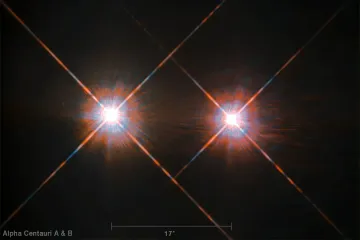
The apparent size of a star in the sky depends on its distance, its actual intrinsic brightness, and the resolving power of the instrument observing it. [2] Even with the world's best ground-based instruments, like the Very Large Telescope (VLT) used by ESO, resolving a star's disk is a monumental task because they are so incredibly far away. [6] The angular size of a star is usually measured in milliarcseconds, tiny fractions of a degree. [2] To put that into perspective, if you held a dime at arm's length, its width would subtend an angle about a million times larger than the apparent size of Proxima Centauri, the closest star to us, as seen from Earth. [2]
This technical challenge means that for most stars, the "up-close" look remains an educated extrapolation based on physics models, spectral analysis, and data gathered from our immediate stellar neighbors. [5] We analyze the light they emit—its spectrum tells us temperature, composition, and velocity—but we cannot resolve the churning plasma texture seen on the Sun or Betelgeuse. [5]
If you ever see a photograph claiming to show a star except the Sun or Betelgeuse as a resolved disk, it is almost certainly an artist’s concept or a highly processed visualization based on inferred data, not a direct, unadulterated image of its photosphere. [3] The true, intimate appearance of most stellar surfaces is something we must continue to infer, rather than observe directly. [3]
# Scale Perception
A final thought on the sheer scale involved in these close encounters is necessary to grasp the visual difference between our local star and others. When we talk about the convection cells on the Sun being hundreds of miles across, that sounds enormous from a human perspective. [1] Yet, that scale is dwarfed when considering a star like UY Scuti, one of the largest known stars, which would swallow Jupiter's orbit entirely if placed where the Sun is. [1] If we could somehow resolve the surface of such a star, its "boiling soup" would appear utterly unlike our Sun's; the features would be so large that one's entire field of view would be filled by just a fraction of a single convective cell. [1] This demonstrates that "up close" is a relative term in astronomy; even the "closest" detailed view we have of a distant star shows a physical structure that makes our own solar system seem microscopic by comparison.[1]
#Videos
First Close-up Picture of a Star Outside Our Galaxy - YouTube
Related Questions
#Citations
What do stars look like up close? | BBC Sky at Night Magazine
First Close-up Picture of a Star Outside Our Galaxy - YouTube
What Do Stars Look Like Up Close? - TikTok
This is the first close-up image of a star beyond our galaxy - Reddit
What Do Stars Look Like Up Close? - Little Passports
Astronomers take the first close-up picture of a star outside our galaxy
Star Basics - NASA Science
What Does a Star Look Like Up Close? - Label Stars