What could make a star look dim?
The night sky presents a seemingly static collection of distant suns, yet the appearance of these celestial bodies is far from constant. A star that was once prominent in the evening might seem muted on another night, leading an observer to wonder what physical or observational phenomenon could cause a star to look dim. The answer usually falls into three broad categories: how intrinsically bright the star actually is, what lies between the star and our eyes, and the momentary influence of Earth’s atmosphere.[3][4]
# Brightness Basics
To understand why a star appears dim, we must first separate its true nature from its perceived appearance from our vantage point on Earth. Astronomers distinguish between a star's luminosity, which is the total amount of light energy it radiates into space, and its apparent magnitude, which is how bright it looks to us here on Earth. [4]
A star can be intrinsically very luminous—a genuine powerhouse—but appear dim if it is incredibly far away. Conversely, a very faint, low-luminosity star (like a small red dwarf) can appear relatively bright if it is very close, such as our own Sun. [4] Stars are overwhelmingly distant; even the closest visible ones are separated by light-years, meaning the light we see left them years ago. [9] Because of this immense distance, nearly all stars look incredibly faint from our perspective. [9] For instance, the Sun is vastly brighter than any other star we see; if the next nearest star, Proxima Centauri, were placed at the same distance as the Sun, the Sun would still appear billions of times brighter. [4] Therefore, the most common reason a star looks dim is simply its vast spatial separation from Earth. [4][9]
The scale used to measure this apparent brightness is the magnitude system, where smaller (and even negative) numbers signify brighter objects, and larger positive numbers mean dimmer objects. [4] This scale is logarithmic, meaning a difference of five magnitudes corresponds to a factor of 100 in brightness; a star with a magnitude of 1 is 100 times brighter than a star with a magnitude of 6. [4]
# Interstellar Dust
Sometimes, the dimming isn't about the observer's location or the star's inherent output, but about something physically obstructing the light path across interstellar space. Massive clouds of gas and dust floating within our galaxy can absorb and scatter starlight before it ever reaches Earth. [6] This effect is known as interstellar extinction. [4]
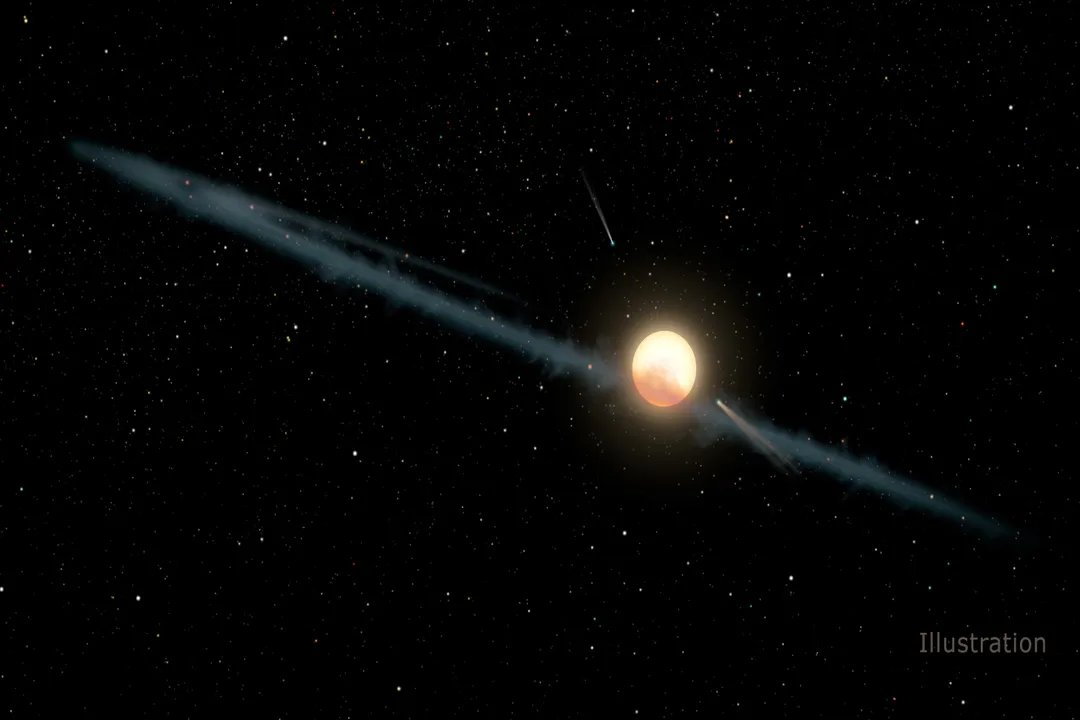
One of the most famous examples of this phenomenon involves a specific star known as KIC 8462852, frequently called Tabby's Star. This star exhibited dramatic, aperiodic dips in brightness that were far too severe to be explained by a standard orbiting planet passing in front of it. [6] Scientists investigating this deep, mysterious dimming concluded that the most plausible explanation involved large structures or, more likely, massive clouds of orbiting dust periodically obscuring a significant portion of the star's face. [6]
This dust isn't a permanent fixture in all directions, but where it exists, it acts like a cosmic veil. While the star itself may be perfectly stable, the amount of light that successfully makes the entire journey to Earth is temporarily reduced. [6] The light that does get through is also often reddened, as the dust scatters blue light more effectively than red light—a subtle clue astronomers look for when diagnosing such dimming events. [4]
# Stellar Variability
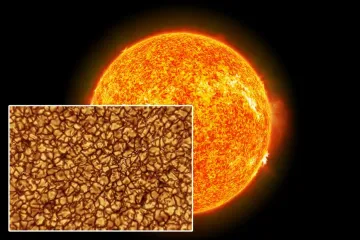
Stars are not inert light bulbs; they are dynamic, living entities undergoing continuous nuclear fusion and internal changes, which cause their luminosity to fluctuate naturally over various timescales. [3] These intrinsic changes lead to stars being classified as variable stars, which brighten and dim due to physical processes within them. [3]
There are many reasons a star might vary:
- Pulsation: Some stars physically expand and contract, causing their surface area and temperature to change cyclically, which directly alters their emitted light. [3]
- Eclipsing Binaries: Many stars exist in binary systems where two stars orbit a common center of mass. If their orbital plane is aligned just right from our perspective, one star will periodically pass in front of the other, causing a temporary, predictable dip in the total observed brightness. [3]
- Surface Activity: Stars experience magnetic activity, including starspots—regions of intense magnetic fields that are cooler and therefore emit less light than the surrounding surface. A star with an increased number of large, dark starspots will appear temporarily dimmer. [3]
The key difference here compared to dust dimming or atmospheric effects is that the light reduction originates from the star itself, not something external to it. [3] While these changes happen constantly across the universe, they are often too slow or too small in amplitude to be noticed by the casual observer in a single evening unless the star is a known, highly variable type. [3]
# Atmospheric Interference
Even if a star is perfectly stable and unobscured by interstellar dust, the final leg of the light's journey—through Earth's atmosphere—can significantly alter its appearance. [1] This is why stars appear to twinkle, or scintillate. [2]
Scintillation is caused by the turbulent layers of air in our atmosphere acting like constantly shifting lenses. As light passes through these varying pockets of air density and temperature, the path of the light ray bends slightly and rapidly, causing the star’s apparent position and brightness to change many times per second. [1][8] While this is usually perceived as twinkling, a very strong turbulence or an observation made very low on the horizon can lead to a noticeable, though usually temporary, dimming or blurring of the star. [1][8]
A related effect is simple atmospheric extinction. When a star is near the horizon, its light has to travel through a much longer column of the Earth's atmosphere compared to when it is directly overhead. [4] This longer path means more light is scattered and absorbed by air molecules, dust, and haze, making the star appear demonstrably dimmer than it would appear at its highest point in the sky. [4] If you observe a star disappear entirely from view, it is almost always due to a temporary atmospheric condition, or perhaps confusion with an object that is not a star, such as a satellite or an airplane, which can be easily mistaken for a sudden disappearance. [8]
If you are trying to compare the true dimness of two distant stars, it is crucial to observe them when they are both high in the sky to minimize the variable path length through the lower atmosphere. [8] This allows you to better isolate whether the dimness is due to the star’s intrinsic properties or simply where you are looking relative to the horizon.
# Comparing Dimming Timescales
The mechanism behind a star appearing dim dictates how quickly and how profoundly the change occurs. Understanding the timescale of the dimming offers a strong clue as to the cause. [3]
| Cause of Dimming | Typical Timescale | Observational Behavior |
|---|---|---|
| Atmospheric Turbulence | Seconds to Minutes | Twinkling, rapid fluctuation, strongest near the horizon. |
| Interstellar Dust (e.g., Tabby's Star) | Days to Years | Deep, often non-periodic dips; light takes years to recover. |
| Eclipsing Binary System | Hours to Days | Predictable, repeating dimming cycle based on orbital period. |
| Intrinsic Pulsation | Hours to Months | Regular, cyclical brightening and fading based on the star's physical expansion/contraction. |
| Stellar Death (e.g., Red Giant phase) | Thousands to Millions of Years | Slow, irreversible shift in luminosity over vast timescales. |
When observing through small amateur telescopes or even with the naked eye, the most common reason for a perceived dimming that might cause alarm is atmospheric interference or a temporary dip caused by a passing high-altitude cloud layer that is too thin to notice otherwise. [1][5] True, significant, non-cyclical dimming lasting for years, like that seen in KIC 8462852, requires long-term, systematic monitoring using professional instruments because the change is too subtle to detect consistently night-to-night without comparison to historical data. [6] The fact that the most prominent stars in our sky remain visibly bright night after night confirms that large-scale, permanent dimming events are rare over human timescales. [3]
# Perspective on Apparent Faintness
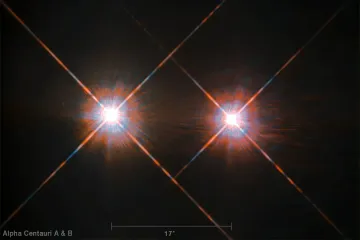
It is easy to forget just how faint the stars are when we look up at a truly dark sky filled with thousands of points of light. While our Sun is a G2V main-sequence star, the majority of stars visible to the naked eye are not, and many are intrinsically much less luminous. [9] For example, Alpha Centauri A, our closest neighbor system, is slightly brighter than the Sun, but we see it primarily because of its relative proximity. [4] If we were to move just a few dozen light-years away, many stars we currently call "bright" would recede into the general stellar haze. [9] This emphasizes that the baseline state for most stars in the galaxy, as seen from Earth, is very dim, and the brightest ones are simply the closest neighbors within a sparsely populated local volume of space. [9] Any factor that pushes a star even slightly further away visually, whether through atmospheric distortion or true distance, pushes it further toward unobservability. [4]
#Videos
STAR BRIGHTNESS EXPLAINED - YouTube
Astronomers Think They Know Why Betelgeuse Got Dimmer
Related Questions
#Citations
Is there a phenomenon which makes star appear bright for seconds ...
STAR BRIGHTNESS EXPLAINED - YouTube
What causes a star to become dimmer or brighter? Why can't we see ...
20.1: The Brightness of Stars - Physics LibreTexts
What could cause a star to brighten and dim suddenly near Big ...
Mysterious Dimming of Tabby's Star May Be Caused by Dust
I just seen a star disappear? - Astronomy and Space - Science Forums
Stars are really dim! - EarthSky