Could a Death Star be built?

The question of engineering a moon-sized weapon capable of planetary destruction moves quickly from science fiction concept to staggering logistical nightmare when viewed through the lens of real-world physics and economics. [3] The Imperial Death Star, as depicted, represents the absolute zenith of military engineering, demanding resources and energy levels far exceeding anything humanity has ever assembled. [7] It requires us to look not just at what we can build, but at the fundamental physical limits we face today when attempting to construct something truly gargantuan in space. [5]
# Scale and Mass

The sheer scale of the Death Star is the first insurmountable hurdle. The first version, often referred to as the Death Star I, was a spherical battle station approximately 120 to 160 kilometers in diameter. [10] If we take the lower estimate of 120 km, that sphere has a volume calculated by , where . This results in a volume of roughly cubic kilometers. [8] To put that volume into perspective, consider that the volume of Earth’s atmosphere, considered from the surface up to the Kármán line (100 km), is only about 1,000 times that volume. [8]
Estimating the mass is complex, as the internal structure is unknown, but assuming the station is built with materials similar in density to steel—which is itself a significant, optimistic assumption—the mass would be astronomical. [3][7] If the station were constructed entirely of iron, its mass would be around kilograms. [7] This calculation highlights that we are dealing with an object whose mass is many times that of the largest asteroids we have encountered, and it needs to be assembled off-world. [3] The material volume alone required for a 160 km diameter sphere, even if constructed from relatively light aluminum alloys, would still demand the mining output of the entire Earth over an extended, likely multi-century, period. [8]
One analysis suggests that even if we replaced the construction material with a low-density plastic, the total mass would still be comparable to several large asteroids combined. [1] The resources required for a station this size would necessitate the complete disassembly of Earth's crust, or perhaps even the entire planet, an act far exceeding any current or near-future industrial capacity. [3][7]
# Material Sourcing
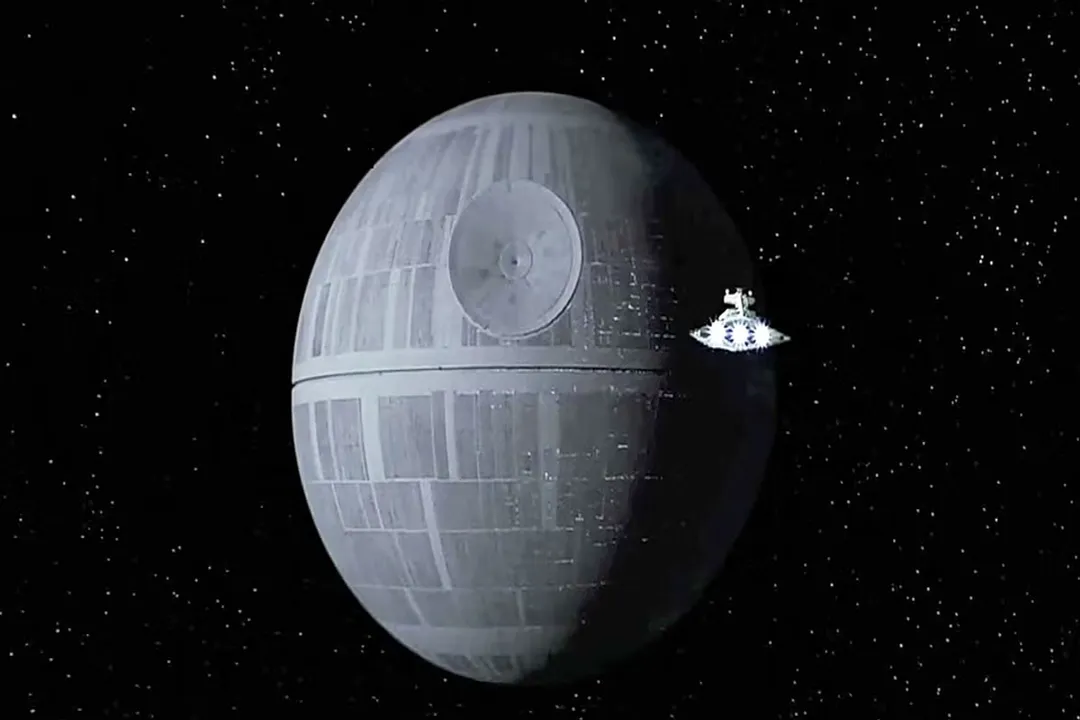
The structural integrity of a mobile space habitat of this size, especially one designed to withstand weapon discharge and combat, requires materials far superior to typical terrestrial construction metals. [7] The fictional Death Star needs to be strong enough to hold together while containing a functional atmosphere, artificial gravity (if present), and internal machinery, all while potentially being subjected to high-G maneuvers or impacts. [5]
Assuming current terrestrial material technology, the bulk of the structure would likely need to be composed of incredibly strong, lightweight alloys, possibly utilizing advanced composite structures that minimize mass while maximizing tensile strength. [7] However, even if we had perfect blueprints, sourcing the raw elements—iron, nickel, silicon, etc.—presents a colossal procurement problem. [8]
Imagine a calculation based on the estimated mass of the first Death Star, stated to be metric tons in some fan calculations. [3] To gather that much material, one would need to mine asteroids or the Moon extensively. [9] For instance, mining the Earth’s crust for the necessary materials might take over a million years using current technology, given that annual global mining output is orders of magnitude smaller. [8] Furthermore, the energy expenditure just to lift and refine that material into useful structural beams in space, fighting Earth’s gravity well, adds an exponential layer of difficulty. [3]
It is an interesting thought exercise to consider the infrastructure required just to transport the raw components. If we assume a constant shipment rate from Earth over 100 years, we would need to lift approximately tons of material annually. Given that the entire mass of the International Space Station is less than 500 tons, this implies a constant launch cadence equivalent to launching hundreds of fully-loaded Saturn V rockets every single day for a century, just to move the parts, not including fuel or construction labor. [8]
# Energy Systems
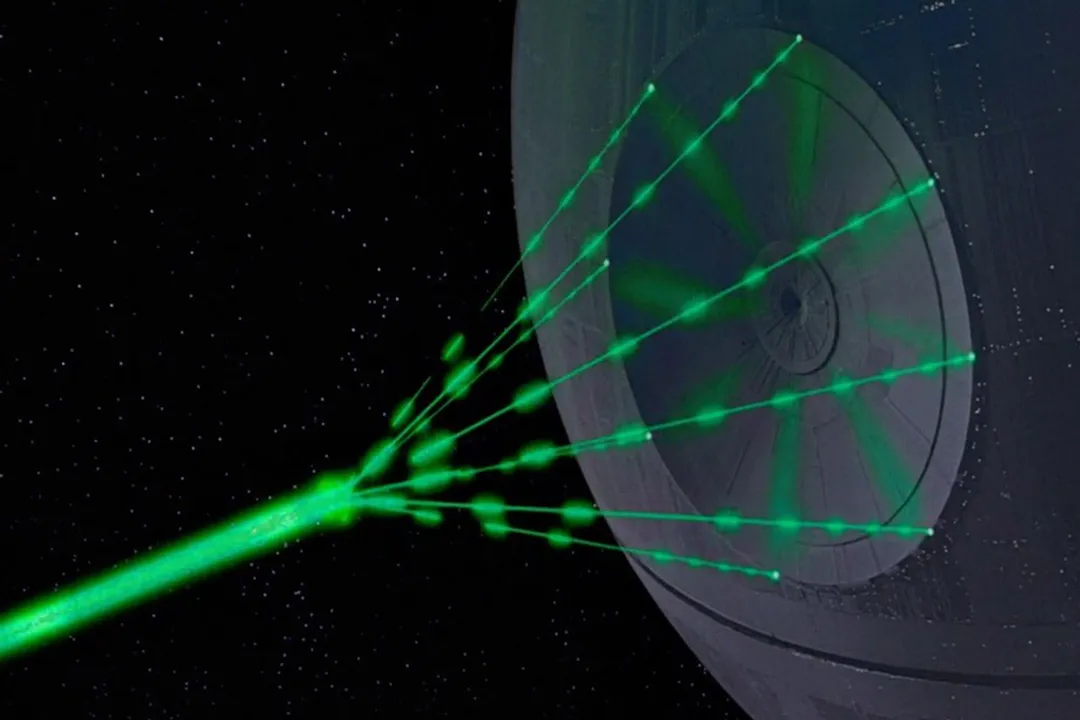
The most iconic—and arguably most demanding—feature of the Death Star is its superlaser, which must be able to destroy an entire planet with a single shot. [3][2] Calculating the energy required to destroy a planet is a matter of physics, specifically overcoming its gravitational binding energy. [9]
For a planet the size of Earth, the energy needed to overcome its gravitational binding energy is roughly Joules. [3][9] This is an incomprehensibly large figure. To provide some context, the total global energy consumption in 2020 was approximately Joules. [9] Therefore, a single blast from the Death Star would require the energy output equivalent to all human energy production for over 370,000 years, concentrated into a single, instantaneous pulse. [9]
Where would this power come from? In the Star Wars universe, it is supplied by a massive hypermatter reactor, often implied to be based on controlled matter-antimatter annihilation or some form of highly efficient fusion. [4] In reality, the only theoretical process capable of yielding such energy density is matter-antimatter annihilation, where nearly 100% of the mass is converted to energy (). [4] To generate Joules, one would need to annihilate approximately 2,500,000 metric tons of matter and antimatter. [4] The problem isn't just generating the energy; it's storing and delivering it in a controlled beam without instantly vaporizing the weapon platform itself. [4] Even if we could produce the antimatter—which requires vast amounts of energy just for its creation—storing the required quantity safely within the station structure presents a physical challenge that defeats current containment technology. [3]
# Construction Logistics
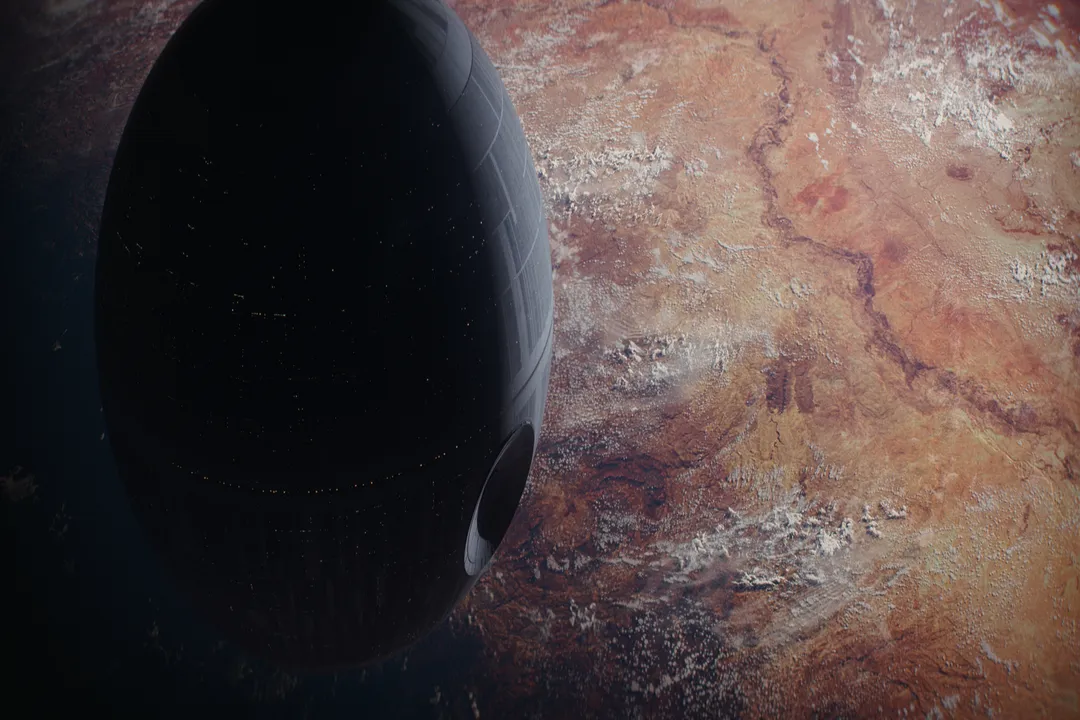
Setting aside material and power, the construction process itself demands a revolutionary shift in how we approach orbital manufacturing and project management. [7] A contemporary project like the ISS took over a decade and involved dozens of international partners to assemble a structure weighing under 500 tons. [8] The Death Star is thousands of times larger and more complex. [7]
# Manufacturing Orbit
The construction would need to take place entirely in space, likely at a Lagrange point or in a high orbit, as the sheer number of launches required to ferry personnel and complex components would overwhelm any terrestrial launch facilities. [9] This implies the development of self-sufficient, massive orbital construction yards capable of assembling modules kilometers in size. [7] The infrastructure required to support the construction crew—life support, waste recycling, and power generation for the manufacturing process—would itself rival a small city. [9]
# Cost Analysis
While the fictional Empire seemingly had no budget constraints, a real-world estimate must factor in the astronomical cost. Some analyses have attempted to price the construction based on current material costs. For the Death Star II, estimated at 900 km in diameter, one calculation priced the steel alone at around $852$ quadrillion US dollars. [6]
However, the true cost isn't the material price tag; it’s the labor and infrastructure investment. [8] If we consider the cost of launching components: launching 1 kg to low Earth orbit currently costs several thousand dollars, even with reusable rockets. [8] Launching the billions of tons of material needed would bankrupt every nation on Earth multiple times over before the first structural truss was bolted into place. [3] The sheer cost pushes the concept into realms where national treasuries become irrelevant; it requires a global, coordinated economic effort on a scale never before seen, possibly sustained for centuries. [7]

# Habitation and Maintenance
A station of this size requires life support for hundreds of thousands, if not millions, of personnel, as indicated by the sheer volume of internal space. [1] Maintaining atmospheric pressure, recycling air and water, and growing food for such a massive population presents an agricultural and ecological engineering problem on par with terraforming a small moon. [1]
The internal environment must also manage waste heat generated by the power core and life support systems. [5] In the vacuum of space, heat dissipation is challenging, relying solely on radiation. The massive amount of waste heat generated by the weapon systems and the reactor would require enormous radiator arrays to prevent overheating, adding significant volume and mass to the structure. [5]
Furthermore, maintenance is a constant battle against micrometeoroids and thermal stress. [5] A structure composed of billions of independent components requires constant inspection, repair, and replacement, necessitating a large, highly skilled, and fully self-sufficient repair fleet and workforce permanently stationed nearby. [5] Any single flaw in a critical load-bearing component, if left unaddressed, could lead to catastrophic structural failure, proving that in space engineering, size does not equal invulnerability. [7]
# The Reality Check
When comparing the fictional capability with current engineering reality, the leap is from sophisticated satellite construction to planetary-scale orbital megastructures. [2] We have mastered building small, modular, low-mass stations like the ISS, which are essentially orbiting laboratories. [8] We are nowhere near mastering the industrial processes required to mine, refine, transport, and assemble materials on the scale necessary for even a model of the Death Star, let alone one that can function as a weapon. [3]
The primary barrier is not a lack of ideas—the physics and engineering principles are generally understood—but a profound lack of scale in our industrial base and energy generation capabilities. [9] If humanity were to dedicate every single resource, every industry, and every person to this single goal, starting today, it is highly probable that even the assembly of a non-functional, inert shell of the smaller Death Star design would take centuries, provided we could somehow solve the antimatter containment issue for propulsion and power generation along the way. [7][8] The technological gap between our current space-faring ability and that depicted in the films is not a few decades; it represents millennia of theoretical advancement and resource accumulation. The Death Star remains, for now, a brilliant, terrifying piece of science fiction that beautifully illustrates the ultimate expression of centralized power and engineering hubris. [2]
#Videos
What If You Could Build the Death Star? - YouTube
Related Questions
#Citations
Would it be possible for humans to build a Death Star? - Reddit
Could we actually build a Death Star? - Quora
Could We Build a Real-Life Death Star? - Space
What If You Could Build the Death Star? - YouTube
Is a Death Star physically possible? - Kerbal Space Program Forums
This Is What It Would Take to Build an Actual Death Star - Men's Health
Building the Death Star with today's tech
Can You Build a Death Star? - Taylor Tuxford
So you want to build a Death Star? Here's how to get started
Death Star - Wikipedia