What is the violent death of a star?
The violent death of a star is not merely a celestial footnote; it is one of the most energetic events in the universe, capable of momentarily outshining an entire galaxy before fading. When a star ceases its nuclear fuel consumption, its fate is sealed by a single determining factor: its mass when it finally exhausts that life-sustaining supply. For smaller stars, those less massive than about 1.4 times the Sun's mass, the end is quiet. They shrink, shedding heat and contracting until they settle as a white dwarf, destined to cool over billions of years into a dim cinder. The Sun itself is slated for this gentle retirement.
However, for stars significantly larger than our Sun, the termination sequence is catastrophic, leading to a stellar implosion that may erupt as a supernova explosion. The energy released during these finales is so immense that nothing else in the cosmos—save the Big Bang itself—rivals its violence. Astronomers classify these explosive farewells primarily into two broad categories: Type I and Type II, based on the spectral signatures observed in their light.
# The Core Collapse
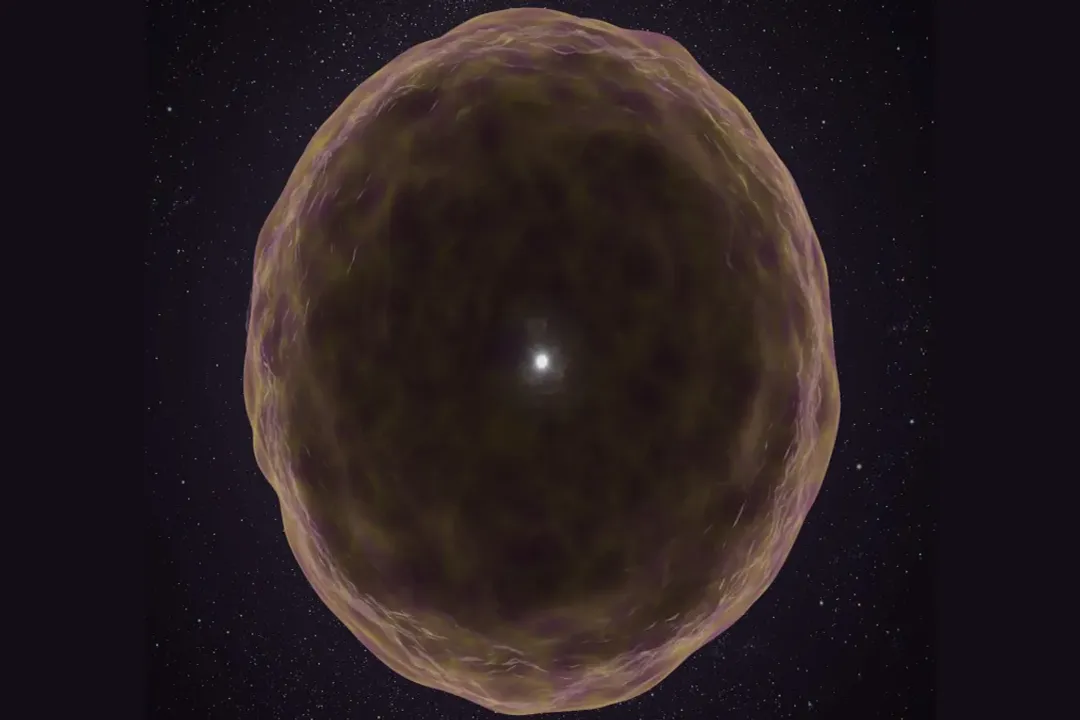
The Type II supernova path is reserved for the truly massive stars, generally those greater than eight solar masses. Throughout its life, such a star burns lighter elements into heavier ones in its core, creating an 'onion-like' structure of fusion shells. This process culminates when the core converts its final usable fuel into iron. Iron cannot be fused to release energy; instead, fusion demands energy, causing the core's outward thermal pressure to vanish.
With no opposing force, gravity instantly wins. The core collapses inward at phenomenal speeds, reaching up to . This implosion compresses matter to densities comparable to an atomic nucleus, a state where electrons are squeezed into the nuclei, turning protons into neutrons. If the resulting neutron core weighs less than about two solar masses, the immense repulsion between the packed neutrons—known as neutron degeneracy pressure—is strong enough to halt the collapse almost instantaneously. This sudden halt causes the outer layers, which are still falling inward, to violently rebound off this newly formed, ultra-dense sphere, generating a massive shockwave.
This rebound powers the visible explosion. Crucially, during the few seconds of core collapse, an enormous amount of energy—about joules, or $10%$ of the star's rest mass—is converted into a flood of neutrinos. While the initial shockwave stalls briefly, it is the enormous energy carried by these nearly massless particles, heating the infalling material from within, that reverses the collapse and drives the outer layers explosively outward. The visible supernova outburst can shine as brightly as a billion normal stars for months, though the core collapse itself takes only seconds.
# Thermonuclear Detonation
The other major mechanism for a stellar explosion involves smaller, dead stars: white dwarfs. These stellar remnants are supported against gravity solely by electron degeneracy pressure—the quantum mechanical resistance of electrons being squeezed too closely together. A white dwarf can gain mass, often by siphoning material from a close binary companion star. When this mass accumulation pushes the white dwarf's core past the Chandrasekhar limit—approximately $1.44$ times the mass of the Sun—the gravitational pressure overwhelms the electron degeneracy pressure.
Unlike a massive star whose core burns iron until collapse, the white dwarf begins runaway carbon fusion, an event that cannot be regulated by expansion or cooling because it lacks a thermal structure to puff up. This leads to a thermonuclear runaway, which utterly destroys the star in a Type Ia supernova. In a variation of this mechanism, two white dwarfs orbiting each other can spiral inward and merge, resulting in a single object instantly exceeding the critical mass limit.
# The Power Source Contrast
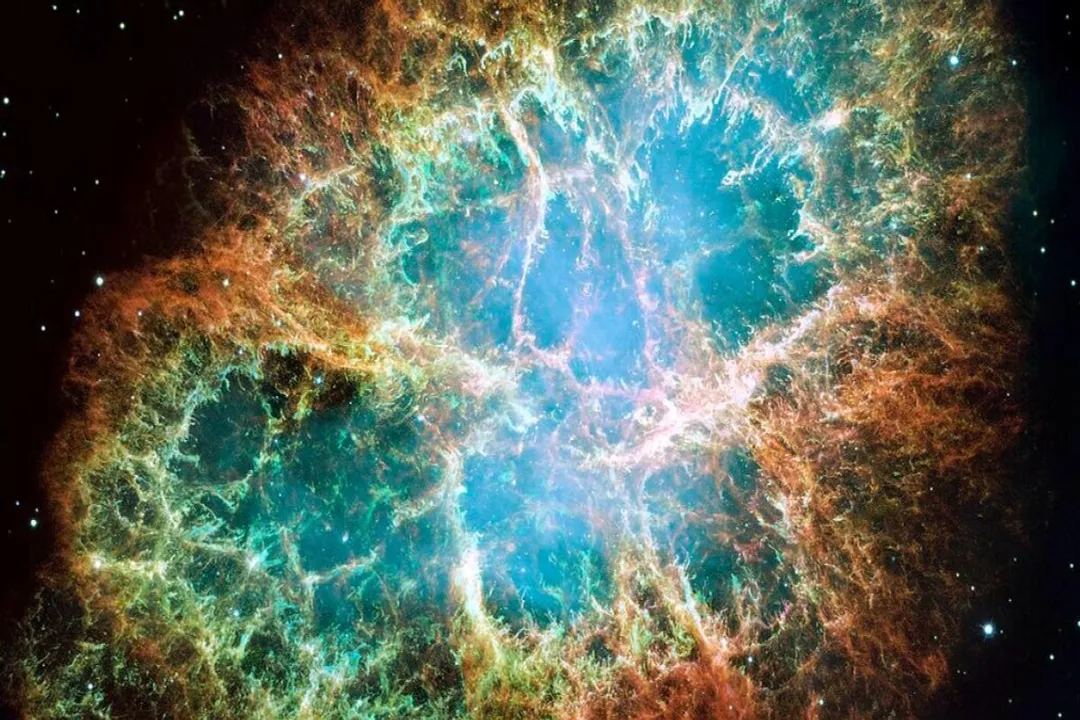
The fundamental difference in energy generation between these two main stellar deaths is striking. In a Type Ia explosion, the energy seen is predominantly kinetic energy imparted to the ejecta and the creation of radioactive isotopes, primarily Nickel-56 (), which powers the visual light curve as it decays to Cobalt-56 () and then to Iron-56 (). The total electromagnetic energy radiated is around Joules (or 1 foe).
In contrast, the core-collapse event is dominated by neutrino emission. The energy released as a burst of neutrinos in the first few seconds is about Joules, an energy release nearly two orders of magnitude greater than the visible light and kinetic energy combined. This disparity means that while Type Ia supernovae are visually consistent and serve as excellent "standard candles" for cosmology due to their uniform peak magnitude (around $-19.3$), the core-collapse event is far more energetic overall, with the visible light being a mere fraction of the total energy budget. If one considers the energy involved, the core-collapse explosion is an event primarily powered by particle physics rather than sustained thermonuclear burning.
# Remnants and Cosmic Enrichment
The aftermath of a supernova explosion is crucial for the universe’s chemistry. Supernovae are the primary mechanism for distributing elements heavier than oxygen, which are forged in stars and during the explosive event itself. Elements up to Sulfur-34 are made during fusion, elements between Argon-36 and Nickel-56 are formed during silicon burning, and elements heavier than iron are created via the rapid neutron capture process (r-process) during the collapse. These enriched clouds of gas and dust seed the interstellar medium, providing the raw material for future stars and planets.
The central remnant left behind depends on the progenitor's initial mass:
- White Dwarfs (Type Ia): Are completely destroyed.
- Lower-Mass Core Collapses: Form an ultra-dense neutron star, possibly observed as a pulsar, weighing between one-fifth and twice the Sun's mass and possessing a density of about a billion tons per cubic inch.
- Higher-Mass Core Collapses: If the remnant core exceeds about two solar masses, even neutron repulsion cannot hold against gravity, leading to unstoppable collapse into a black hole.
# Unveiling Exotic Deaths
While the core-collapse and Type Ia models cover most known events, recent discoveries have unveiled more bizarre death scenarios, suggesting our stellar evolution textbooks may need footnotes for "exotic pathways".
One of the most unusual recent findings is SN 2023zkd, which showed a standard initial bright flash followed by a significant second brightening months later. Archival data revealed the star had been slowly brightening for four years prior to the first blast. The combined evidence suggests the star, in a close orbit with a black hole, shed a thick disk of material, attempting to engulf its partner. The initial explosion hit this pre-existing disk, causing the delayed, luminous flare. This event offered some of the clearest signs yet of a massive star interacting with a companion in the years immediately preceding its explosion.
Even more revealing were the results from SN 2021yfj, which exhibited a spectrum dominated by heavier fusion products like silicon, sulfur, and argon, rather than the expected hydrogen, helium, or carbon seen in other stripped-envelope supernovae. This suggested the star had been "stripped to the bone," losing all its outer envelopes long before detonation, exposing the silicon/sulfur-rich layers forged deep in its interior. This provided direct, unprecedented evidence of the layered internal structure of massive stars, possibly resulting from extreme mass-loss episodes or pair-instability.
Furthermore, in 2020, astronomers witnessed the final 130 days of a red supergiant that exploded as SN 2020tlf. Unlike previous observations where pre-supernova stars were quiescent, SN 2020tlf showed a luminous emission and violent eruption just before collapsing, suggesting significant, tumultuous changes in its internal structure in its final months.
# Observing the End
The inherent rarity of observing a supernova in a relatively nearby galaxy like the Milky Way—estimated at about three per century—makes capturing these events challenging. Dust along the galactic plane further dims or obscures events occurring in the center. To counter this observational bottleneck, modern astronomy relies heavily on rapid, wide-field surveys like the Zwicky Transient Facility (ZTF), often employing Artificial Intelligence to spot fleeting transients like supernovae the moment they flare. The deployment of neutrino detectors, such as the SNEWS project, is designed to provide an early warning system, as neutrinos escape the star moments before the visible light, giving telescopes a critical window to aim and gather spectra of the true detonation moment. These coordinated efforts are essential because they allow scientists to finally begin connecting the dots between a star's long life and its spectacular, often complex, end.
Related Questions
#Citations
Supernova - Wikipedia
[PDF] Death of a star - University of Western Australia
First-of-its-kind supernova reveals inner workings of a dying star
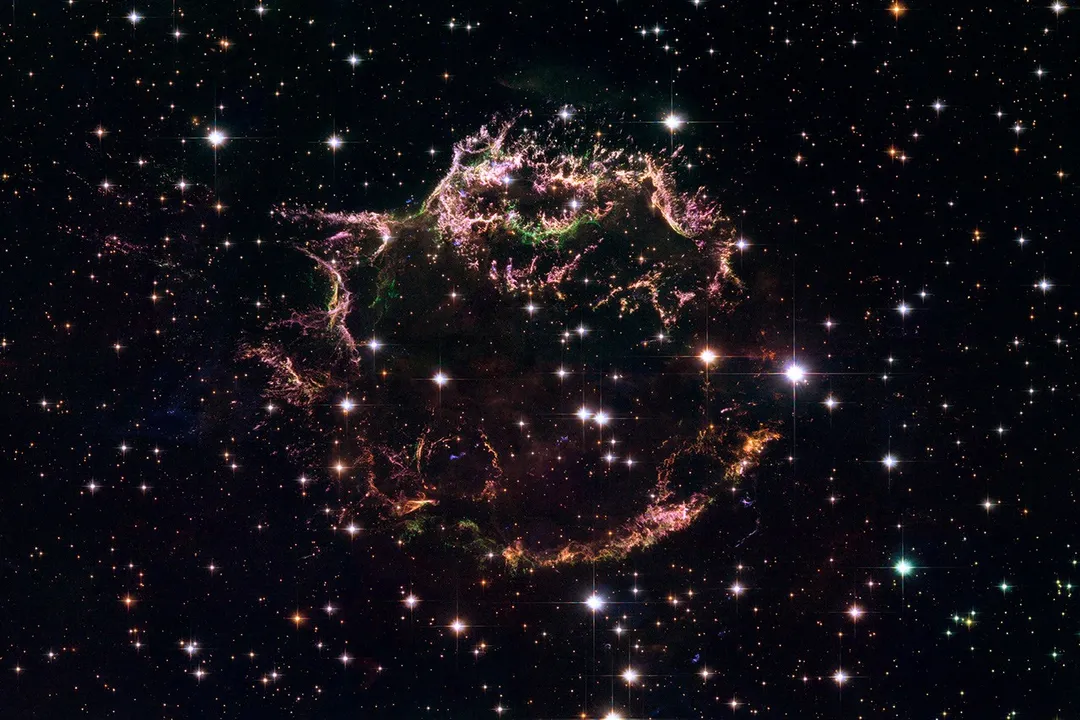
Cassiopeia A - The Colorful Aftermath of a Violent Stellar Death
Violent supernova spilled a star's 'guts' before exploding
There's Something Really Suspicious About the Way This Star Died
Supernovae | Museum of Science
Astronomers Witness a Dying Star Reach Its Explosive End
[PDF] The Death of a Star