Which element spells death for a star?
The creation of a specific element marks an undeniable turning point in a star's life, signaling the inevitable approach of its demise. For stars like our Sun, and much more massive ones, this elemental harbinger is iron (). A star spends the vast majority of its existence in a delicate, protracted battle between the crushing force of its own gravity and the outward thermal pressure generated by nuclear fusion occurring in its core [cite]. As long as fusion is successfully generating energy, the star remains stable, a state often referred to as hydrostatic equilibrium [cite].
# Energy Source
For main-sequence stars, the primary energy source involves fusing hydrogen nuclei into helium nuclei in the core [cite]. This process, which powers everything from the smallest red dwarfs to the largest blue giants, releases energy because the resulting helium nucleus has slightly less mass than the original hydrogen nuclei combined; the missing mass is converted directly into energy according to Einstein's famous equation, [cite]. As a star ages, it exhausts the hydrogen fuel in its center, causing the core to contract and heat up until the temperature is sufficient to begin fusing helium into heavier elements, primarily carbon and oxygen [cite].
This process of building up heavier elements continues in successive layers or shells for sufficiently massive stars—those starting with perhaps eight times the Sun's mass or more [cite]. Following helium fusion, the core can ignite carbon fusion, then neon, oxygen, and silicon fusion [cite]. Each successive burning phase creates a heavier element in the core, surrounded by shells where the preceding, lighter elements are still burning [cite]. This structure, resembling a celestial onion, is a hallmark of a dying massive star [cite].
# Fusion Limit Reached
The critical threshold is reached when silicon fusion produces an iron core [cite]. While fusion up to iron releases energy, iron sits at a unique, somewhat unfortunate, position in the cosmic periodic table [cite]. Iron-56, specifically, has the most tightly bound nucleus of all elements [cite].
Here lies the element that spells death: Iron. Fusing lighter elements releases energy; fusing elements heavier than iron requires an input of energy to proceed [cite][cite]. When the core becomes predominantly iron, the star has reached the end of its thermonuclear road [cite]. The furnace that has kept gravity at bay suddenly shuts down, not because the fuel runs out, but because the fuel itself demands energy rather than supplying it [cite].
Consider the sheer energetic difference involved in this transition. For example, fusing four hydrogen nuclei into one helium nucleus releases a significant amount of energy, perhaps around [cite]. However, to fuse two lighter nuclei into one heavier one past iron, the process must overcome the binding energy of the resulting nucleus, effectively drawing energy from the system, which translates to cooling the core rather than heating it [cite]. This means that once the iron core forms, the primary mechanism supporting the star against collapse vanishes instantaneously from an energy-generation standpoint [cite]. The star can no longer generate the thermal pressure needed to counteract the immense gravitational force pressing inward [cite].
# Core Collapse Initiation
The formation of the iron core itself is a relatively rapid event, especially in comparison to the star's main-sequence life [cite]. While a star might spend billions of years fusing hydrogen, the final silicon-burning phase that produces iron might only last a matter of days in a massive star [cite]. Once the iron core mass exceeds the Chandrasekhar Limit (about $1.4$ solar masses for a white dwarf, though the critical limit for a collapsing massive star core is slightly more complex and often related to the Tolman-Oppenheimer-Volkoff limit for neutron stars, the fundamental instability is triggered when the iron mass becomes too great for electron degeneracy pressure to support it) [cite], instability is guaranteed [cite].
The moment energy production halts, gravity takes over completely. The core begins to collapse catastrophically fast [cite]. In less than a second, the iron core, which might be roughly the size of the Earth, shrinks down to a sphere only a few tens of kilometers across [cite].
This rapid implosion squeezes the matter to incredible densities, far exceeding that of atomic nuclei [cite]. During this final descent, protons and electrons are forced together under the extreme pressure, a process called inverse beta decay, creating neutrons and releasing a massive burst of neutrinos [cite]. This process effectively removes the last sources of outward pressure—the electrons that were providing some initial resistance—accelerating the collapse even further [cite].
# The Violent Aftermath
The collapse halts only when the central density reaches nuclear saturation density—a point where the repulsive strong nuclear force between the closely packed neutrons kicks in [cite]. This sudden stopping of the core generates a powerful outward-moving shock wave [cite]. This shock wave, aided significantly by the sudden flood of neutrinos streaming out from the core, blasts the outer layers of the star into space in a spectacular explosion known as a Type II supernova [cite].
It is within this violent, energetic event that elements heavier than iron are forged [cite]. The extreme temperatures and neutron fluxes during the supernova explosion allow rapid neutron capture (the r-process) to occur, creating elements like gold, uranium, and others far down the periodic table [cite]. Thus, the very element that ends the star's stable life (iron) is the catalyst for creating the universe's heaviest building blocks.
This entire process highlights a remarkable cosmic accounting system. A star can live for eons on the energetic surplus of hydrogen burning, but when it finally produces the element that requires energy to fuse further, the time remaining for the star is counted in milliseconds for the final implosion, after a few days of silicon burning [cite]. The stellar timescale compresses violently at the end. This sharp contrast between stellar lifespan and the duration of the final collapse provides a profound perspective on stellar evolution; the bulk of a star's "work" is slow, deliberate energy management, while the "death" is an almost instantaneous failure of that management system [cite].
# Stellar Mass Determines Fate
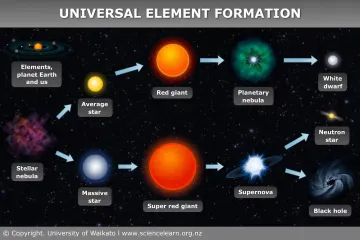
It is important to remember that this iron-triggered death spiral is primarily reserved for the most massive stars [cite]. Stars with lower initial masses, like our Sun, follow a different path [cite]. When a Sun-like star exhausts its central fuel, it becomes a red giant, then sheds its outer layers to form a planetary nebula, leaving behind a white dwarf composed mostly of carbon and oxygen [cite]. This white dwarf is supported indefinitely by electron degeneracy pressure, provided it never accretes enough mass to exceed the Chandrasekhar Limit and trigger a Type Ia supernova (a fundamentally different process) [cite].
For the stars destined for core-collapse supernovae, their initial mass dictates the final remnant. Stars perhaps in the range of $8$ to $25$ solar masses will likely blow off their outer layers and leave behind a neutron star [cite]. If the initial star was extremely massive, say over $25$ times the Sun's mass, the core collapse may be so powerful that even the immense pressure of neutron degeneracy cannot halt the implosion, resulting in the formation of a black hole [cite]. In all these massive stellar death scenarios—neutron star or black hole—the formation of the iron core is the initiating catastrophe [cite].
# Synthesis and Comparison of Endings
To summarize the final moments of a high-mass star, we can contrast the energy balance:
| Element Fused | Energy Balance | Resulting Core |
|---|---|---|
| Hydrogen () to Helium () | Releases Energy | Helium |
| Helium () to Carbon () | Releases Energy | Carbon/Oxygen |
| Silicon () to Iron () | Releases Energy (Decreasingly) | Iron () |
| Iron () and heavier | Consumes Energy | Catastrophic Collapse |
The shift from energy release to energy absorption at the iron boundary represents an insurmountable thermodynamic hurdle for the star [cite]. While the process of building up to iron takes millions of years in the silicon-burning shell, the subsequent inability to fuse iron means the pressure support drops to zero almost immediately, leading to a swift end [cite]. This illustrates that stellar death isn't a slow fizzle for these giants, but rather a rapid phase transition triggered by a single chemical barrier [cite]. The iron core is not merely a byproduct; it is the load that gravity pulls, and once that load exceeds the internal resistance, the structure fails completely.
#Videos
How Stars Die - YouTube
Related Questions
#Citations
The Death of a Star - How Stars Work - Science | HowStuffWorks
The creation of what element signals the death of a star? How much ...
ELI5: Why is the production of iron atoms a sign that a star is dying?
How Stars Die - YouTube
[PDF] Death of Stars
When a star dies what does occur its elements ? - Facebook
Fusion of elements inside heavy stars - Astronomy Stack Exchange
How stars are born and die - Astronomy Magazine